
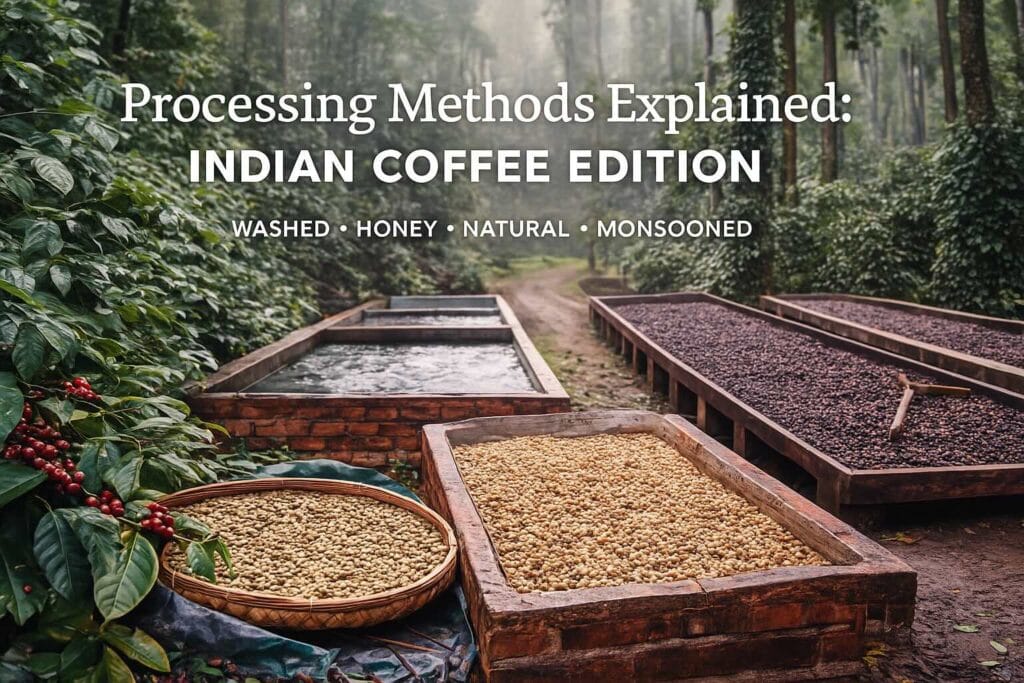
Why Processing Matters in India
Coffee processing plays a pivotal role in defining the sensory profile of Indian coffee. While terroir sets the stage, it is processing that determines how sugars develop, how acids express themselves, how aromatics evolve, and how clean or complex the final cup becomes.
India’s processing landscape is unique: a blend of traditional methods shaped by monsoon climate, high humidity, shade-grown ecology, estate-level innovation, and the slow, careful post-harvest practices practiced across Coorg, Chikmagalur, Wayanad, Nilgiris, and Araku Valley.
A country rich with biodiversity and agroforestry, India has also embraced specialty-grade experimentation. Today, estates routinely produce washed coffees, naturals, honeys, extended fermentations, yeast inoculations, anaerobic lots — and even the world-famous Monsooned Malabar, a process found nowhere else on Earth.
This guide offers the most comprehensive breakdown of every major processing method in India: traditional, modern, industrial, and specialty.
The Foundations of Indian Coffee Processing
Before diving into individual methods, it’s important to understand the context that shapes how Indian coffee is processed.
Climatic Factors Unique to India
The Western Ghats — India’s primary coffee belt — have a tropical monsoon climate:
- Heavy rains from May to September
- Dry, sunny harvest from November to February
- High humidity, especially in Kerala
- Thick forest canopy
- Cool nights, warm days
These conditions influence:
- Drying rates
- Fermentation timelines
- Moisture stability
- Flavor development
As a result, Indian processing is designed to protect coffee from mold, ensure consistent drying, and preserve clarity of flavor.
Shade-Grown and Mixed Cropping Impact
Indian coffee grows under native shade trees like:
- Jackfruit
- Silver oak
- Ficus species
- Red cedar
- Wild forest trees
Pepper vines often climb the canopy, influencing microclimates and humidity.
Shade-grown cherries:
- Ripen slower
- Develop deeper sweetness
- Have higher density
- Require careful drying
Thus, processing in India tends to be slower, more controlled, and highly labor-intensive.
Water Access and Infrastructure
Estates in Karnataka and Kerala usually have:
- On-site pulping stations
- Fermentation tanks
- Raised beds
- Tile or cement drying yards
- Mechanical dryers (in monsoon-prone zones)
This enables consistency across large volumes.
In tribal regions like Araku, processing is often cooperative-led, with strong focus on organic, natural, and honey methods.
Washed Processing: India’s Traditional Strength
India’s washed coffees — especially from Coorg and Chikmagalur — have historically been sought after by global roasters for their balance, clarity, and clean profiles.
What “Washed Process” Means in India
Washed processing involves:
- Pulping fresh cherries
- Fermentation to break down mucilage
- Washing the beans in clean water
- Drying until moisture reaches 10–12%
In India, this process is known locally as “Plantation Arabica” (Plantation A, AA, AAA grades).
Fermentation Styles in Indian Estates
Depending on estate size and tradition, fermentation may be:
- Dry fermentation (most common)
- Wet fermentation
- Overnight soaking for clarity
- Double-stage fermentation for high-grade lots
Microbial activity is influenced by altitude and climate; Chikmagalur’s cooler nights produce particularly clean-washed profiles.
Flavor Profile of Indian Washed Coffees
- Balanced acidity
- Medium body
- Caramel sweetness
- Citrus & mild fruit notes
- Clean, classic cup
Perfect for roasters seeking approachable, versatile coffees.
Natural Processing: The Rising Specialty Trend
Indian naturals (dry-processed coffees) are gaining immense popularity, especially from:
- Bababudangiri
- Chikmagalur
- Araku Valley
- Nilgiris
India’s Climatic Challenges for Naturals
High humidity makes natural drying tricky in some regions. Successful naturals require:
- Optimal picking
- Stable sunlight
- Long, slow drying (20–28 days)
- Regular turning
- Raised beds for airflow
Because shade-grown cherries mature slowly, they tend to develop dense, sugar-rich profiles perfect for natural processing.
Flavor Profile of Indian Naturals
- Fruity (berry, stone fruit, tropical)
- Winey or jammy sweetness
- Heavy body
- Strong aromatics
- Complex acidity
Great for modern specialty roasters and single-origin menus.
Honey Processing: India’s Sweet Spot
Honey processing (semi-washed) has exploded in the specialty estate scene, especially since 2018.
What Honey Processing Looks Like in India
After pulping, the mucilage is partially retained on the beans. Drying happens on:
- Raised African beds
- Cement yards
- Parabolic dryers (in Kerala)
Types of honey processes commonly produced:
- Yellow honey
- Red honey
- Black honey (most challenging due to humidity)
Flavor Profile
- High sweetness
- Thick, syrupy body
- Lower acidity than naturals
- Notes of honey, toffee, dates, tropical fruit
Honey processes strike a beautiful middle ground between washed and natural.
Monsooned Malabar: India’s Signature Processing Method
No other country produces anything like Monsooned Malabar.
How the Process Works
After harvest, fully-dried beans are:
Exposed to monsoon winds
- Stored in open-sided warehouses
- Turned and raked regularly
- Allowed to absorb moisture from humid sea air
- Transformed over 12–16 weeks
The beans swell to nearly twice their size, turn pale gold, and lose most acidity.
Why It Exists
Historically, coffee transported by sea in wooden ships underwent heavy weather — changing flavor. Modern monsooning replicates that old shipping effect.
Flavor Profile
- Extremely low acidity
- Heavy, creamy body
- Earthy, woody, spice-driven notes
- Perfect for espresso blends
This processing style is a major contributor to India’s export identity.
Robusta Processing in India: A Category of Its Own
India is one of the world’s best producers of premium Robusta, particularly:
- Robusta Cherry AA
- Robusta Parchment AB
- Kaapi Royale
Dry (Cherry) Robusta Processing
Widely used in:
- Wayanad
- Coorg
- Kerala foothills
Cherries are sun-dried for 20–30 days. Result: bold, chocolaty flavors.
Washed Robusta (Kaapi Royale)
Kaapi Royale = hand-picked, washed, polished Robusta.
Flavor:
- Clean
- Strong
- Thick crema
- Dark chocolate, tobacco, wood
- Low bitterness for a Robusta
India’s washed Robustas are prized by specialty roasters worldwide.
Emerging and Experimental Processes in India
Specialty estates in Bababudangiri, Coorg, Araku, and Nilgiris are now experimenting with advanced fermentation.
Anaerobic Fermentation
Cherries or depulped seeds are fermented in sealed tanks without oxygen for 24–100+ hours.
Results:
- Intensified fruitiness
- Winey acidity
- Bold aromatics
- Very distinct profiles
Carbonic Maceration
Borrowed from winemaking:
- Whole cherries placed in CO₂-rich tank
- Intracellular fermentation
- High control of temperature and pressure
Produces flamboyant, high-scoring coffees.
Yeast-Inoculated Fermentations
Specific yeast strains (e.g., Saccharomyces) are added to control:
- Flavor development
- Fermentation speed
- Aromatic output
Extended Ferments (48–120 hours)
Used by estates crafting:
- Natural winey lots
- Funky tropical profiles
- Dessert-like cups
Thermal Shock Method (rare but growing)
Cherry skin is shocked with hot then cold water to influence fermentation kinetics.
Drying: The Most Crucial (and Difficult) Stage in India
Drying is a science in India due to humidity variations.
Drying Surfaces Used:
- Raised beds
- Cement yards
- Brick patios
- Polytunnels
- Mechanical dryers (for emergencies)
Drying Targets:
- 10–11% moisture
- Uniform bean color
- No “case hardening”
Storage & Post-Processing
After drying, beans undergo:
Hulling
Removing parchment for washed/honey lots.
Polishing
Optional for higher visual grade.
Grading
By:
- Screen size
- Weight
- Density
- Defects
Curing & Conditioning
Beans are rested to stabilize flavor.
Packaging
Most exports use:
- Jute bags
- Jute + GrainPro
- Carton bulk packs (rare)
How Processing Impacts Flavor for Indian Coffee
Here’s how the main methods compare:
Process | Acidity | Sweetness | Body | Notes |
|---|---|---|---|---|
Washed | Medium | Medium | Medium | Clean, caramel, citrus |
Natural | Medium–High | High | Full | Berry, wine, tropical |
Honey | Medium | High | Thick | Toffee, fruit, syrup |
Monsooned | Low | Low | Heavy | Woody, earthy, spice |
Washed Robusta | Low | Medium | Very heavy | Cocoa, tobacco |
Experimental | Varies | High | Medium | Funky, floral, fruit-forward |
Choosing the Right Process When Buying Indian Coffee
Based on roasting style and menu design:
For espresso blends
- Monsooned Malabar
- Washed Arabica
- Kaapi Royale (washed Robusta)
For pour-over menus
- Washed microlots
- Honey lots
- Experimental fermentations
For standout single-origin features
- Naturals
- Anaerobic lots
- Fruit-forward microlots
For chocolate-heavy flavor foundations
- Wayanad Robusta Cherry AA
- Washed Robusta
India’s Processing Landscape Is Evolving Fast
India has gone from traditional washed and natural coffees to a diverse, experimental, forward-thinking origin capable of producing some of the world’s most unique coffees.
Whether you’re buying for specialty pour-overs, espresso blends, or experimental microlots, Indian producers now offer:
- Consistency
- Innovation
- Traceability
- Heritage
- Bold flavor diversity
India’s coffee future is being shaped not only by terroir but by processing mastery — and the country is quickly emerging as a global leader in both.