
The Complete Buyer’s Guide
India has quietly risen to become one of the world’s most reliable, diverse, and high-potential origins for green coffee beans. With its shade-grown agroforestry systems, multi-generational farms, and rapidly expanding specialty scene, sourcing from India offers roasters the chance to access distinctive flavor profiles, sustainable farming models, and deep traceability—if they know where to look and how to navigate the ecosystem.
This guide breaks down everything a roaster, importer, or green-coffee buyer needs to understand before sourcing green coffee beans from India: regions, grading systems, logistics, seasonality, pricing, quality control, and how to build long-term relationships with Indian estates.
Why Source Green Coffee from India?
Unique Shade-Grown Agroforestry
India is one of the only major coffee origins where nearly all coffee is grown under dense forest canopy. Benefits include:
- Slow cherry maturation
- Complex sugars, deeper sweetness
- High bean density
- Natural pest control
- Greater biodiversity
Distinct Flavour Profiles
Indian green coffee offers:
- Mild, sweet, smooth Arabicas
- Chocolate-forward washed lots
- Spice-driven notes (nutmeg, clove, pepper)
- Heavy-bodied, clean Robustas
- Fruity naturals from Bababudangiri and Araku
Consistent Supply & Reliable Harvest Cycles
Unlike some origins dealing with political instability or extreme climate volatility, India has:
- Stable export systems
- A predictable harvest season
- Improved post-harvest infrastructure
Specialty Coffee Momentum
India’s microlot movement is growing rapidly, with estates now producing:
- Honey processed lots
- Naturals
- Anaerobic fermentations
- Yeast-inoculated fermentations
- Extended fermentation Arabicas
Ethical & Sustainable Farming
Most farms in India are family-run estates (3–5 generations) that emphasize:
- Forest conservation
- Water resource management
- Worker welfare
- Mixed cropping for ecological balance
Understand the Coffee-Growing Regions of India
Sourcing effectively requires knowing what each region produces best.
Coorg (Kodagu), Karnataka
India’s largest coffee district.
Best for: Balanced Arabicas, washed lots, traditional flavor profiles.
Tasting notes: Caramel, citrus, nutty, sweet spice.
Chikmagalur & Bababudangiri
Birthplace of Indian coffee and the heart of specialty.
Best for:
- High-altitude Arabicas
- Microlots
- Boutique naturals & honeys
Notes: Floral, bright, fruity, elegant.
Wayanad, Kerala
Top region for premium Robustas.
Best for:
- Robusta Cherry AA
- Washed robustas
- Kaapi Royale
Notes: Cocoa, herbaceous, heavy-bodied, syrupy.
Nilgiris & Shevaroys (Tamil Nadu)
Elegant, mild Arabicas—clean and sweet.
Best for:
- High-grown washed Arabicas
- Bright citrus profiles
Araku Valley (Andhra Pradesh)
India’s organic tribal-cooperative coffee belt.
Best for:
- Organic naturals
- Fruit-forward microlots
- Complex honeys
Indian Coffee Varieties (What Buyers Should Know)
Arabica Varieties:
- S795 (balanced, classic Indian profile)
- SLN9 (fruitier, specialty favorite)
- Cauvery (brighter, Catimor line)
- Kent (floral, old-world varietal)
- Chandragiri (clean, modern profile)
Robusta Varieties:
- Peridenia
- CxR (Congensis × Robusta)
- Robusta Parchment AB
- Kaapi Royale (premium washed Robusta)
Harvest, Seasonality & Buying Cycles
Harvest Season (Arabica):
- November – February
Harvest Season (Robusta):
- January – April
Peak Buying Window (for Fresh Crop):
- January – May
Monsooned Malabar Production:
- June – September
(Beans exposed to monsoon winds)
Tip for Buyers:
To secure the best microlots, pre-book by November, before harvesting begins.
Understanding India’s Coffee Grading System
India has a structured, highly transparent grading system.
Arabica Grading
- Plantation A : Large beans, clean quality, washed
- AA / AAA: Higher screen size, premium lots
- PB (Peaberry): Single round bean, concentrated flavor
- Arabica Cherry: Dry-processed Arabica
Robusta Grading
- Robusta Cherry AA : Top-quality dry-processed Robusta
- Robusta Parchment AB: Washed Robusta
- Kaapi Royale: India’s premium washed Robusta
Monsooned Grades
- Monsooned Malabar Arabica AA
- Monsooned Malabar Robusta AAA
These beans swell, turn golden, and develop low-acid, heavy-bodied cup profiles.
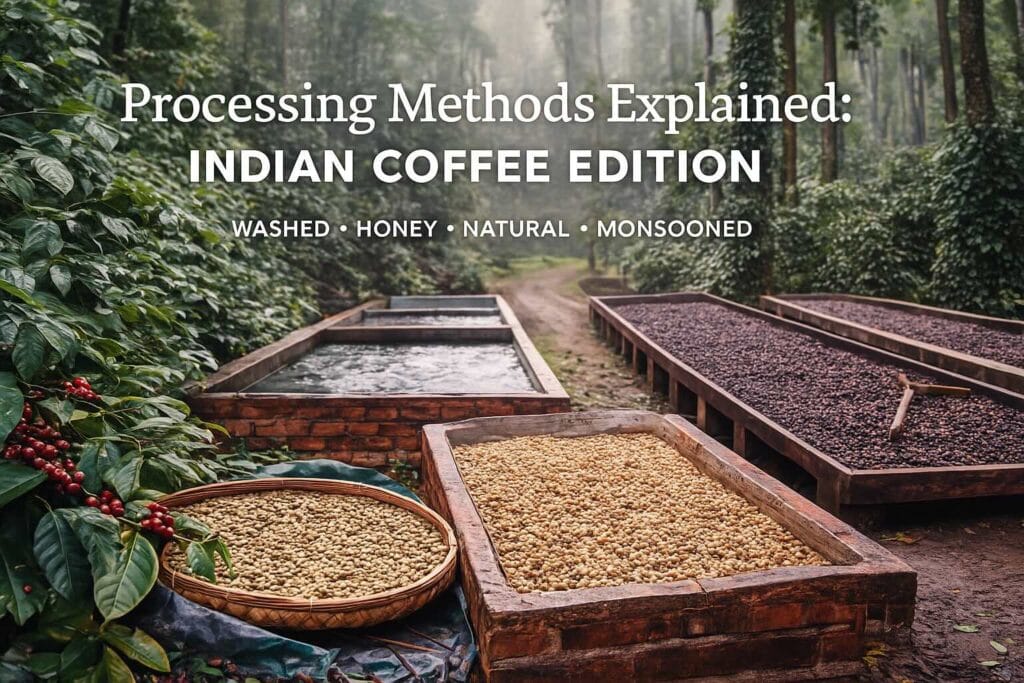
Processing Methods in India (What to Expect When Buying)
India offers a wide array of processes:
- Fully Washed: Clean, balanced, consistent.
- Naturals: Improving significantly in specialty estates.
- Honey Process: Growing rapidly; produces sweet, syrupy cups.
- Experimental Fermentations: Yeast inoculation, anaerobic, extended fermentation.
- Monsooned: Unique to India; excellent for espresso blends.
How to Assess Quality When Sourcing from India
A smart buyer evaluates:
Moisture Content: Ideal: 10–12%
Bean Density :Higher density = better flavor potential.
Screen Size: AA / AAA indicates uniformity.
Defect Count: Follow SCA or Coffee Board standards.
Cupping Score
Look for:
- 80+ for good specialty
- 84+ for microlots
- 87–90 for experimental lots
Price Expectations When Buying Indian Green Coffee
Prices vary by region, grade, and process.
Arabica Price Ranges (FOB India):
- Commodity Arabica: $3.00–$4.00/kg
- Specialty washed: $4.50–$7.00/kg
- Microlots / naturals / honeys: $8.00–$12.00/kg
- Experimental fermentations: $12–$20/kg
Robusta Price Ranges:
- Robusta Cherry AA: $2.50–$3.50/kg
- Washed Robusta (Kaapi Royale): $3.50–$5.50/kg
- Top specialty Robustas: $6–$8/kg
Monsooned Malabar:
- $4.50–$7.50/kg
Logistics: How to Import Indian Coffee
Shipping Ports
Major export ports:
- Mangalore
- Cochin
- Chennai
Shipment Type
- 20 ft containers (18–20 tons)
- 40 ft HQ (26–28 tons)
- LCL (for small buyers, 1–4 tons)
Documentation
Essential export documents:
- Phytosanitary certificate
- ICO Certificate
- FSSAI Export License
- Bill of Lading
- Packing List
- Invoice
Payment Terms
Common terms:
- EXW
- FOB
- CIF
- CAD
- LC for large shipments
Storage & Shelf Life
Indian green coffee stores well 6–12 months in:
- Cool
- Low humidity
- Ventilated environments
- Jute bags (with or without GrainPro liners)
Building Relationships with Indian Farms & Estates
India is a relationship-driven origin.
Long-term partnerships lead to better:
- Pre-booking rates
- Access to microlots
- Early sampling
- Custom processes
- Transparency
Estate Types You Can Work With:
- Multigenerational family farms
- Large organized estates
- Cooperatives (Araku, tribal groups)
- Exporter-curated multi-farm lots
- Direct farm-to-roaster platforms (e.g., India Coffee Company)
How to Choose the Right Supply Partner in India
Evaluate based on:
- Transparency : Clear origin + lot-level details.
- Traceability: Farm map, varietal info, process notes.
- Cupping lab capability: Consistency of QC.
- Logistics support: Customs, freight, documentation.
- Commitment to quality: Agronomy, drying, grading standards.
- Relationship approach: Responsiveness + long-term vision.
Sample Sourcing Workflow (Step-by-Step)
Step 1: Define your target cup profiles
Bright? Fruity? Chocolate-forward? Heavy-bodied?
Step 2: Shortlist regions & estates
- E.g.,Coorg → Balanced washed lots
- Chikmagalur → Microlots
- Wayanad → Premium Robustas
Step 3: Request green samples
150–300g each.
Step 4: Cup & evaluate
Follow SCA protocols.
Step 5: Request pricing & lot availability
Lock volumes.
Step 6: Final QC check
Moisture, density, screen size.
Step 7: Book shipment
Choose EXW/FOB/CIF.
Step 8: Track & receive
Inspect, store, roast.
The Future of Indian Coffee
India is entering a golden era of specialty coffee. Expect:
- More microlots
- Better processing infrastructure
- Global recognition
- Carbon-neutral coffee estates
- Estate-level branding
- Direct farm–roaster relationships
For roasters, this is the moment to build strong positions in Indian origins.
Why You Should Consider India in Your Origin Portfolio
Indian green coffee is:
- Reliable
- Diverse
- Sustainable
- Traceable
- Flavor-rich
- Affordably priced compared to African & Central American origins
For roasters looking to balance their menu with chocolate-forward bases, bright microlots, organic tribal naturals, and premium Robustas, India offers an unmatched spectrum.