
A Complete Guide to the Country’s Rich Coffee Heritage
India’s Quiet Coffee Powerhouse
When the global specialty coffee community discusses origin countries, names like Ethiopia, Colombia, or Guatemala are quick to surface. But tucked in the southern stretch of the Indian peninsula lies a lesser-discussed coffee story—one shaped by monsoon winds, forest ecosystems, ancient trade routes, and multi-generational farmer communities.
India’s coffee is not new. It is simply underestimated.
And as the specialty world continues to explore terroir-driven coffees, India’s plantations—particularly those in Kodagu (Coorg), Chikmagalur, Wayanad, Bababudangiri, Nilgiris, and Araku Valley—are finally receiving the recognition they deserve.
Today, India stands as the sixth-largest coffee producer in the world, cultivating both Arabica and Robusta under dense shade, amidst biodiversity-rich forests, using traditional agroforestry systems rarely seen elsewhere.
This article provides a comprehensive look at the origins of Indian coffee: its history, regions, growing conditions, varieties, unique processes, farmer communities, and what makes Indian coffee distinct on the global map.
The Origins of Coffee in India: From Baba Budan to Modern Plantations
The Legend of Baba Budan (1670 CE)
The story of Indian coffee begins with a daring Sufi saint named Baba Budan, who traveled to Yemen on a pilgrimage. At the time, exporting fertile coffee seeds from Yemen was forbidden. Legend has it that Baba Budan smuggled seven coffee seeds tucked into his beard or strapped to his chest, and planted them on the slopes of present-day Bababudangiri, Karnataka.
These first plants became the foundation of Indian coffee cultivation.
Colonial Expansion (1700s–1800s)
The British East India Company identified India’s Western Ghats as a prime coffee-growing belt. By the early 1800s, large estates began expanding across:
- Chikmagalur
- Kodagu (Coorg)
- Wayanad
- Nilgiris
- Palakkad
- Shevaroys
The British improved processing infrastructure, built curing works, established trade routes, and standardized grading systems.
The Coffee Leaf Rust Crisis (1860s–1900s)
Coffee leaf rust (CLR), caused by Hemileia vastatrix, devastated plantations across Asia. Indian Arabica plantations suffered significant losses. This event shifted many estates temporarily toward Robusta, which was naturally more resistant.
Post-Independence Modernization (1940s–2000s)
After 1947, Indian coffee became farmer-driven. The Coffee Board of India supported smallholder farmers through:
- Research on varieties (S.795, Cauvery, Chandragiri)
- Quality improvement programs
- Market access initiatives
- Promotion of shade-grown coffee
The Rise of Specialty Coffee (2010s–Present)
India’s specialty scene has boomed over the last decade. Microlots, experimental processes, and single-origin Arabicas began appearing from estates in:
- Kodagu (Coorg)
- Chikmagalur
- Nilgiris
- Araku
- Shevaroys
India is no longer only an exporter of commodity-grade beans—roasters worldwide now seek Indian lots for quality, sustainability, and unique cup profiles.
India’s Unique Coffee Ecosystem
India’s terroir is defined by:
Shade-Grown Agroforestry
Almost all Indian coffee is cultivated under a three-tier shade canopy, involving:
- Native trees (silver oak, jackfruit, teak)
- Pepper vines naturally climbing on shade trees
- Mixed crops (cardamom, arecanut, orange, banana)
This creates:
- Rich biodiversity
- Natural pest control
- Humus-rich soil
- Slow cherry maturation
- Distinct flavor development
India is one of the few countries still practicing traditional forest-grown coffee on a large scale.
Tropical Monsoon Climate
The Western Ghats receive:
- Heavy monsoon (May–September)
- Dry, sunny ripening season (October–January)
This climate supports both Arabica and Robusta, giving them:
- Dense bean structure
- Low acidity
- Smooth sweetness
- Distinct spice notes (nutmeg, clove, pepper)
High Biodiversity
Indian coffee estates are home to:
- Elephants
- Bison
- Malabar squirrels
- Hornbills
- Civet cats
- Wild orchids
- Endemic tree species
Unlike sun-grown monoculture plantations, India’s estates function as biodiversity corridors.
Soil Types
Key soil types include:
- Laterite soils (Coorg, Chikmagalur)
- Red loamy soils (Wayanad, Nilgiris)
- Volcanic and mineral-rich uplands (Araku Valley)
These influence nutrient uptake and flavor development.
Coffee-Growing Regions in India (The Complete Map)
India’s coffee landscape is dominated by the southern states, but each region has unique terroir.
Karnataka (70% of India’s Coffee)
Major districts:
Kodagu (Coorg)
India’s largest coffee district.
- Elevation: 900–1,500 m
- Varieties: S.795, SLN9, Cauvery, Chandragiri
- Profile: Caramel sweetness, mild acidity, citrus, nutty tones
- Known for: Mixed cropping, pepper vines, dense native forests
Signature Cup Profile: Balanced cup, smooth body, mild fruitiness, clean finish.
Chikmagalur
The birthplace of Indian coffee.
- Elevation: 1,000–1,900 m
- Varieties: S.795, Kent, SLN9
- Profile: Chocolate, spice, orange peel, balanced sweetness
Bababudangiri microlots are among the most prized Arabicas in India.
Bababudangiri (The Historic Hills)
- High elevations
- Old Arabica cultivars
- Slow-growing heirloom plants
- Often processed experimentally (honey, natural, anaerobic)
Cup Profile: Fruity, floral, complex.
Kerala (Wayanad)
A major Robusta powerhouse.
- Elevation: 700–1,200 m
- Varieties: Robusta CxR, Peridenia
- Profile: Cocoa, dark chocolate, herbal, heavy body
Wayanad produces some of India’s best shade-grown Robustas.
Tamil Nadu
Nilgiris
Known for:
- Fragrant Arabicas
- Citrus and floral notes
- High-grown washed coffees
Yercaud (Shevaroy Hills)
Produces high-quality washed Arabicas with clean acidity.
Andhra Pradesh — Araku Valley
Home to tribal organic coffee.
- Elevation: 900–1,400 m
- Organic practices
- Fruity naturals and honeys
- Known for chocolate-fruit balanced cups
North-East India (Emerging Region)
Nagaland, Manipur, and Meghalaya have begun specialty coffee cultivation with promising results:
- High altitudes
- Wild, rustic coffees
- Fruity and floral profiles
Coffee Varieties Grown in India
India cultivates a mix of Arabica and Robusta varieties.
Arabica Varieties
- S.795 : Most widely planted Arabica in India. Cup: Balanced, sweet, smooth.
- SLN9 (Selection 9): Hybrid of Ethiopian Tafarikela + CxR. Cup: Fruity, complex, specialty-grade.
- Cauvery (Catimor line): Resilient variety. Cup: Bright acidity, crisp finish.
- Kent: Historic variety from early 1900s. Cup: Floral, sweet, elegant.
- Chandragiri: Cup: Balanced, juicy, modern specialty profile.
Robusta Varieties
- Peridenia : Classic Sri Lankan selection.
- CxR (Congensis × Robusta): High-yielding, strong cup.
- Robusta Peaberry: Single round bean from natural mutation. Cup: Intense, strong-bodied.
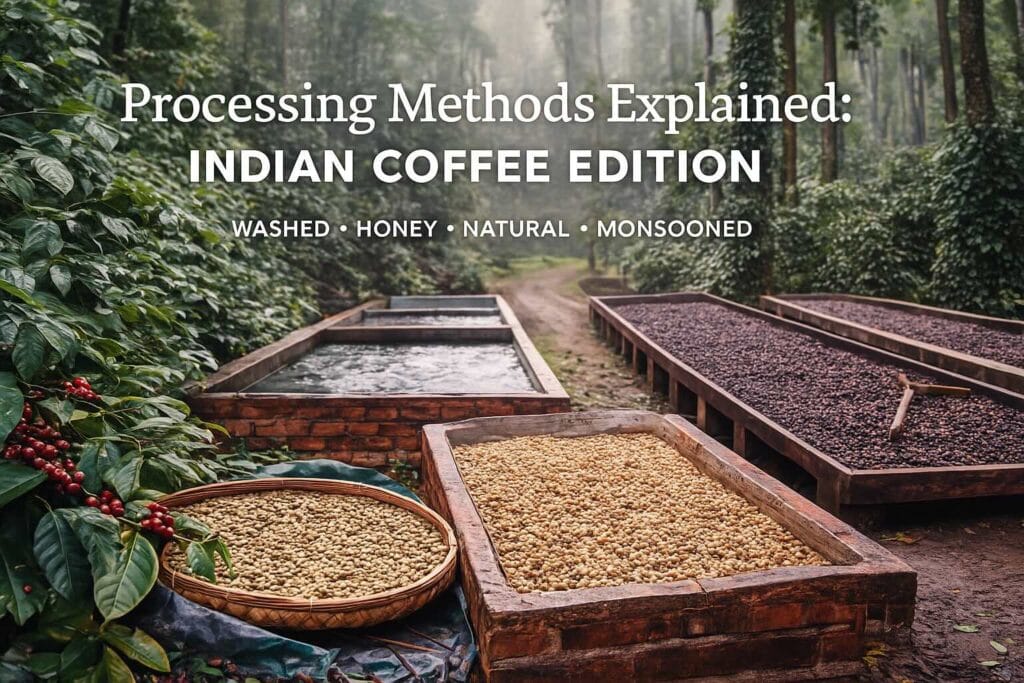
Indian Coffee Processing Methods
India employs a wide range of processes, driven by estate infrastructure and specialty experimentation.
Washed Process (Fully Washed)
India produces clean, balanced washed Arabicas.
- Crisp acidity
- Clean sweetness
- Classic specialty profile
Naturals
Traditionally less common but now growing.
- Fruity
- Winey
- High aromatics
Honey Process
Increasingly common in:
- Coorg
- Chikmagalur
- Bababudangiri
Gives:
- Sticky sweetness
- Complex body
- Tropical fruit notes
Monsooned Malabar (Unique to India)
Aged with monsoon winds.
Takes 3–4 months.
- Swollen yellow beans
- Low acidity
- Earthy, woody, spicy
- Heavy body
Perfect for espresso blends.
What Makes Indian Coffee Unique?
Shade-Grown by Default
Unlike Brazil or Vietnam’s sun-grown farms, India’s coffee grows under dense canopy — enhancing:
- Bean density
- Slow maturation
- Better resilience
- Richer biodiversity
Mixed Cropping
Coffee grows alongside:
- Pepper
- Cardamom
- Arecanut
- Orange
- Banana
This influences soil chemistry and flavor.
Biodiversity Corridors
Coffee estates serve as wildlife corridors rather than monocultures.
Monsoon Transformation
No other origin produces a bean like Monsooned Malabar.
Strong Community-Based Farming
Most farms are family-run estates, some with 3–5 generations of knowledge.
Indian Coffee Grading & Classification
India uses a highly structured grading system:
Arabica Grades
- Plantation A, AA, AAA
- Plantation PB
- Arabica Cherry AA
Robusta Grades
- Robusta Cherry AA
- Robusta Parchment AB
- Kaapi Royale (premium washed Robusta)
Specialty Microlots
Cupped >83–90+
Increasingly produced in:
- Bababudangiri
- Chikmagalur
- Kodagu (Coorg)
- Nilgiris
Challenges Faced by Indian Coffee Farmers
Climate variability
Erratic monsoons, droughts, and excess rain impact flowering and fructification.
Pest pressures
White stem borer remains a threat to Arabica.
Labour shortage
Hand-picked coffee requires large seasonal labour forces.
Global price volatility
Farmgate prices often do not reflect actual costs.
Infrastructure gaps
Smallholders may lack access to advanced pulping, drying, and processing equipment.
Opportunities Ahead
Rise of Specialty Coffee
Roasters globally are now exploring Indian origins.
Sustainability & Carbon Markets
Agroforestry estates can earn carbon credits.
Traceability Platforms
Digital farm-to-roaster models (like India Coffee Company) are building bridges.
Processing Innovations
Anaerobic, yeast fermentation, extended naturals are gaining traction.
Tourism
Coffee estate tourism in Coorg, Chikmagalur, Araku is booming.
India’s Coffee Story Is Still Being Written
From Baba Budan’s seven seeds to modern microlots cupping above 88 points, India’s coffee journey has always been about resilience, adaptation, and quiet excellence.
Today, Indian growers—whether tribal communities in Araku or fourth-generation estates in Coorg—are producing some of the world’s most distinctive coffees:
- Shade-grown
- Biodiverse
- Traceable
- Sustainable
- Rich in heritage
As specialty roasters continue to seek unique origins, India stands ready—not as an alternative origin, but as a primary one.
India’s coffee future is bright, forest-grown, community-led, and deeply connected to its soil and story.