
What India Coffee Company is
India Coffee Company exists to make India-origin coffees easier to evaluate and buy with confidence, giving roasters the clarity, repeatability, and clean lot structure that matters most.
How We Work
Sourcing built on trusted, long-term relationships.
- A small set of producer relationships
- Every lot clearly documented and traced
- Samples ready for confident buying decisions
What We Select
Every coffee measured by acidity, body, structure.
- Consistent quality across every roast and season
- Clean processing with honest flavour claims
- Every note clearly labelled by its source
Who We Partner With
Relationships built for continuity and shared growth.
- Representative lots kept separate from all micro-lots
- Traceability matched to what each lot supports
- Pricing aligned with how coffee is actually used
Understanding India's Coffee Geography
- The Western Ghats is one of only 36 biodiversity hotspots on Earth and a UNESCO World Heritage Site. Our coffee grows under native forest canopy rather than cleared plantations, helping this landscape store carbon and let wildlife move freely.
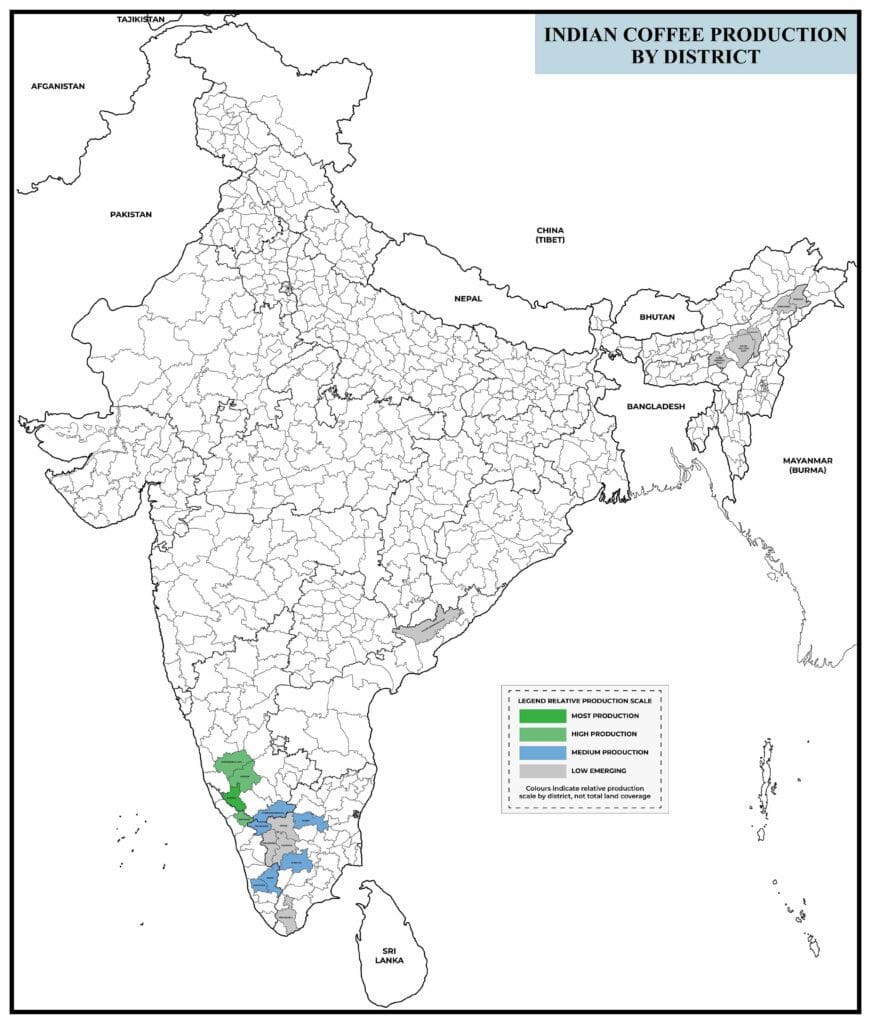
Kodagu (Coorg), Karnataka
India's largest coffee-growing district by volume
Chikkamagaluru, Karnataka
Where Indian coffee cultivation first began
Hassan, Karnataka
Bordering the Bisle Reserve biodiversity hotspot
Wayanad, Kerala
Chemical-free Robusta grown by Adivasi farmers
Chamarajanagar, Karnataka
Grown inside the Biligiriranga Hills, BRT Tiger Reserve
Nilgiris, Tamil Nadu
High-altitude Arabica grown by Indigenous farmers
Dindigul, Tamil Nadu
Coffee grown on Dindigul's forested Palani hills
Salem, Tamil Nadu
Coffee grown across Salem's Yercaud hills
Idukki, Kerala
Cardamom, pepper, and coffee grow together here
Kottayam, Kerala
Coffee grown in Kottayam's Vagamon highlands
Alluri Sitharama Raju, Andhra Pradesh
Araku Valley coffee, tribal-grown
Coimbatore, Tamil Nadu
Tiruppur, Tamil Nadu
Tirunelveli, Tamil Nadu
Erode, Tamil Nadu
Dibrugarh, Assam
Tinsukia, Assam
Golaghat, Assam
Karbi Anglong, Assam
India Coffee Company's Origin
I grew up on a coffee farm in Kodagu (Coorg). My grandfather planted the first coffee at Pambukal Estate in the 1950s. I planted my first coffee sapling when I was sixteen. Today, those trees are over thirty years old and bearing cherries.
Coffee found me early. It is the landscape I grew up in, the work my family has done across three generations, and the thing I know most completely.
In 2015, I took a sabbatical to pursue an idea that had been forming for years: bringing Indian coffee into the specialty market on its own terms. Around the world, conversations around sustainability, traceability, and transparent sourcing were reshaping how coffee was bought and sold. Indian coffee already possessed many of the qualities that specialty buyers valued, diverse growing regions, shade-grown agroforestry systems, strong farming practices, and the potential for exceptional cup quality. What it lacked was a credible route into specialty markets that could represent those coffees honestly.
The challenge was never the coffee itself. It was the system around it.
The generation before mine had built successful businesses supplying the conventional coffee export trade. India had earned a respected place in commodity markets, particularly in Europe, and that model had worked well for decades. Asking growers and processors to think in terms of smaller traceable lots, direct relationships, and long-term partnerships with specialty roasters required a different way of doing business. Change came slowly, as it often does in agriculture.
The turning point came in 2016.
My wife Priya, our one-year-old daughter Ivana, and I were travelling through the United States on holiday. We were there on a family trip, but everywhere we stopped I found myself studying café menus and roastery shelves. Ethiopian. Kenyan. Colombian. Guatemalan. Brazilian. Origin after origin was represented. Indian coffee was almost entirely absent.
For someone raised in one of the world’s great coffee-growing regions, that absence was impossible to ignore.
At that moment, the resistance I had experienced at origin made sense in a different way. Rather than trying to change the supply side first, I realised the clearer path was to build demand. If specialty roasters understood what Indian coffee could offer, demand would eventually create the incentive for greater traceability, better lot separation, and stronger relationships between farms and buyers. Instead of working from the inside out, I decided to work from the outside in.
Over the following years, I continued developing relationships across India’s specialty coffee landscape while refining the model that would eventually become India Coffee Company. Canada emerged as the right place to build from. Toronto, in particular, combines one of the world’s most multicultural communities with a mature and curious specialty coffee culture, an ideal place to introduce coffees that many roasters and consumers had simply never been given the opportunity to evaluate on their own merits.
In December 2025, I founded India Coffee Company.
The company exists to make Indian specialty coffees easier to discover, evaluate, and buy with confidence. We work with coffees that are clearly defined, transparently processed, and consistently documented, because those are the qualities professional roasters need to make informed purchasing decisions.
Our sourcing is built on relationships that predate the company itself. Through family, and through the farming communities of Kodagu, Chikmagalur, BR Hills, and Wayanad where I grew up, studied, and worked, I have spent a lifetime among the people who produce these coffees. That proximity is the practical foundation that allows us to understand each lot, verify how it was produced, and represent it honestly.
The same commitment to truthful representation also shaped Frayed Lines, a film I produced and which was directed by Priya Belliappa. Filmed on and around VPG Estate in Balele, Kodagu, a working coffee estate owned by Priya’s family, it is an observational record of landscape, labour, and life on a South Indian coffee estate. It reflects the same philosophy that guides India Coffee Company: represent origin carefully, document it honestly, and let the work speak for itself.
Vaanu Timaya
[email protected]
Ready to source coffee from India Coffee Company?
Have questions first? Get in touch