Coorg Green Coffee: A Sourcing Guide for Specialty Roasters
Coorg is the most productive coffee district in India. Known formally as Kodagu, it sits in the Western Ghats of Karnataka and produces approximately 35% of India’s total annual coffee output – around 110,730 metric tonnes per year according to the Coffee Board of India. Karnataka as a whole accounts for 71% of national production, and Coorg is its engine.
For most of the history of Indian coffee in the global trade, Coorg meant commodity. High-volume Robusta moving through the conventional export pipeline, graded by screen size, priced relative to the C market, absorbed into espresso blends without an origin story. That framing still describes the majority of what Coorg produces by volume. But it no longer describes the complete picture.
The specialty tier of Coorg has developed rapidly in the past five years. Processing experimentation is more advanced here than in any other Indian region by proportion of specialty lots. Traceable Arabica micro-lots from smallholder farms, honey process and carbonic maceration lots, estate-level natural experiments – the specialty catalog coming out of Coorg is broader and more varied than most international roasters know. This guide is for roasters who want to understand what Coorg actually offers at the specialty level and how to navigate it.
The Geography
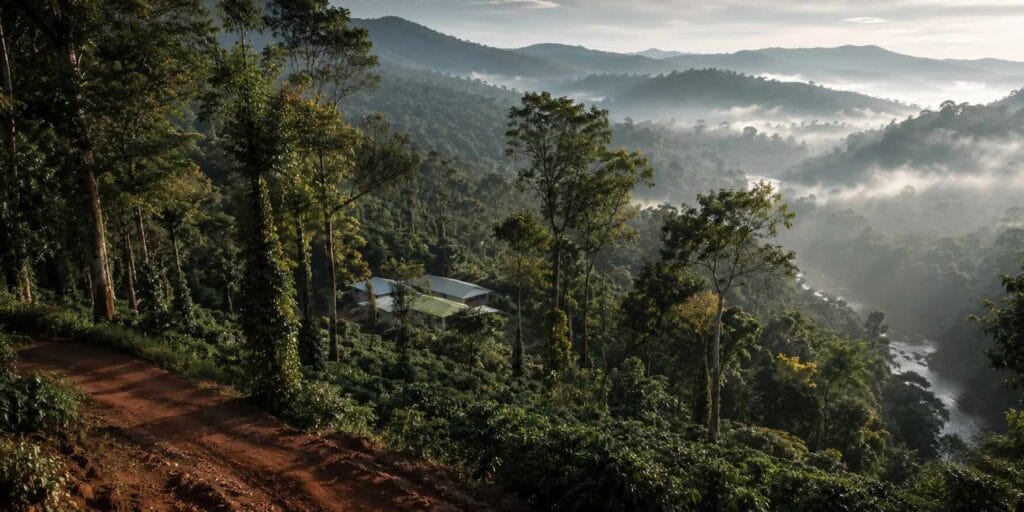
Coorg is a hilly plateau in southwestern Karnataka, bounded on the west and south by the Western Ghats. The district covers 4,106 square kilometres at latitude 11.55 to 12.50 North and longitude 75.25 to 76.14 East. The average elevation of the upper plateau is 1,066 metres, with coffee grown across a range of 800 to 1,500 metres above sea level.
The district is divided into five taluks, each with distinct growing conditions and a different production profile:
Madikeri – the administrative centre, in the higher northern zone. Predominantly Robusta, with some of the most established estate farming in the district. The oldest documented plantation in the Madikeri area opened in 1854.
Virajpet – southern Coorg, also predominantly Robusta. Home to Siddapur, which is developing a specialty identity through producers like Riverside Coffee.
Ponnampet – eastern Coorg, Robusta dominant. Lower elevation blocks in this taluk supply the bulk of commercial-grade Robusta that moves through the conventional trade.
Somwarpet – the Arabica heartland of Coorg. Higher elevation than the other taluks, producing the majority of Coorg’s specialty Arabica micro-lots. Estates in Somwarpet sit at the upper end of the district’s altitude range, where bean development slows and flavour complexity builds.
Kushalnagar – the commercial processing hub. While some coffee is grown here, the taluk is more significant as the location of dry mills and logistics infrastructure that services the broader district.
The geography of the River Cauvery is relevant to Coorg coffee sourcing. The Cauvery originates in Coorg and flows through the district, creating the riverine microclimate that characterises several of the most valued sub-regions. Estates along the Cauvery’s upper tributaries have access to both the river’s moisture influence and the altitude of the surrounding hills – a combination that produces some of the most distinctive lots in the district.
Production: The Volume and the Specialty Inversion
Coorg’s production numbers are substantial by any measure. The district has 106,921 hectares under coffee cultivation, farmed by 40,447 growers with holdings below 10 hectares. This is overwhelmingly a smallholder district – less than 500 growers have holdings above 10 hectares. The social structure of Coorg’s coffee industry is therefore fundamentally different from large-estate origins in East Africa or Central America.
By volume, Robusta dominates: approximately 69,000 metric tonnes of Robusta annually against 24,000 metric tonnes of Arabica. Robusta occupies 73,795 hectares of planted area versus 27,434 hectares of Arabica.
The specialty market inverts these numbers completely. Analysis of the Indian Coffee Beans specialty catalog – the most comprehensive publicly available dataset on Indian specialty lots – shows 38 Coorg coffees, almost all of which are Arabica micro-lots. The specialty trade has effectively selected for a different product than what the district produces by volume. The commercial crop is Robusta; the specialty crop is Arabica.
This inversion is important for roasters to understand because it shapes how Coorg lots are priced and how they are sourced. A roaster buying Coorg green coffee for espresso blend body is buying into the commodity Robusta market. A roaster buying Coorg for a single origin or micro-lot programme is entering a separate, Arabica-focused market with different pricing, different volumes, and different supply chain relationships.
GI Status and What It Means
Coorg Arabica coffee received Geographical Indication status from the Government of India in 2019. The GI designation applies specifically to Arabica grown and processed in the Kodagu district under conditions that reflect the region’s documented quality profile – altitude, shade canopy, laterite soil, and traditional farming practices.
GI status for Coorg Arabica is meaningful in two ways for international buyers. First, it provides legal protection against misrepresentation – coffee labelled as Coorg Arabica must actually come from the district and meet the qualifying conditions. Second, it places Coorg Arabica in the same category as other GI-protected Indian agricultural products: Darjeeling Tea, Basmati Rice, Wayanad Robusta, and Araku Valley Coffee. These are products whose geographic identity is legally recognised and whose premium positioning in international markets is supported by that recognition.
Coorg Arabica’s GI designation also provides a useful benchmark for buyers evaluating quality claims. A lot that carries GI documentation has met the qualifying standards. A lot sourced from the district without GI documentation is still Coorg coffee but has not been evaluated against the GI criteria.
The Processing Picture
Coorg’s specialty processing landscape is more experimentally diverse than any other Indian region by proportion of specialty output. This is a data point worth paying attention to, because it suggests that the producers working at the specialty level in Coorg are not defaulting to conventional methods.
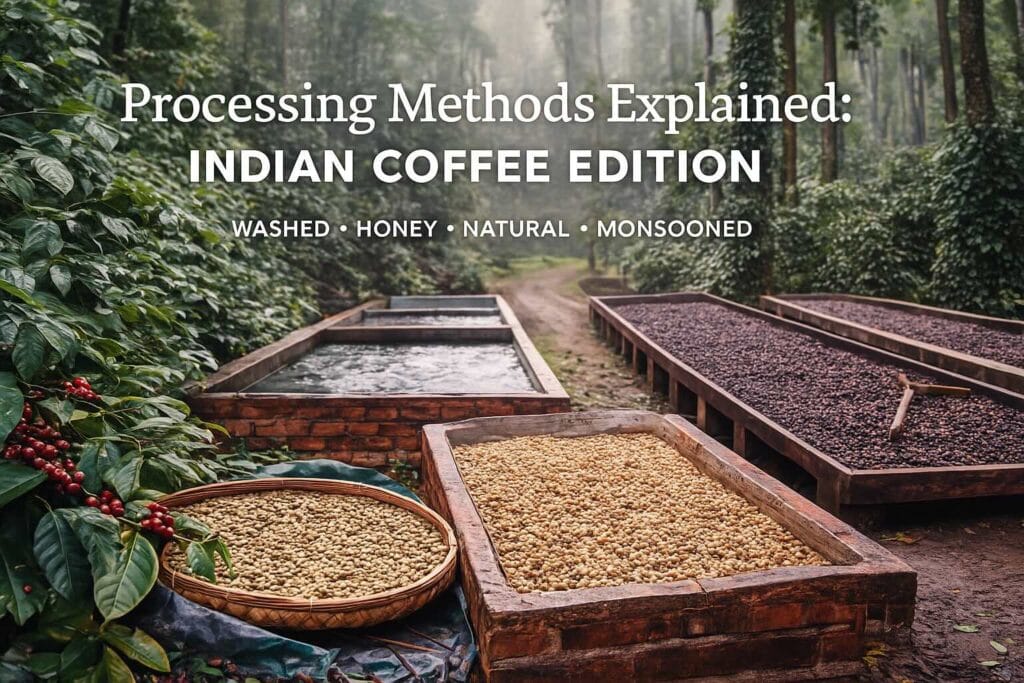
Washed is the baseline. Most specialty Arabica from Coorg is washed – depulped, fermented in tank, washed clean, and dried. Washed Coorg Arabica produces a cup characterised by caramel, dark chocolate, and moderate citrus acidity. It is clean, structured, and consistent season to season. This is the entry point for roasters evaluating Coorg as an origin.
Honey process is growing. Honey lots from Coorg – particularly from Somwarpet and Virajpet – show added sweetness and a more textured body than washed lots from the same material. The climate during harvest period in Coorg supports controlled honey drying without the over-fermentation risk that warmer regions face.
Carbonic maceration has emerged as a specialty processing technique with a notable presence in the Coorg catalog. The proportion of carbonic maceration lots in Coorg’s specialty output is the highest of any Karnataka region. Carbonic maceration lots from Coorg show plum, jasmine, and wine-adjacent notes that are atypical of standard Arabica processing – these are the lots for roasters who want something distinctly different from the conventional Indian Arabica profile.
Natural process is present but less common. Natural Coorg Arabica requires careful cherry selection and managed drying to succeed at the specialty level. When executed well, Coorg naturals produce dense fruit sweetness and heavy body that the washed lots do not.
The processing diversity in Coorg is significant for roasters building an India programme. A single origin – Coorg – can supply washed, honey, carbonic maceration, and natural lots across the same harvest season, providing range within a coherent regional identity.
Varieties
Coorg’s Arabica blocks are planted primarily with S795, Cauvery (Catimor), and Selection 9. Each produces a distinct cup profile.
S795 – also known as Jember in Indonesia – is a cross between a hybrid of Coffea arabica and Coffea liberica (S288) and the Kent variety. Developed at the Indian Coffee Research Station, it produces a cup with maple syrup, brown sugar, berry, cocoa, and honey notes. It is the most widely planted specialty Arabica in Coorg’s higher-elevation blocks and the variety that most commonly appears on specialty roaster bags from this district.
Cauvery (Catimor) – a hybrid involving Timor Hybrid and Caturra, with Robusta genetics from the Timor Hybrid lineage. Cauvery is disease-resistant, high-yielding, and adapted to the lower elevation blocks in Coorg. Its cup is broader and less nuanced than S795 at equivalent elevations, but at 1,000 metres and above it produces a clean, structured cup that is useful for blending.
Selection 9 – a hybrid involving Ethiopian heirloom Tafarikela genetics, as discussed in the Palani Hills post. In Coorg’s Somwarpet Taluk at higher elevations, Selection 9 produces a bright, balanced cup with brown sugar sweetness and good acidity that responds well to light roast profiles.
Robusta in Coorg is predominantly CxR and Peridinia – the same varieties that define Coorg’s specialty Robusta output. These are discussed in detail in the Peridinia Robusta and Honey Process Robusta posts on this blog.
The Ecology
Coorg’s farming system is one of its most important quality assets. Coffee in this district is grown under a dense, multi-layered shade canopy that includes jackfruit, rosewood, silver oak, pepper vines, cardamom, citrus, and native forest trees. The intercropping is not cosmetic – it is the structural foundation of a farming system that has been in place for over a century and that creates the microclimate conditions responsible for Coorg’s cup character.
The shade canopy moderates temperature extremes, maintains soil moisture through the dry season, and creates a forest floor ecosystem that sustains the beneficial insects, birds, and microorganisms that a monoculture system cannot support. The pepper vines that wind through Coorg’s coffee estates are themselves high-value crops – Coorg is one of India’s most productive black pepper regions – meaning the intercropping system generates income beyond coffee and reduces the economic pressure that drives monoculture intensification.
Wildlife in Coorg’s coffee landscape is significant. Elephants, leopards, and gaur move through the district’s larger estates. The Pushpagiri Wildlife Sanctuary and the Brahmagiri Hills at the southern end of the district form part of the Nilgiri Biosphere Reserve connectivity. This is not marketing language – it is the ecological reality of a farming landscape embedded in one of the eight global biodiversity hotspots.
What Coorg Arabica Produces in the Cup
The documented flavor center for Coorg Arabica at the specialty level is: caramel, dark chocolate, and citrus. This is consistent across multiple sourcing references and reflects the combination of S795 varietal character, shade-grown development, and washed processing that defines the mainstream of Coorg specialty output.
Beyond this center, the processing method pulls the profile in different directions:
Washed lots are clean and structured. The chocolate and caramel notes are precise, the citrus is moderate, and the cup is stable across roast levels from light to medium. These are the most accessible Coorg lots for roasters building an India menu for the first time.
Honey lots add sweetness and texture. The caramel character deepens, body increases, and the cup becomes more approachable for customers who find washed Indian Arabica too reserved.
Carbonic maceration lots show plum, jasmine, and wine-adjacent complexity. These are the most departure-from-baseline lots in Coorg’s specialty output and require roasters who are comfortable profiling experimental process coffees.
Natural lots are dense and fruit-forward when well-executed. Dark fruit, heavy body, and sweetness that persists through a wider range of roast levels than washed or honey lots.
One important note for roasters evaluating Coorg Arabica for the first time: the “traditional dark, full-bodied Coorg coffee” characterisation that appears in most regional guides applies to commercial Robusta production, not to specialty Arabica micro-lots. Evaluating a specialty washed S795 lot from Somwarpet against the traditional Coorg Robusta reference frame will produce a misleading read. Cup at light to medium roast, at 85 to 88 degrees Celsius, against specialty Arabica benchmarks rather than the South Indian filter coffee tradition.
Sub-Regional Traceability
As specialty sourcing in Coorg has deepened, sub-regional and estate-level labels have begun to appear on roaster pages. These are meaningful differentiators:
Somwarpet – the highest-elevation Arabica sub-region. Lots labelled Somwarpet signal altitude, S795 dominance, and the lighter, brighter profile associated with Coorg’s upper growing zone.
Siddapur – within Virajpet Taluk, developing a specialty identity around Robusta. Riverside Coffee is the most documented specialty producer in this sub-region.
Ammathi / Gonikoppal – south Coorg, home to some of the oldest established estates and the location of the Coffee Board’s regional research centre at Arvathoklu. Lots from this area have deep farming history and established varietal material.
Estate-level labels from Coorg – Sandalkad, Riverside, Pambukal, and others – represent the most traceable tier. When an estate name appears on a bag, it signals a direct sourcing relationship and lot-level documentation. This is the tier that India Coffee Company sources from.
For Roasters Evaluating Coorg Green Coffee
When assessing Coorg lots, the following parameters are most relevant:
Taluk and elevation – Somwarpet Arabica at 1,200 metres reads differently from Virajpet Arabica at 900 metres. Confirm both before drawing conclusions about the origin.
Variety – S795, Cauvery, and Selection 9 produce measurably different cups at equivalent processing levels. Ask for the variety designation on specialty lots.
Processing documentation – Coorg specialty producers at the leading edge can provide harvest date, processing method, fermentation duration, drying duration, and moisture readings. Lots without this documentation are likely aggregated from multiple smallholders without individual lot management.
Screen size – Coorg Arabica at altitude tends toward larger screen sizes. Mixed screen distributions may indicate cherry from different elevation blocks combined during processing.
Season freshness – Coorg Arabica harvest runs November to January, with Robusta extending to February or March. Lots arriving in market between March and June are fresh crop. Lots offered beyond December of the same year are approaching past-crop territory for Arabica.
India Coffee Company sources green coffee from Coorg through direct relationships with partner farms in the district. To enquire about current availability, use the wholesale enquiry form.