Peridinia Robusta from Coorg: One of India’s Oldest and Most Overlooked Coffee Varieties
When specialty roasters talk about Indian Robusta, the conversation usually centres on CxR – the hybrid variety that dominates commercial production across Karnataka. CxR is well documented, widely traded, and increasingly understood in the specialty market.
Peridinia is different. Older, rarer, and in most sourcing catalogues, unlabelled. It grows on estates in Kodagu (Coorg) alongside CxR and S.274, often harvested together into the same lot, its identity absorbed into the regional grade. For most of its history in the Indian coffee trade, Peridinia has been invisible by name.
That is beginning to change. A small number of producers in Coorg are now processing Peridinia as a distinct, traceable variety. A few importers and roasters outside India have started to name it. The story behind the variety – its origin, its age, its connection to the collapse of an entire industry – is one of the more compelling narratives in Indian coffee.
This post is for roasters and green coffee buyers who want to understand what Peridinia is, where it comes from, and what it produces in the cup.
The Name and Its Origin
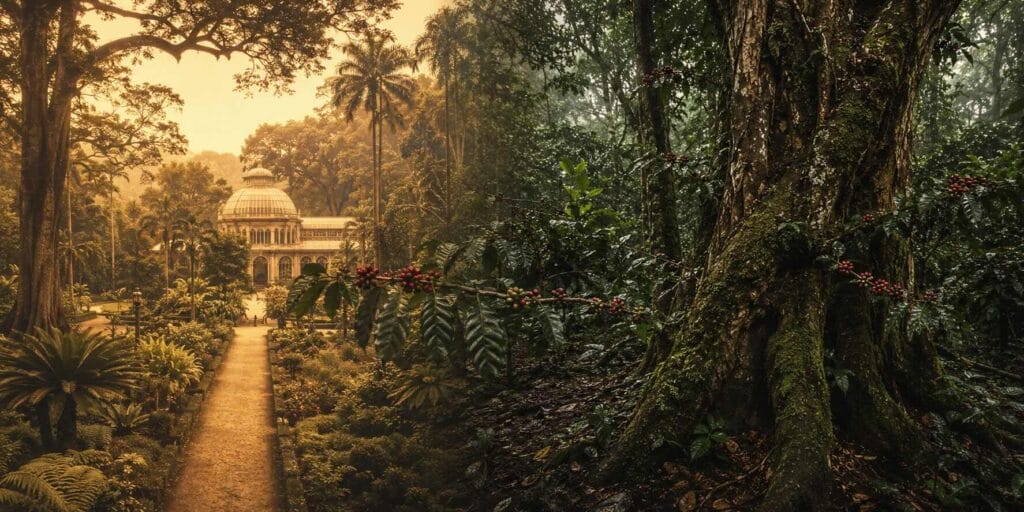
Peridinia takes its name from the Royal Botanical Gardens of Peradeniya in Sri Lanka, then known as Ceylon under British colonial rule. The gardens at Peradeniya were established formally in 1843 and became one of the most important botanical research centres in Asia during the 19th century.
The name is a phonetic corruption of Peradeniya that became fixed in use across South Indian coffee cultivation. Old documentation and scientific literature refer to the variety interchangeably as Old Robusta, Peradeniya, and Peridinia. All three names refer to the same material: the original Robusta introduction from Ceylon into South India.
How It Came to Coorg
To understand why Peridinia exists in Coorg today, you need to understand what happened to coffee cultivation in Ceylon in the 1870s.
By the mid-19th century, Ceylon was one of the most productive coffee regions in the world. The British had established large-scale Arabica plantations across the island from the 1820s onwards. Coffee was the dominant export crop and the foundation of the colonial economy.
In 1869, coffee leaf rust, caused by the fungus Hemileia vastatrix, was identified in Ceylon. Within a decade it had spread across the entire island. By the late 1870s, the rust had destroyed most of Ceylon’s Arabica cultivation. The industry did not recover. Tea replaced coffee as the primary crop, and Ceylon’s coffee history effectively ended.
The same rust spread to South India. Arabica estates in Karnataka and Tamil Nadu were severely affected. Growers began looking for disease-resistant alternatives. Robusta, which had been discovered in the Belgian Congo and was known to be resistant to leaf rust, was identified as a replacement crop.
The earliest Robusta material introduced into India came from Ceylon – specifically from the Peradeniya botanical gardens, where plant material had been collected and held. This material was introduced into South India during the early 19th century, and the trees established from it became the founding population of what is now known as Peridinia, or Old Robusta.
The estates planted with this material in Coorg during the late 19th and early 20th centuries still carry trees descended from that original introduction. Some of the oldest trees on Coorg estates with Peridinia blocks are over a century old, identifiable by their trunk size and the characteristic density of their cherry clusters.
Peridinia, S.274, and CxR: Understanding the Difference
India has three primary commercial Robusta varieties, each representing a different point in the breeding history of the species in the country.
Peridinia (Old Robusta/Peradeniya) is the original introduction. It is a Coffea canephora selection that arrived directly from Ceylon and was established in Indian growing conditions without further crossbreeding. It is the oldest of the three varieties and the one with the longest unbroken cultivation history on Indian soil.
S.274 was the first Robusta selection formally released by the Indian Coffee Research Station. This happened in the late 1940s. S.274 was selected for improved yield and consistency relative to the older Peridinia material, and it became the dominant commercial Robusta planting for much of the second half of the 20th century. Its cup profile is characterised by chocolate, caramel, and nut notes with a spice finish.
CxR is a hybrid developed through interspecific hybridisation involving Coffea congensis and Coffea canephora. It offers higher yield than both Peridinia and S.274, with good disease resistance, and has become the most widely planted commercial Robusta in Karnataka. Its cup profile is clean and structured, making it the default variety in most Indian Robusta green coffee sourced by specialty buyers today.
The cup character documented for Peridinia in scientific literature is distinct from both: chocolate and malt notes, brightened by citrus. This profile is different enough from S.274 and CxR to be genuinely useful to roasters seeking to differentiate their Indian Robusta offering.
Why Peridinia Is Rare
Peridinia’s rarity is a function of economics, not quality. When S.274 was released in the late 1940s and CxR became commercially dominant from the 1970s onwards, new planting decisions on Coorg estates shifted toward higher-yielding varieties. Peridinia was not actively replanted. The trees that existed continued to produce, but new land was planted with S.274 and CxR.
The result is that Peridinia today exists primarily as old-growth trees on established estates. These trees produce reliably but at lower volume than modern varieties. Their age means they are not being replaced like-for-like when they come to the end of productive life. The Peridinia population in Coorg is not being maintained at scale.
There is a further layer of invisibility: because most estates with Peridinia blocks harvest and process variety-mixed lots, Peridinia’s contribution to any given bag of Indian Robusta goes undocumented. It enters the market as CxR or as Robusta Cherry without a varietal designation.
The producers who are now separating Peridinia into distinct lots are doing so with deliberate intention. It requires harvesting old-growth blocks separately, maintaining lot integrity through processing, and accepting the lower volume that comes with it. The material rewards the effort.
Coorg as the Primary Growing Context
While Peridinia exists on estates in other Robusta-growing regions of Karnataka, Coorg is its most documented and historically significant home. The combination of altitude, shade, and the specific microclimate of the Kodagu hills creates conditions that have shaped Peridinia’s development over nearly two centuries of in-situ cultivation.
Coorg Robusta is grown at altitudes of 800 to 1,200 metres above sea level, which is considerably higher than global Robusta norms. The majority of Robusta globally is grown below 700 metres. This altitude difference affects bean density, flavour development, and the pace of cherry maturation.
Shade cover on Coorg estates is consistent and deep. The agroforestry systems in place, where coffee grows beneath a canopy of jackfruit, rosewood, silver oak, pepper vines, and native forest trees, moderate temperature, retain soil moisture, and create a microbiome that influences flavour development in ways that open-sun cultivation cannot replicate.
Peridinia trees on old Coorg estates have spent decades in this environment. The root systems of century-old trees reach deeper into the soil than younger plantings. The canopy they sit under is mature. The intercropping around them is established. These are not the conditions of a recently planted commercial block. They are the product of long-term ecological relationships between plant, soil, and climate.
What It Produces in the Cup
The documented flavour profile for Peridinia in scientific literature is chocolate and malt with bright citrus notes. In the context of Indian Robusta, the citrus brightness is notable – it is not typical of S.274 or standard CxR, which tend toward chocolate, nut, and spice without a bright top note.
This profile makes Peridinia useful to roasters in ways that go beyond the standard Indian Robusta use case. Standard washed CxR performs reliably as an espresso blend component for body, crema, and dark chocolate character. Peridinia, particularly when processed with care, offers those structural qualities alongside a brightness that creates more versatility across roast levels and brew methods.
When processed as honey, as is being done on select Coorg estates, the citrus brightness is modulated by the sweetness developed through mucilage-contact drying. The resulting cup character – chocolate, malt, citrus, and the jaggery-adjacent sweetness of honey processing – is a profile not easily replicated from any other Robusta source.
For roasters building a single-origin Robusta programme or looking to differentiate their India offering beyond the standard washed lot, Peridinia is worth seeking out and worth naming. The variety designation is meaningful. It tells a story that goes back nearly two centuries, to a botanical garden in Ceylon, to the collapse of an industry, and to the replanting decisions made by coffee growers in Coorg in the aftermath.
Why It Matters Now
Indian Robusta is undergoing a revaluation in the specialty market. The conversation has moved from whether Indian Robusta can be specialty-grade to which specific lots and varieties offer the most distinct and useful cup character. That is a more interesting and more productive conversation, and it is one that varietal designation enables.
Peridinia offers something that CxR cannot: genuine historical depth and a documented flavour profile that is distinct within the Indian Robusta category. As producers in Coorg bring more Peridinia lots to market as traceable, variety-designated green coffee, the opportunity for roasters to build something meaningful around this material grows.
The trees are old. The lots are small. The availability is limited. These are not arguments against sourcing Peridinia – they are exactly the conditions that make it worth sourcing.