
Why Indian Robusta Is Often Mis-Evaluated
Indian Robusta occupies an unusual position in the global coffee conversation. It is widely grown, heavily traded, and deeply integrated into India’s coffee economy, yet it is rarely discussed on its own terms. When it is evaluated, it is often judged against expectations that were never designed for it.
This mis-evaluation is not the result of poor intent. It is structural. Robusta is frequently assessed using Arabica-centric frameworks, cupping standards, and flavour expectations. When Indian Robusta does not conform to those frameworks, it is dismissed, undervalued, or misunderstood.
To understand Indian Robusta properly, the first step is not to defend it, but to evaluate it according to what it is designed to do, how it is grown, and where it performs best.
How Robusta Became a Category Problem
Globally, Robusta has long been positioned as a secondary species. Its association with instant coffee, commodity blends, and price-driven markets shaped its reputation early. Over time, Arabica became synonymous with quality, nuance, and specialty, while Robusta became shorthand for volume and strength.
This binary framing left little room for nuance. Robusta was rarely evaluated with the same care as Arabica, nor was it expected to express the same attributes. When specialty coffee standards emerged, they largely evolved around Arabica flavour structures: acidity, aromatics, clarity, and layered complexity.
Robusta, by definition, did not fit neatly into this model.
Indian Robusta Is Not an Afterthought Crop
In India, Robusta is not a marginal species grown only for volume. It is a deliberate agricultural choice shaped by climate, terrain, and disease pressure.
Indian Robusta is typically:
- Grown at lower to mid elevations
- Cultivated under shade
- Selected for resilience and consistency
- Integrated into estate systems with long production histories
It is not planted because Arabica failed. It is planted because it performs reliably under Indian conditions, particularly in regions with higher humidity and disease risk.
This matters, because intention influences outcome. A crop grown for structural strength, yield stability, and cup solidity should not be evaluated solely for brightness or aromatic lift.
The Problem With Arabica-Centric Evaluation
Most professional cupping frameworks assume Arabica as the reference point. Attributes such as:
- High acidity
- Floral aromatics
- Fruit-forward profiles
- Sparkling clarity
are treated as universal indicators of quality.
When Indian Robusta is evaluated using these criteria, it predictably underperforms. Not because it is poorly grown, but because it is structurally different.
Indian Robusta typically expresses:
- Lower perceived acidity
- Heavier body
- Greater bitterness tolerance
- More bass-note flavour profiles
Judging it for what it lacks rather than what it offers leads to systematic undervaluation.
What Indian Robusta Is Actually Optimised For
Indian Robusta excels in areas that are often under-weighted in specialty evaluation.
- Structure and Body
Indian Robusta provides density and mouthfeel that hold up across a wide range of roast developments. - Solubility
It extracts efficiently, particularly in espresso and milk-based applications, providing consistency and strength without collapse. - Sweetness Under Development
When roasted with intention, Indian Robusta can express cocoa, jaggery, nut, spice, and dark sugar notes with remarkable stability. - Stability Across Seasons
Robusta lots often show less dramatic year-to-year variation than Arabica, making them valuable in blends and production environments.
These are not consolation qualities. They are functional strengths.
Why Cupping Scores Undersell Indian Robusta
Cupping protocols were designed to identify acidity, aroma, and flavour articulation in washed Arabicas. When those same protocols are applied to Robusta, the scoring system does not fully capture:
- Textural quality
- Sweetness at higher solubility
- Performance in brewed or espresso contexts
- Behaviour under darker roast development
As a result, Indian Robusta often scores lower on paper than it performs in use.
This disconnect creates a distorted market signal: coffees that function exceptionally well are undervalued because their strengths do not map cleanly onto scoring rubrics.
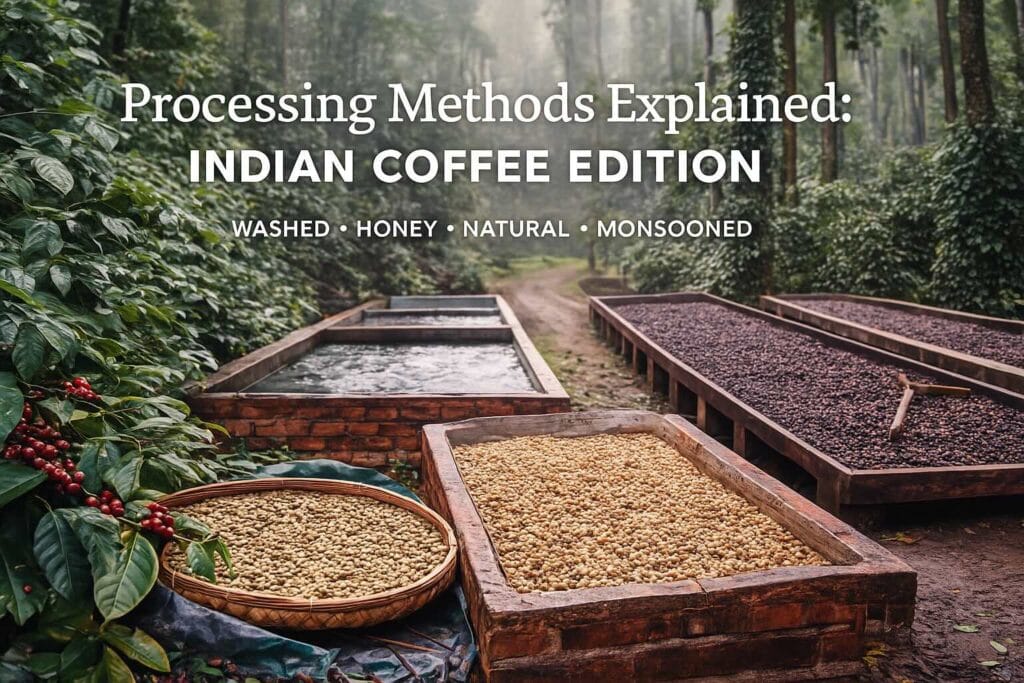
Processing and Indian Robusta
Processing plays a different role in Robusta evaluation than it does in Arabica.
Washed Robustas in India often aim for:
- Cleanliness
- Reduced harshness
- Improved uniformity
Natural and other dry-processed Robustas can amplify:
- Sweetness
- Heavier flavour notes
- Earthy or spicy characteristics
However, processing is frequently expected to “fix” Robusta — to make it behave like Arabica. This expectation is misplaced.
Processing can refine expression, but it does not change species character. When evaluated on its own terms, even straightforward washed Indian Robusta can perform exceptionally well.
Shade, Agronomy, and Robusta Quality
Indian Robusta is commonly grown under shade, which influences:
- Cherry maturation
- Sugar development
- Bean density
- Flavour balance
Shade moderates temperature and reduces stress, allowing Robusta cherries to mature more evenly. This contributes to smoother bitterness, better sweetness integration, and more stable cups.
Good agronomic practices — pruning, fertilisation, and harvest discipline — matter as much for Robusta as they do for Arabica. The difference is that Robusta’s improvements often show up in structure and balance rather than in high-toned aromatics.
The Use-Case Problem
One of the most persistent reasons Indian Robusta is mis-evaluated is that it is rarely assessed in the context it is intended for.
Robusta is often:
- Cupped lightly
- Evaluated black
- Compared directly to Arabica lots
Yet many of its strengths emerge:
- At medium to medium-dark roast levels
- In espresso
- In milk-based beverages
- In blends where structure matters
Evaluating Robusta outside its use case is like judging a structural beam for its decorative finish. The criteria are misaligned.
Why Buyers Miss Good Indian Robusta
Buyers unfamiliar with Indian Robusta often make predictable mistakes:
- Dismissing lots based on cupping score alone
- Expecting fruit-forward profiles
- Over-penalising bitterness without context
- Ignoring stability and repeatability
This leads to missed opportunities, particularly for roasters looking for dependable components rather than showcase lots.
Indian Robusta is not always a headline coffee. It is often a backbone coffee. That distinction matters.
How Indian Robusta Is Read at Origin
From an origin-side perspective, Indian Robusta is evaluated differently.
Key considerations include:
- Bean uniformity
- Moisture stability
- Defect tolerance
- Performance across roast curves
- Consistency across shipments
Rather than asking whether a Robusta is “specialty enough,” the more relevant questions are:
- Is it clean?
- Is it sweet for its type?
- Does it perform predictably?
- Does it add value where it will be used?
These questions align more closely with how coffee actually moves through supply chains.
The Risk of Forcing Robusta Into the Wrong Narrative
When Indian Robusta is framed as “Arabica-like” to gain acceptance, it creates unrealistic expectations. Coffees are positioned to impress in cupping rooms rather than to perform in production.
This does a disservice to producers, buyers, and roasters alike.
A more honest approach is to let Robusta occupy its own category, with its own strengths and limitations clearly understood.
Re-Evaluating Indian Robusta Properly
Re-evaluating Indian Robusta does not require lowering standards. It requires adjusting them.
That means:
- Weighting structure and sweetness appropriately
- Evaluating performance, not just flavour notes
- Considering context of use
- Valuing repeatability and stability
When assessed this way, Indian Robusta often proves itself to be not just viable, but essential.
Indian Robusta is often mis-evaluated because it is misunderstood, not because it is lacking.
When judged by Arabica standards, it predictably falls short. When judged on its own terms — for structure, solubility, balance, and consistency — it reveals a different kind of quality.
Not louder. Not flashier. But deeply functional.
And in many real-world coffee programs, that kind of quality matters more than is often acknowledged.