Why Altitude Tells You Less Than You Think in Indian Coffee
Altitude is one of the first numbers people look for when evaluating a coffee. It appears on spec sheets, cupping tables, websites, and offer lists, often treated as shorthand for quality. Higher altitude, the logic goes, means slower cherry maturation, higher density, brighter acidity, and better cup potential.
That shorthand works reasonably well in some coffee-growing contexts. It works less well in others. And in India, it often obscures more than it reveals.
This is not an argument against altitude as information. Altitude matters. It influences temperature, flowering cycles, and maturation rates. But in Indian coffee, altitude is rarely decisive on its own, and sometimes not even particularly informative. Understanding why requires looking beyond a single number and into how coffee is actually grown, processed, and selected across Indian origins.
How Altitude Became a Proxy for Quality
In global coffee discourse, altitude became associated with quality for practical reasons. In many producing countries, higher elevations tend to bring cooler temperatures, slower cherry development, and greater sugar accumulation. These conditions often result in higher perceived acidity, complexity, and clarity in the cup.
Over time, altitude became an easy signal. It was measurable, comparable, and exportable. Buyers learned to associate “high grown” with “better,” and sellers learned to foreground altitude as a differentiator. The relationship was never absolute, but it was reliable enough in some regions to become conventional wisdom.
The problem arises when that same framework is applied uniformly, without accounting for regional growing systems that do not behave the same way.
India is one of those systems.
What Altitude Actually Influences (And What It Doesn’t)
Before discussing why altitude behaves differently in India, it helps to be precise about what altitude does and does not control.
Altitude primarily affects:
- Average temperature
- Diurnal temperature variation
- Rate of cherry maturation
- Potential bean density
These factors can influence flavour development, but only in interaction with other variables. Altitude does not determine:
- Soil composition
- Shade management
- Rainfall patterns
- Agronomic practices
- Harvest discipline
- Post-harvest handling
In other words, altitude shapes the environment in which coffee grows, but it does not dictate how that environment is managed.
In India, that distinction matters.
India’s Coffee Grows in Managed Forest Systems
One of the most important differences between Indian coffee and many other origins is shade.
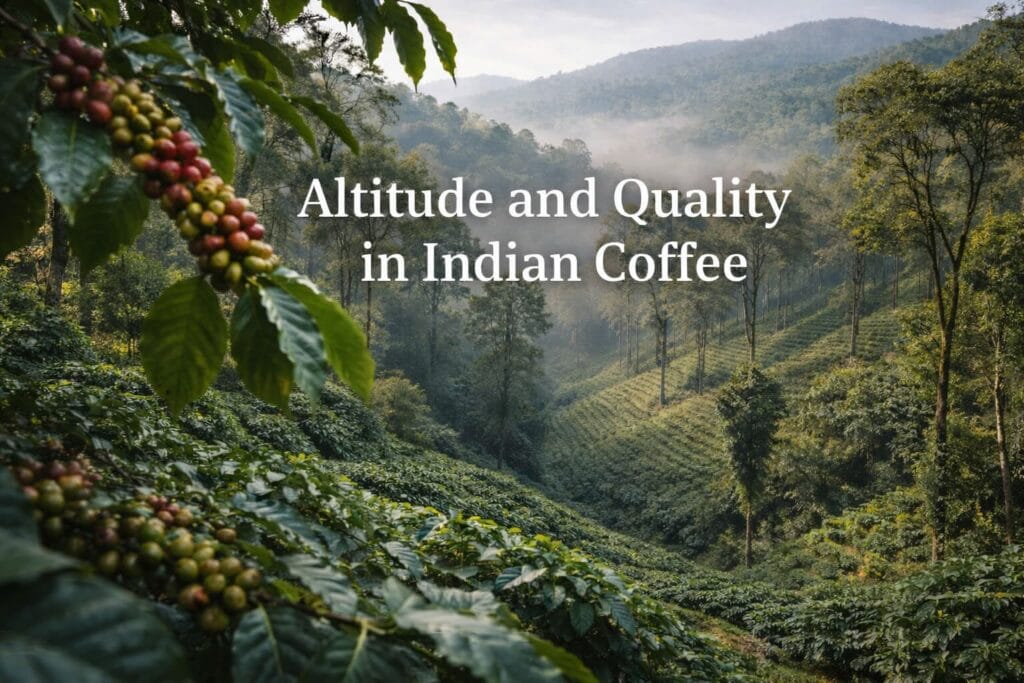
Most Indian coffees are grown under dense, multi-layered shade canopies. These are not lightly shaded farms. In many regions, coffee grows beneath native forest trees, fruit trees, and timber species that significantly moderate temperature and light exposure.
Dense shade:
- Reduces temperature extremes
- Slows cherry maturation even at lower elevations
- Protects cherries from heat stress
- Creates more stable microclimates
As a result, a coffee grown at 900–1,100 meters under heavy shade in India may experience a maturation profile similar to, or slower than, a coffee grown at much higher elevations in more exposed systems elsewhere.
When shade density is high, altitude alone becomes a weak predictor of maturation speed and sugar development.
Rainfall Patterns Matter as Much as Elevation
India’s coffee regions are shaped by the monsoon. Rainfall is not evenly distributed across the year, and it varies significantly by region, elevation band, and exposure.
Monsoon patterns affect:
- Flowering synchronisation
- Cherry development cycles
- Harvest timing and spread
- Disease pressure
In some Indian regions, excessive rainfall at higher elevations can create challenges:
- Increased fungal pressure
- Dilution of sugars if harvest timing is poor
- Difficulties in drying and post-harvest control
Meanwhile, slightly lower elevations with better drainage, more predictable rainfall breaks, and controlled shade can produce cleaner, more balanced cups.
Altitude does not account for rainfall timing or intensity. In India, those factors often exert more influence on cup outcome than elevation alone.
Soil Depth and Composition Are Often Overlooked
Soil is rarely discussed with the same enthusiasm as altitude, but in India it plays a critical role.
Many Indian coffee regions have:
- Deep, well-draining soils
- High organic matter from forest litter
- Long-established root systems
These soils support consistent nutrient uptake and water regulation, even in years with uneven rainfall. In some cases, lower-elevation sites with deep, healthy soils outperform higher-elevation sites with shallower or more eroded profiles.
Again, altitude does not capture this. Two farms at the same elevation can behave very differently depending on soil depth, structure, and management history.
Varietal Adaptation Changes the Equation
Much of the altitude-quality shorthand assumes varietals that respond predictably to elevation changes. Indian coffee complicates this assumption.
Indian Arabicas are often:
- Selected for disease resistance
- Adapted to shade and humidity
- Bred for stability rather than extreme expression
Varietals such as S795, Chandragiri, and others were developed with Indian conditions in mind. They perform consistently across a range of elevations when managed well, and they do not always express dramatic altitude-driven flavour shifts.
In other words, varietal adaptation flattens the altitude curve. The difference between 1,000 and 1,400 meters is less pronounced when the plant itself is bred to prioritise resilience and balance.
Estate Systems vs Smallholder Assumptions
Another reason altitude can mislead in India is the structure of production.
Much Indian coffee comes from estate systems rather than fragmented smallholder plots. Estates often manage:
- Shade
- Fertilisation
- Pruning
- Harvest labour
- Processing infrastructure
This level of control reduces variability that altitude might otherwise introduce. A well-run estate at a moderate elevation can consistently outperform a poorly managed high-elevation site.
Buyers accustomed to associating high altitude with smallholder quality narratives may underestimate how much management matters in estate-based systems.
When High Altitude Does Matter in India
None of this means altitude is irrelevant in India. It does matter, but in more specific ways.
Higher elevations in India can contribute to:
- Slightly brighter perceived acidity
- Firmer structure in washed coffees
- Greater clarity when other variables are aligned
However, these benefits appear only when:
- Shade is balanced, not excessive
- Harvest timing is precise
- Processing is clean and controlled
- Drying conditions are managed carefully
High altitude amplifies good decisions. It also amplifies bad ones.
This is why altitude should be read as a multiplier, not a guarantee.
Why Altitude Marketing Persists
If altitude is such a limited signal in India, why does it remain so prominent?
Partly because altitude is:
- Easy to communicate
- Familiar to buyers
- Expected on spec sheets
It also persists because it allows Indian coffee to be framed using global language, even when that language does not fully apply. Removing altitude from the conversation would require replacing it with more nuanced explanations of shade, rainfall, soil, and management — concepts that are harder to compress into a single number.
But clarity often requires resisting convenience.
How We Interpret Altitude at Origin
From an origin-side perspective, altitude is one data point among many. It is never read in isolation.
When evaluating Indian coffees, altitude is considered alongside:
- Shade density and canopy composition
- Rainfall patterns during flowering and maturation
- Soil depth and health
- Varietal choice and age
- Harvest practices
- Post-harvest infrastructure
A moderate-elevation coffee that performs consistently across seasons often represents a stronger, lower-risk choice than a higher-elevation coffee that shines only in ideal years.
This is not a quality judgment. It is a decision-making framework.
The Risk of Over-Indexing on Altitude
For buyers unfamiliar with Indian contexts, over-indexing on altitude can lead to several problems:
- Overpaying for elevation rather than performance
- Overlooking stable, repeatable lots
- Misinterpreting cup profiles
- Setting unrealistic expectations
It can also distort producer incentives, encouraging elevation-based positioning rather than investment in agronomy, processing, and selection.
When altitude becomes the headline, the real work disappears from view.
Reading Indian Coffee More Accurately
To read Indian coffee accurately, altitude needs to be re-positioned — not removed, but re-scaled.
Better questions than “How high is it grown?” include:
- How is shade managed?
- How consistent is harvest timing?
- What does rainfall look like during maturation?
- How is processing handled on the estate or at the curing works?
- How does the coffee perform across seasons?
These questions are harder to answer quickly. They are also more useful.
Altitude is useful information. It is just not decisive information in Indian coffee.
Understanding Indian coffee requires shifting from single-variable assumptions to systems thinking. When you do that, altitude finds its proper place — not as a promise, but as context.
And context, in Indian coffee, is where quality actually lives.