BR Hills (Biligirirangan Hills) Green Coffee: A Sourcing Guide for Specialty Roasters
Most roasters who source Indian coffee know Coorg and Chikmagalur. Fewer know BR Hills.
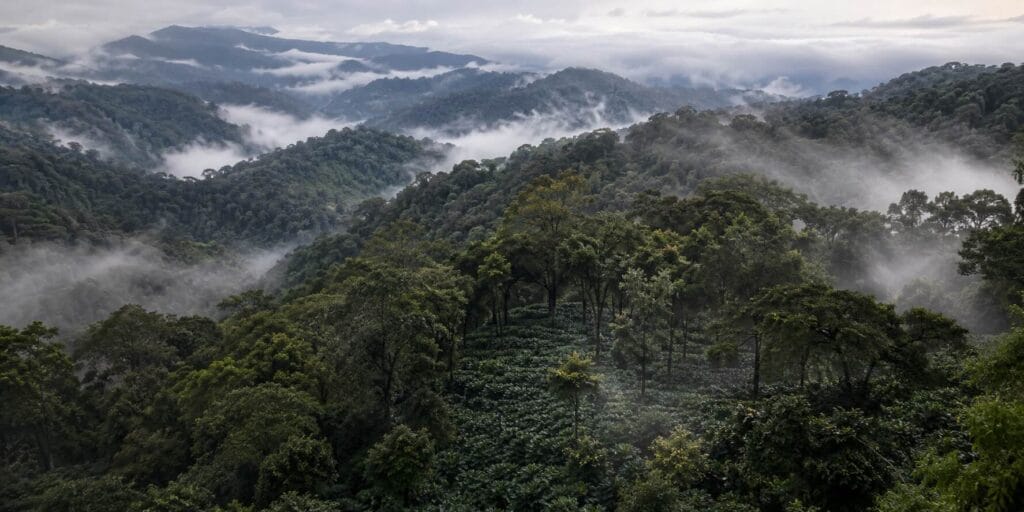
The Biligirirangan Hills, abbreviated universally as BR Hills, sit at the confluence of the Western and Eastern Ghats in Karnataka’s Chamarajanagar District. They are named after the white mist and silver clouds that cover the peaks for most of the year – Biligiri meaning white hill in Kannada. The region is one of the most biodiverse in India, legally protected as the Biligiri Ranganatha Swamy Temple Wildlife Sanctuary and Tiger Reserve, and home to one of the oldest continuous coffee farming traditions in the country.
As a green coffee origin, BR Hills is almost entirely invisible in global trade. No major importer lists it as a named region. No origin catalogue from North America or Europe has published a sourcing guide to it. The coffee that comes from here reaches the global market either unlabelled, absorbed into Karnataka or Western Ghats regional blends, or through a small number of Indian specialty producers who are building the category from the ground up.
For roasters willing to look beyond the established Indian origins, BR Hills offers altitude, biodiversity, smallholder producer depth, and processing experimentation that is genuinely difficult to find at this combination anywhere else in India.
The Geography
BR Hills covers 540 square kilometres of protected forest in Chamarajanagar District, approximately 100 kilometres south of Mysore. The sanctuary was established in 1974 and expanded in 1987. Its highest peak reaches 1,707 metres above sea level.
The ecological position of BR Hills is unusual. Most growing regions in India sit firmly within either the Western Ghats or the Eastern Ghats. BR Hills occupies the junction between the two, creating a transitional zone where the flora, fauna, and microclimate characteristics of both mountain ranges overlap. This confluence is one of the primary reasons the region is considered a biodiversity hotspot – species from both Ghat systems coexist here in a density that is rare in South India.
Coffee is grown across a wide elevation range within the sanctuary and its buffer zones. Smallholder farms managed by the Soliga community sit at lower elevations within and adjacent to the forest. Estate-scale farming at higher elevations reaches 1,200 to 1,300 metres for Selection 9 Arabica lots, while the highest estate in the region, Attikan, sits at 1,200 to 1,310 metres above sea level, making it one of the highest altitude coffee growing areas in South India.
Rainfall in BR Hills ranges from 600 millimetres annually at the base to significantly higher on the upper slopes, where mist and cloud cover contribute moisture beyond direct rainfall. The combination of altitude, humidity, forest canopy, and temperature variation between day and night creates a slow, even cherry development that is the foundation of the region’s cup quality.
The Soliga Community
The Soliga are an indigenous tribal community whose presence in the Biligirirangan Hills predates recorded coffee cultivation in the region by centuries. They are forest dwellers with deep ecological knowledge of the BR Hills landscape – its seasonal rhythms, its plant communities, and its wildlife corridors.
Coffee cultivation among the Soliga began in 2015 when over 650 growers, each managing 2 to 3 acres of land, began cultivating Arabica under the forest canopy. Their farming is organic by default – not because of certification programmes but because accessing chemical fertilisers and pesticides in the forest interior is logistically and economically impractical. Coffee and black pepper are intercropped on the same land, with pepper vines providing additional income and contributing to the multi-layered canopy structure.
The Soliga harvest under conditions that most mechanised farming systems cannot replicate and would not attempt. Cherry must be hand-carried on foot through forest pathways, sometimes for 15 kilometres before reaching a road. There are no vehicles, no conveyor systems, and no shortcuts. The result is that only fully ripe cherry reaches the processing point – not because of protocol enforcement, but because the physical effort of the harvest makes selective picking the only rational approach.
In 2020 and 2021, the Bilirangana Hills Soliga Farmers Producers Association recorded a turnover of over 1.5 crore rupees from coffee and pepper sales. The Coffee Board of India has formally recognised the commercial and social potential of Soliga-grown coffee, signing an MoU to replicate the model of Araku Tribal Coffee for BR Hills – aiming to bring the same kind of international premium positioning that took Araku from a forest community to specialty coffee shelves in Paris.
Estate Farming at Altitude
Alongside smallholder production, BR Hills has a small number of estate-scale farms that represent some of the longest continuous coffee cultivation histories in South India.
Attikan Estate was founded in 1888 by a Scottish planter, Randolf Morris, who is said to have ridden on horseback from the Nilgiri Mountains to BR Hills to establish the farm. After Morris was incapacitated following an encounter with a bison on the estate, Attikan was managed by his wife and subsequently by generations of the Morris family and later Indian owners. The estate sits at 1,200 to 1,310 metres above sea level, with no electricity or mobile connectivity – conditions that have preserved the ecosystem of the surrounding forest in a state that is unusual even by Indian specialty standards.
Arabica varieties grown at Attikan include Hawaii Red Catura, Catimor, BBTC, Selection 9, and Chandragiri. The estate is intercropped with durian, jackfruit, and pepper. Its isolation from infrastructure has meant that farming practices have remained low-intervention and the forest canopy surrounding the estate is intact.
The Black Baza Coffee sourcing network in BR Hills operates through a 400-member Farmer Producer Organisation, working with smallholder producers at elevations around 1,400 metres. Selection 9 is the primary Arabica variety in this network. The FPO model concentrates processing expertise and quality management in a way that individual smallholders cannot sustain independently, enabling consistent cup quality across a large number of micro-producers.
Wildlife and the Coffee Ecosystem
BR Hills is among the most wildlife-rich landscapes in which specialty coffee is grown anywhere in the world. The sanctuary supports tigers, elephants, leopards, sloth bears, gaurs, Indian giant flying squirrels, chitals, and sambhars. Over 254 bird species have been documented within the sanctuary, including species endemic to the Western Ghats and species from the Eastern Ghats that overlap here and nowhere else in India.
The Lion-tailed Macaque, one of the most endangered primates in Asia with fewer than 3,500 individuals remaining in the wild, is found in the BR Hills forest. The Indian Gaur, the world’s largest bovine species, moves through coffee farms and forest corridors. The presence of these species is not incidental. It is a direct function of the farming practices – shade-grown, low-intervention, organically cultivated coffee that maintains forest structure and biodiversity rather than replacing it.
Research published in scientific literature has documented that shade-grown Arabica and Robusta agroforests in the Western Ghats support habitat specialist bird species at levels comparable to native forest, with Robusta farms showing slightly higher abundances of habitat specialists in some categories due to dense canopy. BR Hills, as one of the most intact forest-coffee interfaces in Karnataka, represents the upper end of this spectrum.
For roasters who communicate provenance and sustainability to their customers, BR Hills coffee carries an ecosystem story that is verifiable, specific, and genuinely rare. It is not greenwashing language applied retrospectively to commodity coffee. The biodiversity is documented, protected by law, and visible to anyone who visits the region.
Processing and Experimentation
BR Hills is not a single-process origin. The range of post-harvest methods applied here is broader than most roasters would expect from a region with this degree of geographic isolation.
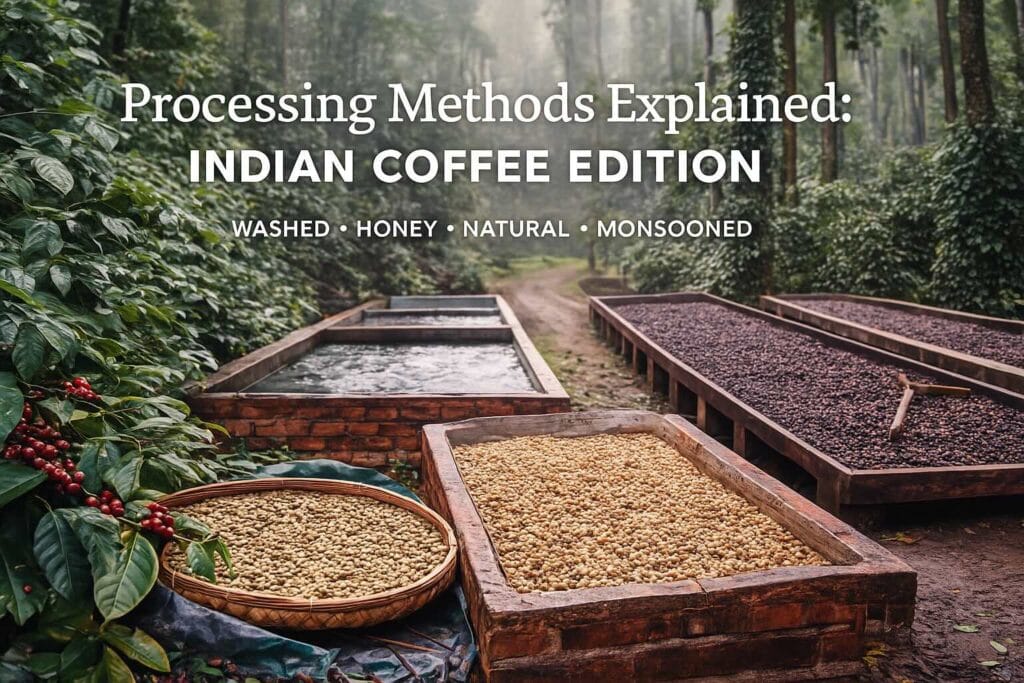
Washed Arabica is the established baseline. Producers in the Black Baza network hand-pulp cherry to ensure zero bean damage before fermentation, a level of care that is unusual even among Indian specialty producers. The washed lots from Selection 9 at 1,400 metres produce a clean, structured cup with dark chocolate and caramel character and moderate acidity.
Natural process lots are produced alongside washed, with sun-drying on raised beds or ground tarps depending on the producer’s infrastructure.
Microlot processing in the FPO network has expanded to include yellow honey, red honey, anaerobic fermentation, and fruit fermentation. These methods were introduced incrementally, with producers experimenting on small volumes before scaling what works. The honey and anaerobic lots represent the leading edge of what BR Hills can produce and the most compelling case for the region as a specialty origin in its own right rather than as a contributor to blended Karnataka grades.
What It Produces in the Cup
Cup character in BR Hills Arabica is shaped by three dominant factors: altitude, shade canopy, and variety.
At 1,200 to 1,400 metres, bean development is slower than at lower elevations. The result is denser beans with higher sugar concentration and a more complex flavour foundation than altitude-equivalent lots from faster-developing microclimates. The forest canopy moderates temperature extremes, reducing the stress that direct sun exposure places on cherry development.
Selection 9 is the dominant variety in the FPO network. It is a hybrid selection developed in India that produces a cup characterised by brightness, brown sugar sweetness, and a clean, balanced body. It performs well across roast levels and is one of the more versatile Indian Arabica varieties for roasters who need range across their menu.
Chandragiri, grown at Attikan and other higher-elevation blocks, produces a more complex cup with fruit-forward notes and higher acidity than Selection 9. It is less commonly available as a traceable variety lot but represents a distinctive expression of BR Hills terroir when it is.
Washed lots from the FPO network typically cup with dark chocolate, brown sugar, moderate acidity, and a clean, round finish. Honey processed lots from the same base add sweetness and a slightly fuller texture. Anaerobic and fruit fermentation lots are more experimental – the results vary by producer and season, with the best examples showing tropical fruit and wine-adjacent complexity that is atypical of South Indian Arabica.
The Sourcing Gap
No green coffee importer outside India currently lists BR Hills as a named sourcing region. The coffee that leaves this area reaches the global market through two paths: absorbed into Karnataka-grade blends with no origin attribution, or through Indian producers who are building direct relationships with international roasters one lot at a time.
The second path is where the opportunity is. A roaster who sources BR Hills coffee as a named, traceable lot is not competing for shelf space with dozens of other buyers sourcing the same material through the same channels. They are sourcing from a region that the global specialty market has not yet named, priced, or positioned.
The comparison to Araku Valley is instructive. Araku was unknown globally a decade ago. Concentrated effort by producers and importers to tell the story – tribal farming community, high altitude, organic cultivation, traceable processing – built a premium positioning that now commands prices in Paris and London that would have been unthinkable when the coffee was moving as unnamed commodity. BR Hills has the same structural ingredients: indigenous community, exceptional biodiversity, high altitude, organic farming, and a story that is not yet told in the global trade.
For Roasters Evaluating BR Hills Green Coffee
When assessing BR Hills lots, the following parameters are most relevant:
Altitude and variety documentation – confirm the elevation of the specific block and the variety designation. The difference between a 900 metre Soliga smallholder lot and a 1,400 metre Selection 9 FPO lot is significant in the cup and in the pricing conversation with your customers.
Processing documentation – BR Hills producers who are working at specialty level can provide harvest date, processing method, drying duration, and moisture readings. These details separate intentional specialty lots from cherry that was processed without quality management.
Screen size – BR Hills Arabica at altitude tends toward larger screen sizes, consistent with slow bean development. Lots with mixed screen size may indicate cherry from different elevation blocks that was combined during processing.
Freshness – given the limited volume coming out of BR Hills as named traceable lots, these are not coffees that sit in warehouse for extended periods. Green freshness is a genuine advantage of sourcing early in the season.