Nilgiris Arabica Green Coffee: India’s Highest and Most Overlooked Origin
The Nilgiris are better known for tea than coffee. That is the first thing most people know about India’s Blue Mountains, and for most of the region’s modern agricultural history, it has been accurate. Tea replaced coffee across much of the Nilgiris in the late 19th century after the collapse of Arabica cultivation across South India following the coffee leaf rust epidemic.
What that history obscures is that coffee never left. Indigenous farming communities in the Nilgiris Biosphere Reserve – primarily the Irula and Kurumba peoples – continued cultivating Arabica in the forest margins throughout the period when commercial estate production shifted to tea. The coffee they grew was consumed locally, sold in small volumes to regional buyers, and moved through informal channels with no documentation and no origin attribution.
Today, that coffee is beginning to be organised, processed with intention, and offered to the specialty market. The volumes are small. The infrastructure is limited. The global trade presence is effectively zero. For a roaster looking to source an Arabica origin that is genuinely unknown outside India, the Nilgiris represents one of the clearest opportunities in the Indian coffee landscape.
The Geography: Blue Mountains at the Edge of Three States
The Nilgiri Mountains, from the Kannada and Tamil word for blue mountain, sit at the junction of Tamil Nadu, Kerala, and Karnataka in South India. The name comes from the Strobilanthes flower that covers the higher slopes in a mass of blue-purple bloom every twelve years, and from the blue-grey mist that settles across the peaks for much of the year.
The Nilgiris are exceptional by Indian and global coffee standards. The highest peak, Doddabetta, reaches 2,637 metres above sea level. Ooty, the main town, sits at 2,240 metres. Coffee in the Nilgiris is grown at elevations ranging from 950 to 1,500 metres in the tribal farming areas, and up to 1,800 metres on higher estate blocks – making some Nilgiris Arabica among the highest-grown coffee in India.
For context: most Indian Arabica is grown at 800 to 1,200 metres. The 1,500 to 1,800 metre range that characterises upper Nilgiris production is the altitude bracket where Ethiopian highland coffees are grown. The temperature, bean development pace, and flavour potential at that elevation is different in kind, not just degree, from what lower-altitude Indian Arabica produces.
The Nilgiris District spans three distinct natural zones. The high plateau above 2,000 metres, dominated by Shola forests and grasslands, is where the most recognised estates operate. The mid-elevation slopes, between 950 and 1,500 metres, are where tribal farming communities grow coffee in the forest interior. The lower Wynaad tableland around Gudalur, at approximately 1,000 metres, forms the warmer southern fringe of the region.
The entire Nilgiris District sits within the Nilgiris Biosphere Reserve, designated as India’s first biosphere reserve in 1986 and part of the UNESCO World Network of Biosphere Reserves since 2000. The broader Western Ghats, of which the Nilgiris are a part, was declared a UNESCO World Heritage Site in 2012. The coffee produced here is not grown alongside a protected ecosystem. It is grown inside one.
The Irula and Kurumba Communities
The Irula and Kurumba peoples are among the oldest indigenous communities in South India. Their presence in the Nilgiris predates recorded history. They are forest communities whose traditional ecological knowledge – of plant species, seasonal rhythms, soil types, and water sources – has been accumulated over centuries of living in the Nilgiris Biosphere.
Coffee was introduced to the Nilgiris Biosphere in the late 1820s during the British colonial period. It found its way into indigenous agricultural practice because it suited the shaded, multi-layered farming systems that tribal communities already maintained. Arabica grows well under the canopy of jackfruit, mango, silver oak, orange, lime, banana, and pepper vines – all of which are already part of the intercropped agroforestry systems that Irula and Kurumba farmers maintain alongside tamarind, clove, and millets.
Farming is organic by practice, not certification. Access to chemical inputs in the forest interior is logistically difficult and economically impractical for smallholders managing 1 to 3 acres. The organic inputs used by tribal producers include Panchakaaviya, a traditional concoction derived from five cow-derived ingredients used across South Indian agroforestry, and Poochiverati, a plant-based pest deterrent made from local botanical materials. Leaf litter from the surrounding forest is the primary fertiliser.
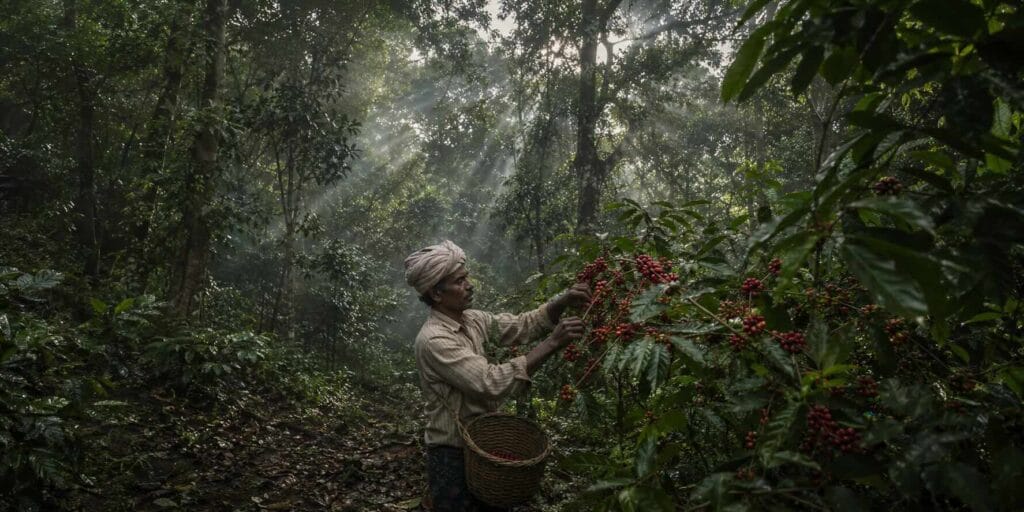
Harvest takes place between November and March. The entire family participates – cherry is hand-picked and sorted, then pulped at the village level using small hand-pulping machines. Both men and women are involved throughout the harvest and processing stages. The coffee is sold to Aadhimalai, the primary aggregation and processing organisation for tribal coffee in the Nilgiris.
The Keystone Foundation, a non-governmental organisation based in the Nilgiris, has been working with tribal communities in the region for over 30 years. They have been central to building market access for Nilgiris tribal coffee and are the institutional force behind the Slow Food Nilgiris Coffee Coalition, which connects Irula and Kurumba producers to international buyers. In 2014, an Italian roaster near Bologna became the first documented international buyer of Nilgiris tribal coffee through the Slow Food channel – making it one of the earliest European specialty relationships with this origin.
Aadhimalai Pazhangudiyinar Producer Company
Aadhimalai is the central institution for understanding how Nilgiris tribal coffee moves from forest farm to market. Its name means “original hill people” in Tamil – a direct reference to the indigenous communities whose produce it handles.
Aadhimalai is structured as a producer company, meaning the tribal farmers who supply coffee to it are also shareholders in the company. This is not a conventional cooperative model where farmers are members of a buyer-controlled organisation. Aadhimalai’s producers have ownership stakes in the entity that processes and markets their coffee, giving them both income from their crops and returns from the organisation’s commercial activity.
The company procures green coffee in multiple forms: as harvested cherry, as dried cherry (called kari coffee in the region), and as parchment after pulping and drying. It operates its own processing facility and roasting equipment, but also sells green beans directly to roasters and buyers who want to roast the material themselves.
Coffee is offered as washed Arabica, natural process, and blended Arabica-Robusta. The primary variety is Arabica, which dominates production in the higher-altitude tribal blocks. Robusta is present in lower-elevation areas.
The processing at Aadhimalai is carried out by women from the indigenous communities, consistent with the broader Keystone Foundation model of building women’s livelihoods within the value chain rather than concentrating income at the household level. This processing workforce represents one of the most genuinely community-embedded processing structures in Indian specialty coffee.
Estate Production and the Chandragiri Variety
Alongside the tribal smallholder sector, the Nilgiris has a small number of estate-scale producers operating at higher altitudes. Balmaadi Estate, in the O’Valley area approximately 50 kilometres from Ooty, grows Arabica at 1,200 to 1,800 metres under the natural shade of Shola trees – the montane forest species native to the Nilgiris plateau. Balmaadi’s Arabica won the Flavour of India Fine Cup Award in 2004, judged by an international jury at Trieste, Italy, confirming the cup potential of this elevation range.
Curious Life Coffee, a Czech specialty roaster, has published one of the most detailed assessments of Nilgiris coffee available in English: estates in the Nilgiris average 5,500 feet in elevation with some reaching 6,500 feet, making the region one of the most altitude-advantaged Arabica growing areas in India. Their sourcing documentation describes coffee surviving in plots surrounded by tea estates, maintaining quality because of a microclimate and altitude combination that the region’s best farms exploit with precision.
The Chandragiri variety deserves specific attention. Chandragiri is a hybrid Arabica developed at the Indian Coffee Research Station at Balehonnur, released in 2003. It was bred for disease resistance, particularly against coffee leaf rust and white stem borer, combined with cup quality that holds up against the S-series varieties that dominate Indian Arabica production. In the Nilgiris at high altitude, Chandragiri develops a cup character that is noticeably more complex than what the same variety produces at lower elevations in Karnataka – the altitude slows development and concentrates the flavour compounds in a way that is altitude-dependent.
The Wildlife Context
The Nilgiris Biosphere is home to wildlife that makes coffee farming in the region ecologically significant rather than ecologically neutral. Tiger, elephant, leopard, and sloth bear populations move through the same landscapes where coffee is cultivated. Over 3,000 plant species are documented in the reserve. The Nilgiri Tahr, a mountain goat found only in the upper Nilgiris, is classified as Endangered.
The five major indigenous tribal groups of the Nilgiris – the Toda, Kota, Kurumba, Irula, and Badagas – have maintained their traditional relationships with this ecosystem for centuries. Their farming systems are, in the most literal sense, biodiversity-compatible: shade canopy maintained, chemical inputs absent, forest structure preserved. The coffee produced under these conditions is not just high-altitude Arabica. It is forest-integrated Arabica produced by communities whose continued presence in the biosphere is tied to the economic viability of their land use.
The Global Trade Gap
The Nilgiris does not exist as a named origin in international green coffee trade. No major importer in North America, Europe, or Australia lists it in their origin catalogue. The only documented international specialty trade relationship for Nilgiris coffee as of the time of writing is the Italian roaster connection established through Slow Food in 2014. A small number of Indian specialty producers, including Black Baza, have begun bringing Nilgiris lots to international buyers, but the origin has no established global market identity.
This is a different situation from BR Hills, where the absence is recent. Nilgiris coffee has been traded internationally only at the margin for over a decade, despite having verifiable altitude credentials, a documented indigenous producer community, FAO Mountain Partnership recognition, Slow Food listing, and a UNESCO-designated biosphere as its growing environment. The absence from global trade is not a quality gap. It is an information and access gap.
For roasters, that gap is the opportunity. A sourcing story that combines 1,800 metre altitude, indigenous tribal producers, organic forest farming, UNESCO World Heritage designation, and a variety – Chandragiri – that few roasters outside India have ever encountered is not a story that requires retrofitted sustainability language. It is a story that exists on its own terms and needs a channel to reach the roasters who would value it.
What to Expect in the Cup
Nilgiris Arabica varies by altitude and producer, but the general profile across well-processed lots from the higher elevation blocks is:
Bright acidity – noticeably more than most South Indian Arabica, a function of the altitude and slow development. Roasters used to washed Coorg or Chikmagalur Arabica will find Nilgiris lots more acidic and more fragile, requiring lighter roast profiles to preserve the cup character.
Fruit-forward aromatics – the amla, cranberry, and citrus notes documented across multiple sourcing references are consistent with high-altitude Arabica development. These are not manufactured through processing – they are varietal and altitude characteristics.
Clean body – well-processed Nilgiris washed Arabica cups clean without the earthiness that can appear in lower-altitude Indian lots processed in high-humidity conditions.
Complexity at lighter roasts – the cup character that makes Nilgiris Arabica interesting to specialty roasters is found at light to medium-light roast. At darker roasts, the altitude-driven acidity and fruit character are consumed by caramelisation and the coffees read more generically. Roasters evaluating these lots should cup them at 85 to 88 degrees Celsius at light to medium roast levels before making sourcing decisions.
For Roasters Evaluating Nilgiris Green Coffee
The evaluation framework for Nilgiris Arabica differs from standard Indian Arabica assessment in one key respect: altitude compensation. The acidity and brightness that appear elevated relative to Karnataka Arabica benchmarks are not defects – they are the defining characteristics of this origin. Evaluating a Nilgiris lot against a Chikmagalur reference frame will produce a misleading read.
The most relevant comparison is with other high-altitude South Asian Arabicas: Araku Valley’s highest elevation lots, Yercaud’s upper blocks, or – for roasters with broader sourcing experience – Ethiopian highland washed coffees at comparable altitude. Against those references, Nilgiris Arabica is in its correct context and its quality reads accurately.
When requesting samples of Nilgiris green coffee, confirm the altitude of the specific block, the producer community, and whether the lot was processed by Aadhimalai or a separate estate facility. These variables determine the cup character more than any other factor in this origin.