Wayanad Robusta Green Coffee: Kerala’s GI-Tagged Origin and What It Means for Roasters
Wayanad is not an obscure origin. Within India, it is one of the most recognised coffee names in the country. Kerala’s green paradise, as the district is popularly called, produces 50,000 to 60,000 tonnes of Robusta annually, accounts for 80 percent of all coffee grown in Kerala, and supplies a significant portion of the Indian Robusta that moves through the commodity trade each year.
What is less well known globally is that Wayanad Robusta holds a Geographical Indication tag from the Government of India – a legal designation recognising its unique geographic and production identity – and in July 2025 received national recognition under the One District One Product programme as the first product from Kerala to receive a special mention in the Agriculture category at the national level.
For specialty roasters, Wayanad is not typically the first name that comes up in sourcing conversations. Most Indian specialty sourcing points toward Coorg, Chikmagalur, BR Hills, or the Nilgiris. Wayanad’s volume and its historical association with commodity-grade Robusta have kept it outside the specialty frame. That framing is changing. A small number of producers in Wayanad are now working with organic cultivation, natural processing, and Adivasi smallholder lots that produce a cup profile meaningfully different from standard washed Wayanad Robusta. This post is for roasters who want to understand what Wayanad is, what makes it distinct, and what the specialty opportunity looks like within this large and complex origin.
The Geography
Wayanad is a highland district in northern Kerala, located on the top of the Western Ghats at the northern end of the state. It borders Karnataka to the north and east, and Tamil Nadu to the south-east. The name is believed to derive from the Malayalam words vayal, meaning paddy field, and naadu, meaning land – though an older interpretation connects it to vana-naadu, meaning forest country, which is arguably more descriptive of the landscape today.
The district sits on an undulating plateau with altitude ranging from 700 to 2,100 metres above sea level. The highest peaks – Vellarimala, Banasura, Brahmagiri, and Chembra – range from 1,500 to 2,100 metres. Coffee is grown primarily at the lower to mid elevations, between 700 and 1,200 metres, on the forested hillsides and plantation land that covers approximately 58 percent of Wayanad’s total cultivated area.
Forest coverage in Wayanad is 37 percent of the total geographic area. The district has been designated a biodiversity hotspot within the broader Western Ghats UNESCO World Heritage landscape. Annual rainfall averages 2,500 millimetres, with significant variation between the southwest monsoon season and the drier months of the harvest period from November to March. The combination of high rainfall, rich laterite soil, and consistent shade cover from the forest canopy creates growing conditions that are fundamentally different from drier, more exposed Robusta-growing regions in Vietnam or much of Africa.
Temperature variations across the year range from 18 to 28 degrees Celsius. The moderate temperatures, even at the lower coffee-growing elevations, slow cherry development enough to produce a denser, more flavourful bean than equatorial lowland Robusta. This is the foundation of Wayanad Robusta’s documented cup character: fuller body, lower bitterness, and chocolate-adjacent sweetness compared to the commodity Robusta reference profile.
A Coffee History Built on Resilience
Coffee arrived in Wayanad through the British East India Company in the early 19th century. The first plantations were established on the Ambukuthy hills of Mananthavady. By 1841, Parry and Company of Madras had established large-scale Wayanad Coffee Plantations, and by 1869, half of South India’s 120,000 acres of Arabica cultivation was concentrated in Wayanad. The district was, briefly, one of the most important Arabica-growing regions in Asia.
Then coffee leaf rust arrived. The same Hemileia vastatrix epidemic that destroyed Ceylon’s industry moved through South India from the 1870s onwards. Wayanad’s Arabica plantations collapsed. The colonial economy pivoted to tea in some areas, and to Robusta in others. Robusta’s natural resistance to leaf rust made it the recovery crop for the region, and it has dominated Wayanad’s coffee production ever since.
This history is not incidental to how Wayanad Robusta should be understood. The Robusta varieties established in Wayanad in the late 19th and early 20th centuries were planted in an environment that had already supported Arabica at scale – meaning the soil, the altitude, the shade canopy, and the rainfall were all in place for quality coffee production. Robusta did not replace Arabica in a degraded environment. It replaced it in one of the richest agricultural landscapes in South India.
The result is Robusta grown at altitudes and under conditions that globally would be considered appropriate for Arabica. At 700 to 1,200 metres, with 2,500mm of annual rainfall and dense forest shade, Wayanad Robusta is not low-altitude, sun-grown commodity material. It is highland Robusta produced in a forest ecosystem by a farming community whose relationship with this land predates the colonial coffee industry by centuries.
The Adivasi Communities of Wayanad
Wayanad has the highest Adivasi population of any district in Kerala. As of the 2011 census, one-third of Wayanad’s total tribal population of 151,443 people lived in the district. The major Adivasi communities include the Paniyas, the Kurichiyans, the Kurumas, the Adiyars, and the Kattunayakans – five distinct peoples with distinct languages, traditions, and relationships to the landscape.
The Paniya are the largest Adivasi community in Wayanad and have the most documented relationship with coffee cultivation. Until the arrival of settler peasantry from other parts of Kerala in the early 19th century, Wayanad was essentially home to its tribal population. The transition to large-scale commercial plantation agriculture displaced many Adivasi communities from land they had occupied for generations. Today, those communities that have retained or reclaimed agricultural land typically manage small plots of 1 to 3 acres, intercropped with coffee, pepper, cardamom, and food crops.
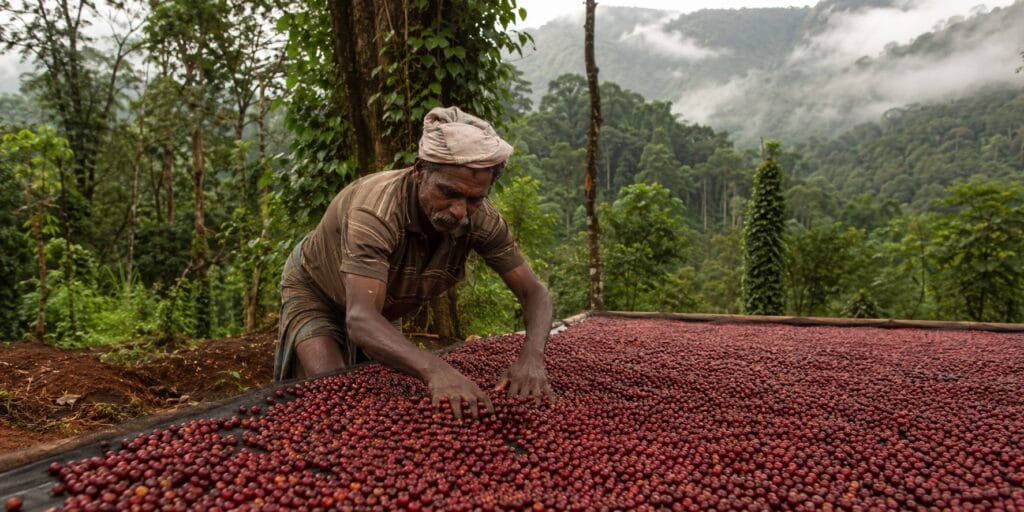
Adivasi coffee farming in Wayanad is organic by practice. Chemical inputs are expensive and often inaccessible for smallholders in forested areas. The farming systems that have survived across generations in these communities are low-intervention by necessity and by tradition. Coffee grown on Adivasi land in Wayanad is often processed as natural – cherry dried whole without pulping – because the labour and water requirements of washed processing are less practical at small-farm scale in remote forest areas.
The natural process Robusta produced by Adivasi smallholders in Wayanad is the least documented and least traded category within the origin. Most Wayanad Robusta that reaches the global market moves as washed parchment through large aggregators and commodity channels. The smallholder natural lots that Black Baza Coffee sources through Adivasi farming networks in Wayanad represent a completely different category of material from the same geography.
GI Tag and ODOP Recognition
In 2011, Wayanad Robusta Coffee received a Geographical Indication tag from the Government of India. GI status is a legal designation that recognises a product’s qualities as being attributable to its geographic origin and protects that attribution from misuse. For Wayanad Robusta, the GI tag formally recognises what the district’s growing conditions produce: a cup profile shaped by the Western Ghats highland climate, the forest canopy, the laterite soil, and the traditional cultivation practices of the farming community.
In July 2025, Wayanad Robusta received further national recognition as the first product from Kerala to receive a special mention under Category A – Agriculture in the Government of India’s One District One Product programme. ODOP is a national initiative to identify, brand, and promote a single representative product from each district. The recognition at the national level reflects both the quality and the economic significance of Wayanad Robusta for the district’s 60,000 coffee farmers, 95 percent of whom are small-scale cultivators.
For roasters building a provenance story, GI designation is a verifiable credential that is immediately meaningful to buyers who understand the system. It places Wayanad Robusta in the same category as Darjeeling Tea, Basmati Rice, and Coorg Arabica – products whose geographic identity is legally protected and internationally recognised.
The Specialty Gap Within a Commodity Origin
The challenge with Wayanad for specialty roasters is the same as with any large-volume origin: most of what comes out is not specialty. The 50,000 to 60,000 tonnes of Robusta produced annually in Wayanad moves primarily through commodity channels as washed parchment, graded by screen size and defect count, priced relative to the commodity market. This is the commercial reality of a district with 60,000 small-scale farmers and a well-established export infrastructure.
The specialty opportunity exists in a small sub-category: organic cultivation, natural processing, smallholder lots with documented producer identity, processed with care and sold at prices that reflect the labour and intention invested. This sub-category is not widely available. It requires sourcing relationships that reach into Adivasi farming communities rather than stopping at aggregation points. Black Baza has built those relationships in Wayanad specifically, working with Adivasi smallholder networks to produce natural process organic Robusta at a scale and quality level that the commodity channel does not serve.
The distinction matters for roasters because the cup is different. Natural process Wayanad Robusta from Adivasi smallholder farms at 900 metres, sun-dried and organic, is not the same product as washed parchment Robusta from a commercial estate in the same district. The processing method changes the cup character significantly. The organic cultivation changes the traceability story. The Adivasi community context changes the provenance narrative. These are not cosmetic differences. They are substantive differences in what the roaster is buying and what they can communicate to their customers.
What Wayanad Robusta Produces in the Cup
The documented cup profile for GI-tagged Wayanad Robusta is: soft to neutral base, full body, intense aroma, and subtle hints of chocolate, nuts, and spice. Superior crema-enhancing qualities are specifically cited by the Kerala Industries Department as a defining characteristic – Wayanad Robusta’s contribution to espresso blends is depth and lingering richness without flavour aggression.
This profile is shaped by three factors specific to Wayanad:
The altitude – 700 to 1,200 metres is higher than most global Robusta, producing denser beans and slower development that moderates the bitterness and caffeine-forward character of lower-altitude material.
The rainfall and shade canopy – 2,500mm of annual rainfall and consistent forest shade reduce the stress-driven compounds that make low-altitude, high-intensity Robusta aggressive in the cup. The beans develop in a humid, shaded environment rather than under direct solar exposure.
The farming practice – low-intervention, intercropped farming without heavy chemical inputs produces a cleaner base material than intensive commercial Robusta cultivation.
For natural process lots from Adivasi smallholder farms, the cup diverges further from the standard Wayanad Robusta profile. Sun-dried whole cherry produces additional sweetness and body. At 900 metres with good cherry selection and careful drying management, natural Wayanad Robusta produces dark chocolate, woody, and nutty notes with a heaviness that makes it particularly well-suited to espresso blends and South Indian or Vietnamese filter preparation where body and intensity are primary requirements.
Positioning Wayanad Robusta for Your Customer
Wayanad Robusta occupies a specific and useful position in a roaster’s India offering. It is not the complexity-forward, acidity-driven profile that high-altitude Arabica from the Nilgiris or Coorg provides. It is a robust, full-bodied, high-crema Robusta with a documented geographic identity, legal GI protection, and a producer community story that is substantive and verifiable.
For espresso blenders, it is a direct upgrade from anonymous commodity Robusta. Same functional contribution to the blend – body, crema, stability – with a named origin, a GI tag, and a producer story that justifies a price premium and differentiates the offering.
For single-origin Robusta programmes, natural process lots from Adivasi smallholder communities in Wayanad offer a cup that challenges the commodity Robusta reference frame. The combination of altitude, organic farming, and natural processing produces a result that most roasters have not encountered from this species.
The comparison to Vietnamese Robusta – which dominates global Robusta trade and provides the reference point most roasters work from – is instructive. Vietnamese Robusta is predominantly low-altitude, sun-grown, wet-hulled, and commodity-graded. Wayanad Robusta at its specialty tier is altitude-grown, shade-cultivated, organically farmed, and naturally processed. These are not the same product. The cup reflects that difference clearly.
For Roasters Evaluating Wayanad Robusta Green Coffee
When evaluating Wayanad Robusta lots, the following parameters most determine cup quality:
Processing method – washed parchment and natural process produce significantly different results. Specify which category you are evaluating before drawing conclusions about the origin.
Producer documentation – Adivasi smallholder lots should come with harvest date, community or farm name, and drying duration. Lots without producer documentation are likely commodity-channel material regardless of the Wayanad label.
Moisture content and water activity – natural process Robusta is more sensitive to moisture management than washed lots. Target 10.5 to 12 percent moisture and water activity below 0.65. Lots above these parameters carry elevated fermentation risk.
Altitude of the specific block – within Wayanad’s 700 to 2,100 metre range, elevation materially affects cup character. Lots from below 700 metres read differently from lots at 900 to 1,000 metres. Confirm elevation before cupping.
Organic certification or practice documentation – GI tag does not guarantee organic farming. Confirm whether the specific lot is from certified organic land or from farms operating without chemical inputs by practice.