Honey Process on Indian Robusta: What It Is and Why It Matters for Roasters
Honey processing is most commonly discussed in the context of Arabica. The method built its reputation on washed Arabica farms in Costa Rica and Panama, and entered the specialty vocabulary as a way to add sweetness and body to an already nuanced species.
When applied to Robusta, the logic is different. The species is different, the starting material is different, and the results require a different frame of reference than what most roasters bring to the table. In India, where Robusta is grown under conditions that are already unusual by global standards, honey processing produces results that deserve careful evaluation on their own terms.
This post is written for roasters and green coffee buyers who want to understand what honey processing actually does to Indian Robusta, how it differs from its effect on Arabica, and what to expect when sourcing, roasting, and evaluating these lots.
What Honey Processing Actually Involves
In honey processing, the outer skin of the coffee cherry is removed by a depulper within 24 hours of harvest. Unlike the washed process, the mucilage, the sticky, sugar-rich layer beneath the skin, is not fermented away or washed off. It stays on the parchment through the entire drying phase.
The amount of mucilage retained determines the intensity of the process. More mucilage left on means slower drying, more fermentation activity, and a more pronounced effect on the final cup. Less mucilage means a profile closer to washed. This is what gives rise to the yellow, red, and black honey classifications.
The fermentation that happens during drying is not controlled in the same way as a tank fermentation. It is driven by ambient microorganisms, temperature, humidity, and airflow. These variables are harder to standardise than wet fermentation, which is why honey processing demands more skilled labour and more active management throughout the drying phase.
For Indian Robusta, field research conducted by CSIR-CFTRI in Mysore on CxR Robusta cherry from Kodagu found that honey processing takes approximately 10 days to reach the target moisture content of 11 to 12 percent, compared to 8 days for the washed process on the same material. The extended drying time reflects the mucilage layer slowing moisture loss from the bean.
Yellow, Red, and Black Honey: What Each Level Means
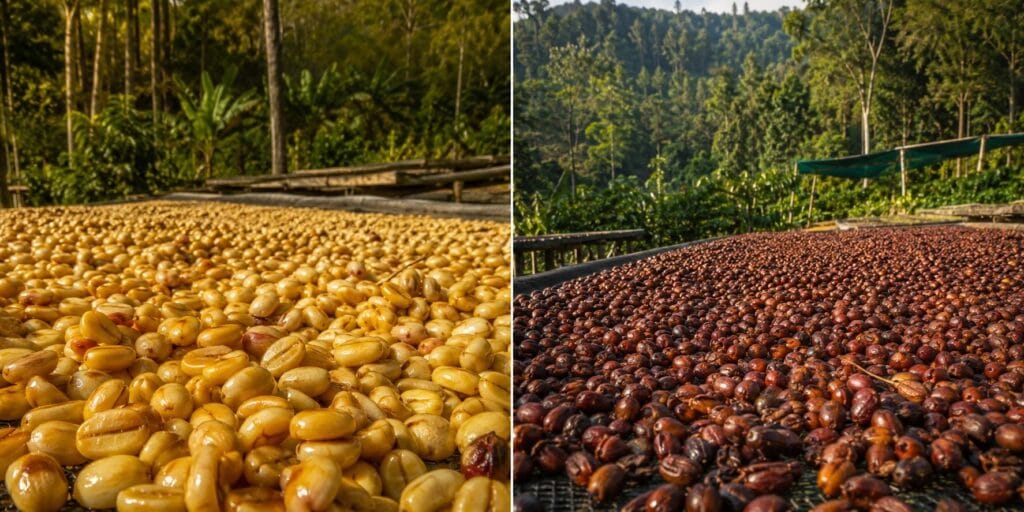
The honey classification system is based on how much mucilage is left on the bean during drying. The categories are not rigid industry standards. They are approximate points on a spectrum, and what one producer calls red another may call black. The names refer to the colour the drying parchment develops, which in turn reflects how much mucilage is present.
Yellow honey retains roughly 25 percent of the mucilage. Drying is faster, fermentation activity is lower, and the resulting cup is the closest to washed of the honey variants. Body increases compared to washed, and there is added sweetness, but acidity and clarity are largely preserved. For Robusta, yellow honey is the most controlled entry point into the process.
Red honey retains between 50 and 75 percent of the mucilage. Drying is slower, fermentation more active, and the cup result is noticeably different from washed. Brown sugar, dried fruit, and a fuller, more textured body are characteristic. For Robusta this is where the species character begins to be meaningfully altered by the process.
Black honey retains 75 to 100 percent of the mucilage, approaching the natural process in the amount of fruit contact during drying. Drying takes the longest, monitoring requirements are the highest, and the risk of defects is the greatest. The cup reward is the most dramatic departure from washed Robusta: rich, dense sweetness with dark fruit and molasses-adjacent notes. Black honey Robusta requires the most experienced producer and the freshest possible green beans once they arrive with the roaster.
Why Robusta Responds Differently Than Arabica
The standard framing of honey processing is built around Arabica. Most roasters’ mental model of the method is: take a washed Arabica, leave some mucilage on, get more sweetness and body. That framing does not translate cleanly to Robusta.
The key difference is the composition of Robusta cherry flesh. Robusta mucilage carries a higher brix measurement than Arabica mucilage, meaning more fermentable sugars are present at the start of the drying process. More available sugar means the fermentation activity during drying is more pronounced. The result is that honey processing produces a more detectable and more dramatic change in Robusta than it does in Arabica.
For Arabica, honey processing softens acidity and adds sweetness to an already complex flavour structure. For Robusta, honey processing does something structurally different. It does not add complexity to complexity. It changes the base character of the species. The harder, more aggressive edges that are typical of commercial washed Robusta are softened. The bitterness, which is structural in Robusta due to higher caffeine and chlorogenic acid content, is moderated. And in well-executed lots, notes of sweetness and mild fruitiness appear that are not present in washed lots from the same material.
The practical read for a roaster: washed Indian Robusta and honey processed Indian Robusta are not the same product used in the same way. They serve different purposes in the cup.
Indian Robusta as a Base Material
To understand what honey processing does to Indian Robusta, it helps to understand what makes Indian Robusta different from commodity-grade Robusta before any processing decision is made.
Indian Robusta is grown at altitudes that are high by global Robusta standards. Most Robusta globally is cultivated below 700 metres. In Kodagu (Coorg) and Wayanad, Robusta farms sit at 800 to 1,200 metres above sea level. In the BR Hills, some farms sit higher. At these elevations, temperatures are lower, bean development is slower, and the resulting raw material is denser and more structured than low-altitude Robusta.
Indian Robusta is also consistently shade-grown. The canopy cover that has characterised Indian coffee cultivation for more than a century, driven originally by the region’s native forest ecosystems, produces beans that are less exposed to direct heat stress during development. The cup character of shade-grown Indian Robusta is notably different from Vietnamese or African commodity Robusta grown in full sun at lower altitudes.
The primary commercial variety is CxR, a hybrid of Coffea canephora and Coffea congensis selected in India in the 1930s for its combination of yield, cup quality, and disease resistance. CxR is also a key variety in the Peridinia group used by specialty producers in Coorg. Selection 274, another Robusta variety common in Indian specialty contexts, shares similar characteristics.
What this means for honey processing: the floor is higher. Honey processing applied to low-quality Robusta cherry picked with poor selectivity and processed without careful management produces unstable, inconsistent results. Applied to well-selected CxR cherry from shade-grown Coorg farms at altitude, it has a strong and well-controlled base to work with.
The Coorg Context
Coorg, known formally as Kodagu, is India’s most concentrated specialty coffee region. Its combination of altitude, rainfall, and shade canopy has produced some of the most structured and traceable lots in Indian green coffee. Robusta is the dominant species in many parts of the district.
The climatic conditions in Coorg during the harvest period, roughly January to March for Robusta, include moderate temperatures in the range of 27 to 30 degrees Celsius during the day and cooler nights, with humidity levels of 65 to 75 percent. These conditions are relevant to honey processing because drying speed and fermentation activity are both influenced by ambient temperature and humidity. Coorg’s harvest-period climate supports controlled honey processing without the extreme temperature swings that can cause rapid over-fermentation in hotter growing regions.
The region’s Robusta estates have also been at the centre of post-harvest experimentation in India. Research conducted at CSIR-CFTRI specifically on Coorg CxR material has documented the microbial dynamics of Robusta honey fermentation. Lactic acid bacteria dominate the fermentation profile at around 48 percent of the microbial community, alongside the fungal species Wallemia, which has been identified as a selective marker of Robusta honey fermentation in this region. This microbial profile shapes the volatile compound development in the bean and contributes to the cup notes characteristic of Coorg honey Robusta.
What to Expect in the Cup
Roasters evaluating honey processed Indian Robusta for the first time benefit from approaching the cupping with different reference points than they use for washed Robusta or for honey processed Arabica.
From washed Indian Robusta, the characteristic cup profile is: clean structure, full body, chocolate and nut notes, low acidity, good crema performance, and stable season-to-season consistency. These qualities make it a trusted espresso blend component. A honey processed lot from the same material will share the structural body and low acidity. What changes is the flavour character layered on top of that structure.
At yellow honey level, the difference from washed is modest. Sweetness increases. The harder bitternotes of washed Robusta are softened slightly. Body may feel marginally more textured.
At red honey level, the difference is clear. Brown sugar, dried fruit, and a richer sweetness are typical. The bitterness that characterises standard Robusta is less prominent. The cup is noticeably more accessible to drinkers who would otherwise find washed Robusta too aggressive.
At black honey level, the departure from washed is the most dramatic. Dark fruit, molasses, and a dense, almost wine-adjacent sweetness. These lots are more complex and more variable. They reward careful evaluation.
One important note for cupping: honey processed Robusta should not be evaluated against Arabica honey benchmarks. The acidity-softening effect that honey processing has on Arabica is not the primary mechanism here. The relevant question when cupping these lots is not whether they have become Arabica-like. It is whether the processing has successfully modulated the Robusta character in a way that expands the species’ usability.
Roasting Considerations
Honey processed Indian Robusta responds differently to heat than washed lots from the same material. The key difference is in the Maillard phase. Mucilage-derived sugars alter how the bean develops colour and flavour during the critical middle phase of the roast. The sweetness available for development is greater than in washed lots, and the bean responds to heat with more sensitivity during yellowing to first crack.
A few practical points for roasters approaching these lots for the first time:
The Maillard window is where the character of honey processed coffee is built or lost. Extending this phase slightly produces more caramel and sugar sweetness. Rushing through it, or carrying too much heat momentum into first crack, produces baked or muddled results that lose the distinctive character of the process.
For black honey lots in particular, roast as soon after green arrival as possible. Black honey processed coffee has greater potential for freshness loss than yellow or washed lots due to the residual organic material from the mucilage. The sweet character that justifies the method is most pronounced in fresh green and diminishes with extended storage.
Allow honey processed Robusta to rest 10 to 14 days post-roast before cupping for green buying decisions. The sugars developed during roasting continue to evolve in the first two weeks. Cupping too early can understate the cup quality of these lots.
Do not apply the same roast profile as washed Robusta. The two are not interchangeable from a profiling perspective. Start with a profile you would use for a honey processed Arabica of similar density and adjust from there.
Sourcing and Quality Indicators
When buying honey processed Indian Robusta as green coffee, the quality indicators differ somewhat from those for washed lots.
Moisture content should be in the 10.5 to 12 percent range. Honey processed Robusta that has been under-dried carries elevated risk of mould development and unstable fermentation character in the cup. Over-drying tightens the bean and can produce a woody or papery quality.
Screen size and defect count remain relevant but are not the primary quality signal for specialty honey lots. The more important information is the processing documentation: drying duration, turning frequency, humidity monitoring during drying, and lot separation. Producers who can provide this documentation are the ones running the process with intentionality rather than as a catch-all for cherries that missed the washed line.
Ask for the harvest date and the drying completion date. These two data points tell you the drying duration. A lot that dried in five days was either yellow honey under optimal conditions or a lot that was pushed through too fast. A lot that dried in 15 days either had very high mucilage retention or encountered moisture management issues. The 8 to 12 day range is where controlled, well-managed honey Robusta from Coorg typically lands.
Water activity reading, if available, gives you the most accurate picture of internal moisture stability. A reading above 0.65 warrants caution regardless of moisture percentage.
Why It Matters Now
For most of the history of Indian coffee in the global trade, Robusta has moved as a commodity: graded by size, evaluated by defect count, priced by the C market. Specialty buyers used it in blends for body and crema, but rarely sought it for its own cup identity.
Honey processing applied to high-quality Indian Robusta from well-managed estates at altitude represents one of the clearest pathways to changing that positioning. It does not make Robusta into Arabica. It does not chase the flavour profiles that have defined specialty coffee for the past two decades. It develops the species on its own terms, using a process that is well-suited to its biological composition and that produces results that are genuinely distinct from anything else on a roaster’s sourcing menu.
The material is there. The knowledge is developing. The roasters who engage with it now, when availability is still limited and the conversation is still early, are the ones who will have established sourcing relationships and developed roasting competence when the broader market catches up.