Araku Valley Green Coffee: India’s Most Celebrated Tribal Origin
Araku Valley is the Indian coffee origin that broke through to the global stage first. While Coorg and Chikmagalur built their reputations through commodity volume and domestic specialty development, Araku arrived on the international scene with a Paris café, SCA scores above 90, a Rockefeller Foundation prize, a GI tag, and a story of 10,000 tribal farmers transforming from subsistence poverty to coffee entrepreneurs. By any measure, it is the most internationally documented Indian specialty coffee origin.
For specialty roasters, this creates an interesting situation. Araku’s story is well told. Its scores are verified. Its tribal community credentials are real and audited. But almost all of that story reaches the global market through one channel: the ARAKU brand, which sells roasted consumer coffee directly in Paris, Bangalore, and online. The green coffee trade has largely missed this origin. No major North American importer currently lists Araku Valley green coffee as a named lot in their catalogue. The origin’s reputation has been built by a brand, and the green coffee opportunity that reputation creates remains almost entirely open.
The Geography
Araku Valley sits in the Eastern Ghats of Andhra Pradesh, in the Alluri Sitharama Raju district near Visakhapatnam. The Eastern Ghats run parallel to India’s eastern coastline, a discontinuous range of hills and plateaux stretching from Odisha through Andhra Pradesh into Tamil Nadu. Unlike the Western Ghats, which form a continuous escarpment that intercepts the southwest monsoon, the Eastern Ghats are fragmented by river valleys and receive a different rainfall distribution. Araku gets its moisture primarily from the northeast monsoon, which brings rainfall from October to December, supplemented by summer rains that arrive ahead of the southwest monsoon.
The valley sits at approximately 910 metres above sea level at its floor, with surrounding hills rising to 1,300 metres. Coffee is grown across this elevation range, with the highest-altitude plots in the 1,100 to 1,300 metre zone producing the Grand Reserve and Haute Altitude tier lots that score above 90 on SCA evaluation.
The soil in Araku is iron-rich and mineral-dense, described consistently across scientific and agronomic documentation as dark rocky laterite. The mineral composition of the soil directly influences the cup character, contributing the intensity and body that distinguish Araku Arabica from higher-altitude but lighter-soil Western Ghats lots. The combination of iron-rich soil, bimodal rainfall, and elevation produces a coffee with pronounced body alongside the fruity and floral aromatics that altitude-driven slow development provides.
Coffee History in Araku: From Colonial Planting to Cooperative Revival
Coffee arrived in the Araku Valley around 1898, introduced during the colonial period as part of broader agricultural development in the tribal hill areas of Andhra Pradesh. The Adivasi communities who inhabited the valley were drawn into coffee cultivation but retained limited control over the crop’s value chain. After independence, the Andhra Pradesh government formalised coffee cultivation through the Girijan Cooperative Corporation, established in 1956 in partnership with the Coffee Board of India, to engage tribal farmers in organised production.
Through the following decades, coffee continued in the valley but without systematic quality development. By the 1990s, the tribal farming communities of Araku were among the poorest in Andhra Pradesh, with high infant mortality, low female school attendance, and limited economic autonomy. Coffee existed but had become a neglected crop.
The turning point came in 1999 when the Naandi Foundation, a social enterprise focused on rural development, arrived in the valley with a different question: what would it take for these communities to generate their own sustainable income? The answer the foundation found, after studying the agricultural potential of the landscape, was the same coffee trees that had been present for a century. The revival began with one million new trees planted across 40 pilot villages, agronomic training delivered by field experts every fortnight, and a systematic mapping of each plot’s soil, shade, altitude, and sun exposure.
By 2011, the programme had expanded to 6 million trees planted and 25,000 farmers mobilised. A cooperative was formed to eliminate the middlemen who had captured most of the value from tribal farmers since colonial times. In 2015, the cooperative launched its own brand rather than continuing to sell green beans to external roasters. In January 2017, an Araku café opened in Paris. In 2018, Araku coffee won a Gold Medal at the Prix Epicures OR in Paris for best coffee pod. In 2020, the Arakunomics model won the Rockefeller Foundation Food System Vision 2050 Prize.
Today, more than 150,000 tribal families farm coffee across 2.5 lakh acres in the Eastern Ghats under the GCC programme, producing over 100 tonnes of Arabica annually under the ARAKU brand and its associated cooperatives.
The Terroir Mapping System
Araku holds a distinction unique in Indian coffee and rare in global specialty coffee: it is the world’s first terroir-mapped coffee origin.
The terroir mapping project was inspired by Burgundy’s appellation system for wine, where specific plots are classified by measurable environmental characteristics rather than by arbitrary geographic boundaries. Naandi Foundation agronomists and soil scientists measured each plot in the valley against 11 criteria: sunshine, forest shade, nature of the soil, exposure, altitude, water retention, slope, microclimate, biodiversity index, tree species composition, and cup evaluation. The analysis identified six distinct terroir zones across the valley, each with a different combination of growing conditions that produces a measurably different cup.
The six terroirs gave rise to six product lines from the ARAKU brand, each roasted differently to reveal the specific characteristics of its environmental origin:
Signature sits in the mid-elevation village plots of the core valley, washed process, SCA scores above 86. Chocolate, green pepper, and vegetal notes. The most accessible entry point to Araku’s character.
Selection comes from carefully chosen plots with dark rocky soil, washed process. Dark chocolate, caramel, and sugarcane. Full-bodied, designed for espresso and moka pot.
Micro Climate comes from plots in Baankubedda village on a river island in the valley, natural process, SCA scores above 87. Candied red fruit, generous body. The most process-forward expression.
Grande Réserve comes from the highest-quality plots in terms of biodiversity, soil richness, and altitude. The grand cru tier, scored above 90. Complex and slowly matured, intense aromatic profile.
Haute Altitude from the highest elevation blocks, 1,100 to 1,300 metres. Bright, structured, clean.
Première Récolte from the first cherries of each season, 50% natural and 50% washed, light roast. Fresh and intense, suited to Chemex and V60.
For specialty roasters evaluating Araku as a green coffee origin, this terroir classification provides a level of documentation that most Indian origins cannot match. The six-terroir system means that when a roaster sources Araku green coffee, they can specify which terroir zone and which environmental profile they are working with, a level of specificity comparable to Burgundy premier and grand cru designations.
The Adivasi Farming Community
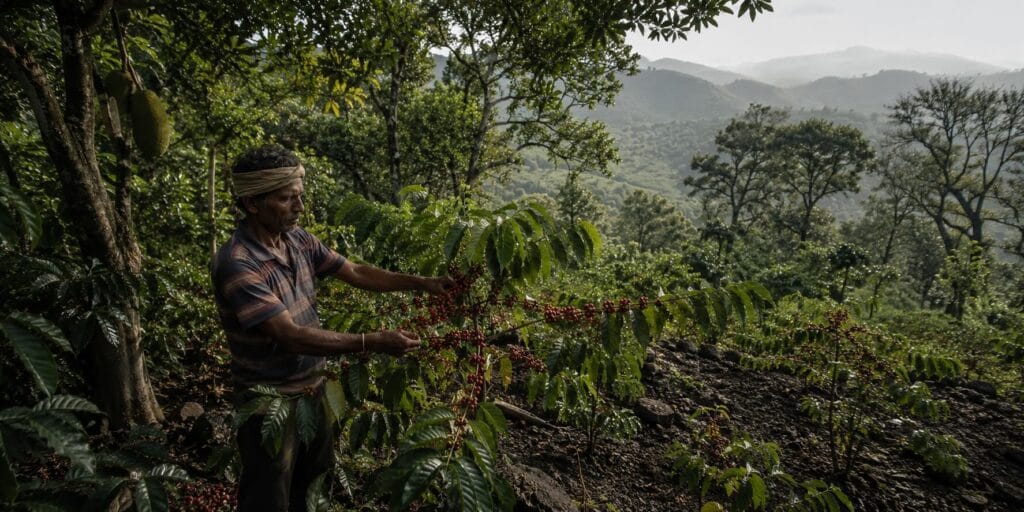
The Adivasi communities of Araku Valley, primarily from the Kondh, Bagata, Valmiki, and Koya tribal groups, have inhabited these hills for centuries. Their traditional land management practices, including multi-species agroforestry, seasonal burning management, and oral ecological knowledge of the forest ecosystem, created the conditions that now underpin the quality of Araku coffee.
Each farmer in the cooperative owns and manages their own micro-plot, typically under one hectare. The ownership structure was established deliberately to prevent the consolidation of land under corporate or cooperative control and to ensure that each farmer retains autonomous economic status. The cooperative aggregates and processes the coffee but the underlying land and trees belong to the individual farming families.
Regenerative agriculture is the farming framework. Compost rich in bio-inoculants replaces synthetic fertilisers. Water management systems have reduced per-hectare water consumption by a factor of 36 over 10 years. Thirty million trees have been planted across the valley over two decades, restoring forest cover that had been depleted. The system is certified organic and fair trade, with prices paid to farmers consistently above world market levels.
The social transformation is documented. Since 1999, infant mortality in the valley has fallen, female school attendance has risen, and the income of tribal farming families has increased measurably. The Naandi Foundation model, built around coffee as the economic engine of community development rather than as an extractive crop, has been cited as a replicable template by the Rockefeller Foundation and FAO.
The GI Tag and Its Significance
Araku coffee holds a Geographical Indication tag, applied for at the Chennai GI Registry in 2016 by the Girijan Cooperative Corporation. The GI designation recognises the specific combination of Eastern Ghats geography, Adivasi farming practice, organic cultivation, and the distinct cup character of Araku Valley coffee as a protected product identity.
For roasters sourcing Indian green coffee with sustainability credentials, the GI tag provides a legal framework for the origin claim that goes beyond self-reported certification. It places Araku coffee in the same category of legally protected geographic products as Darjeeling Tea, Coorg Arabica, and Wayanad Robusta within the Indian system, and connects it to the broader global framework of GI-protected agricultural products.
The Cup
Araku Arabica produces a cup character defined by four consistent elements across its six terroir tiers: pronounced body from the iron-rich mineral soil, natural sweetness from high-altitude slow cherry development, fruit-forward aromatics from the shade-grown agroforestry system, and brightness from elevation-driven acidity.
The base cup across the valley reads as chocolate, caramel, and moderate citrus. On top of this base, the six terroir zones produce variation: the mid-valley Signature lots are chocolate and vegetal, the natural process Micro Climat lots are candied red fruit, the grand cru plots produce the highest aromatic complexity with berry, caramel, and vanilla documented across multiple roaster evaluations.
SCA cupping scores for Araku range from 85 on standard lots to above 90 on micro-lot and grand cru material. Scores above 90 represent genuine exceptional quality by global specialty standards, and Araku’s consistent achievement of this level across multiple seasons is among the most thoroughly documented quality claims in Indian specialty coffee.
Roasters evaluating Araku for the first time should cup at light to medium roast. The fruit and floral character that distinguishes this origin from Western Ghats Arabica is most accessible at lighter roast levels. The natural process lots in particular benefit from extended rest post-roast, allowing the fermentation-derived sweetness to fully develop.
The Green Coffee Trade Gap
Araku’s international reputation was built through consumer brand channels rather than the green coffee trade. The ARAKU brand made a deliberate decision in 2015 to sell roasted coffee directly rather than continuing to supply green beans to international roasters. This decision built brand recognition in France and India but left the green coffee market for this origin essentially unaddressed.
No North American importer currently lists Araku Valley green coffee as a named, traceable lot. No Australian or Japanese importer has published sourcing documentation for Araku. European access exists primarily through the ARAKU brand’s own wholesale offering rather than through independent green coffee importers.
For a roaster who wants to serve Araku Valley coffee, the current options are limited to buying roasted beans from the ARAKU brand or navigating the GCC cooperative directly. A green coffee importer with a direct sourcing relationship to Araku Valley opens access that currently does not exist in the North American market.
The origin has the scores, the story, the certification, the GI tag, and the international recognition. What it needs in North America is the trade infrastructure. That gap is the opportunity.
India Coffee Company is developing sourcing relationships in Araku Valley as part of its broader India green coffee programme. To register interest in Araku Valley lots, use the wholesale enquiry form.