Yercaud and the Shevaroy Hills: India’s Oldest Coffee Belt and Its Global Trade Gap
In 1922, William H. Ukers published “All About Coffee,” the most comprehensive reference work on coffee written in the 20th century. In it, he identified the Shevaroy Hills as a source of some of the finest coffee in India. A century later, no major specialty green coffee importer in North America, Europe, or Australia lists Yercaud or the Shevaroys as a named origin in their current catalogue.
That gap between documented quality and global trade presence defines Yercaud’s position in the Indian coffee landscape. The hills have grown coffee since 1820, cover 22,000 acres of active cultivation, and are home to estate families whose coffee operations span five and six generations. A GI tag is in process. Blue Tokai, India’s largest specialty roaster, sources from estates here. Moganad Estate’s CxR Robusta won India’s Best Robusta Coffee award in 2016. Navin Rajes of Hill Tiller, whose family has farmed these hills for over a century, describes the shift: “In 2014, nobody asked for Indian coffee at international fairs. Today, they ask for Shevaroy Hills by name.”
The domestic specialty market has discovered Yercaud. The global green coffee trade has not.
The Geography: Eastern Ghats, Bauxite Soil, and Microclimates Within Four Kilometres
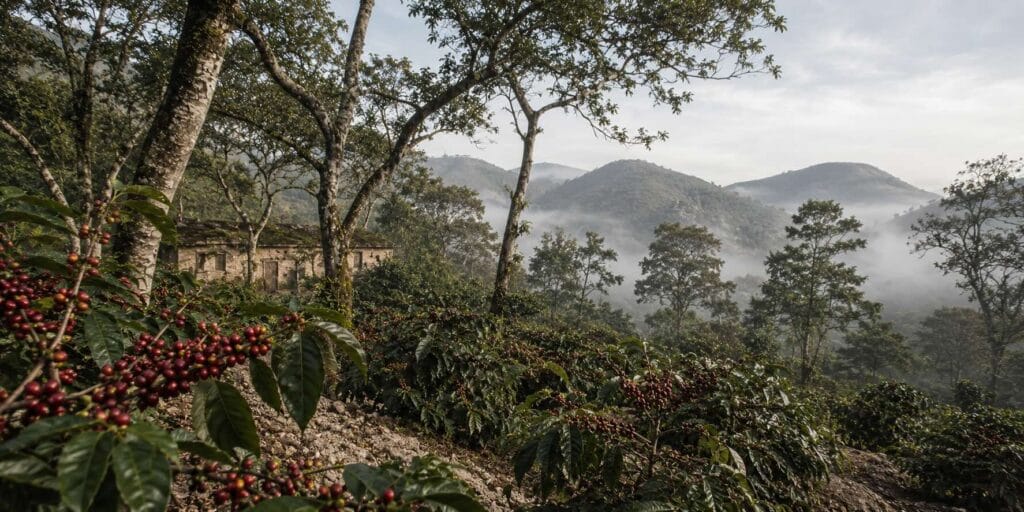
Yercaud sits in the Shevaroy Hills, a compact massif rising abruptly from the plains of Salem district in central Tamil Nadu. The name derives from the Tamil words yeri, meaning lake, and kaadu, meaning forest. It translates literally as Lake Forest, a reference to the lake at the centre of the hill station and the dense forest cover that has characterised this landscape for centuries.
The Shevaroy Hills are part of the Eastern Ghats, the discontinuous chain of hills running parallel to India’s eastern coastline. At 15 million years old, the Eastern Ghats are among the most ancient geological formations in South Asia. Their age is directly relevant to the coffee grown here: 15 million years of weathering has scattered soils every few kilometres, producing a mosaic of soil types, slopes, and microclimate conditions within a compact geographic area that is unusual even by Indian specialty coffee standards.
Coffee in the Shevaroys is concentrated between 1,000 and 1,500 metres above sea level. The highest point in the range is Shervarayan Temple at 1,623 metres. The highest coffee estates, including Orchardale at 1,430 to 1,520 metres, sit among the upper range. Lower estate blocks begin at around 1,000 metres.
The soil is bauxite. This is the most significant geological distinction between Yercaud and every Karnataka and Kerala coffee origin on indiacoffee.co. Coorg, Chikmagalur, Wayanad, and the Nilgiris all grow coffee in laterite soil, the iron-rich red soil characteristic of the Western Ghats. Yercaud’s bauxite is a different mineral composition entirely: aluminium-rich, with a sharp, mineral-driven flavour influence on the cup that experienced tasters describe as a distinctive brightness and intensity absent from the rounder laterite-grown profiles of Karnataka.
Rainfall in the Shevaroys is moderate by Western Ghats standards, generally 1,500 to 1,800 millimetres annually, distributed bimodally across two monsoon seasons. The northeast monsoon brings the primary rainfall from October to December. Blossom showers in March drive uniform flowering across the range, a climatic advantage that produces more consistent cherry development across estates than origins dependent on a single monsoon event.
The microclimate variation is remarkable. Within four kilometres on the same estate, three distinct climatic zones can exist. Navin Rajes of Hill Tiller Coffee Roasters describes walking between zones in shorts and a polo shirt while his cousin a few kilometres away wore a jacket and beanie with frost on his face. These microclimates shape the flavour of Selection 9 coffee from each zone measurably. Yercaud’s terroir diversity within a compact geography is one of its defining quality characteristics.
Two Hundred Years of Coffee History
Coffee arrived in Yercaud in 1820, introduced by David Cockburn, the Scottish collector of Salem district, on what was then called Grange Estate. Cockburn is known locally as the Father of Yercaud for his role in introducing coffee, fruit trees, and agricultural development to the hills. The plantation economy he established attracted other British planters through the 19th century, and the Shevaroys developed as one of the earliest European plantation belts in South India outside the Mysore territory.
The colonial plantation infrastructure, bungalows, processing sheds, road networks through the hills, and the shade canopy of silver oak and native trees that was established during this period, remains visible today. Tipperary Estate’s century-old colonial bungalow is described as carrying the legacy of that era. The estates themselves have absorbed this history into their physical fabric, with old-growth shade trees and processing structures that predate Indian independence.
The transition from colonial plantation to family-owned Indian estate shaped the Shevaroys in a way that distinguishes it from Karnataka’s coffee districts. MSP Senthikumar Nadar, the great-great-grandfather of Navin Rajes, was among the first Indian planters to enter the Yercaud coffee economy in the early 1900s. Educated and trusted by the British administration, he began trading in coffee, cardamom, and spices before acquiring estates across Tamil Nadu, Kerala, and Karnataka. His grandson MSP Rajes established Hill Tiller Coffee Roasters, which held the position of India’s leading coffee exporter for over three decades.
The Rajes family’s estates in the Shevaroys, operating under the MSP Coffee banner, represent five generations of continuous coffee farming in these hills. Their holdings include Moganad Estate in the northern Shevaroys at 1,100 to 1,400 metres, Bison Valley Estate at 1,220 to 1,370 metres, Stanmore Estate at 1,220 to 1,310 metres, Gowri Estate at 1,310 to 1,430 metres, Gowri Woodlands at 1,310 to 1,430 metres, and Orchardale Estate at 1,430 to 1,520 metres, the highest coffee plantation in the Shevaroys.
The Bauxite Soil Advantage
Bauxite soil is the defining geological characteristic of Yercaud’s cup profile and the most important differentiator for roasters evaluating this origin against Karnataka alternatives.
Bauxite is an aluminium-rich sedimentary rock formed by intense weathering of aluminium silicate minerals over geological timescales. Yercaud’s 15-million-year-old Eastern Ghats geology has produced bauxite deposits that underlie the coffee-growing slopes throughout the range. The soil is nutrient-dense, with high mineral content that translates directly into the flavour complexity of the coffee cherry.
Cauvery Peak Estate at 1,450 metres describes the effect precisely: the rich bauxite soil produces a sharp flavour profile for discerning coffee enthusiasts. Perennial water sources within the bauxite-rich slopes maintain soil moisture through the dry season, supporting even cherry development without irrigation.
The flavour signal of bauxite soil in the cup is a mineral-driven brightness and structural sharpness that distinguishes Shevaroys Arabica from the rounder, chocolate-forward profiles typical of laterite-grown Karnataka Arabica. Roasters who have evaluated both origins side by side consistently describe Yercaud coffee as having more defined acidity and a cleaner, more precise finish than the smoother Karnataka baseline. This is a terroir characteristic, a function of the soil and geology, that cannot be replicated by processing choices or variety selection.
Varieties and Processing
Arabica dominates the Shevaroys, with S795, Cauvery, and Chandragiri as the leading varieties across the majority of estates. On higher-elevation blocks above 1,300 metres, Selection 9 and the S5 series (S5A and S5B) are planted for their altitude-appropriate cup character and disease resistance. Catimor appears on estates where rust pressure is significant. Robusta is grown on the lower margins of the range, where elevation drops below 1,000 metres, with CxR as the dominant variety.
The variety that deserves specific attention for specialty roasters is Selection 9. On Nachammai Estate at 1,400 metres, Blue Tokai sources a washed Selection 9 that represents the clean, structured expression of this variety at the upper end of the Shevaroys’ elevation range. The Ethiopian genetic heritage of Selection 9 produces a brightness and aromatic complexity in the cup that the estate’s bauxite soil amplifies into a profile distinct from Selection 9 grown in Karnataka laterite.
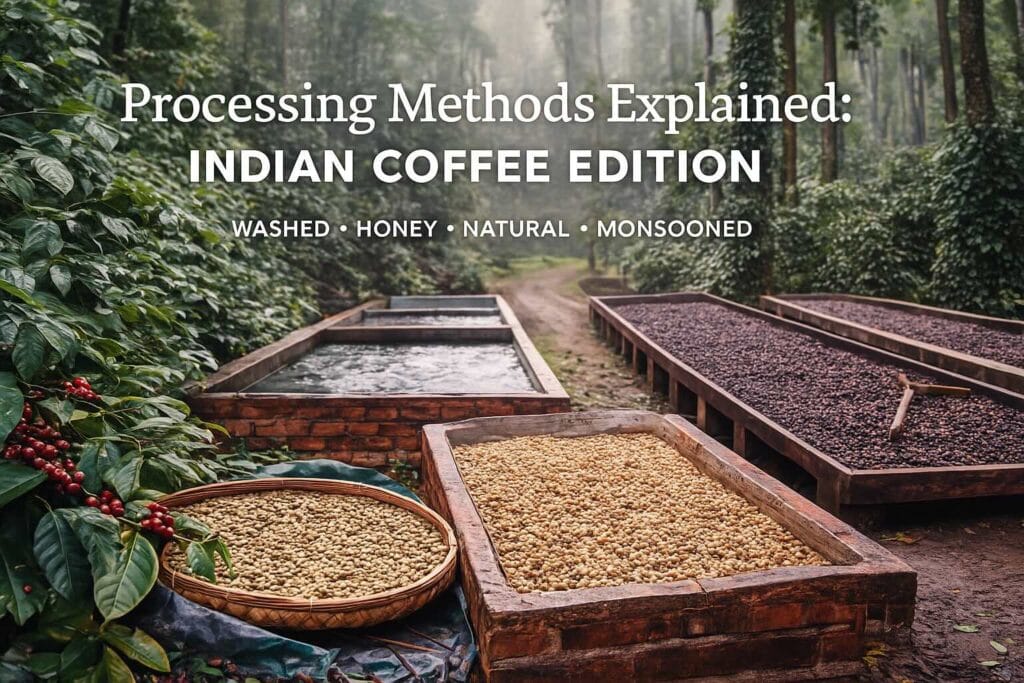
Processing across the Shevaroys is predominantly natural, with washed Arabica on the larger and more specialty-oriented estates. The natural process tradition in this origin reflects the dry season conditions and the availability of sun-drying infrastructure on estates that have operated continuously for over a century. Washed lots from estates with controlled processing facilities produce the cleaner, brighter profiles that light-roast specialty roasters seek from this origin.
The most significant recent development in Shevaroys processing is the specialty focus introduced by the MSP Coffee estates under Navin Rajes. The estate-zoned approach, where each block is mapped for soil, slope, varietal, and microclimate before processing decisions are made, produces lots with a level of terroir specificity that goes beyond typical Indian estate practice. This zone-mapping approach mirrors what Araku Valley did with its six-terroir classification and points toward a Shevaroys specialty future built around micro-lot specificity rather than district-level blends.
The Award and the Recognition
Moganad Estate’s CxR Robusta won India’s Best Robusta Coffee award in 2016. The award was judged on cup quality, consistency, and processing precision, confirming that the Shevaroys can produce award-level Robusta from its lower-elevation blocks alongside the Arabica that defines the range’s specialty identity.
Blue Tokai Coffee Roasters sources Nachammai Estate at 1,400 metres as a named, traceable lot in their catalogue, confirming that the origin’s quality at the estate level meets the standard of India’s most demanding domestic specialty roaster.
William H. Ukers’ 1922 endorsement in “All About Coffee” remains the most authoritative historical quality statement for this origin. A century of continuous cultivation since that endorsement, on the same hills, with the same bauxite soil and bimodal rainfall, has maintained and in many cases improved the quality of what Ukers described.
The GI Tag in Progress
Yercaud coffee’s GI tag application is in process, according to Navin Rajes, who describes it as a missing chapter in India’s coffee identity that recognition will finally supply. The 22,000 acres under cultivation and the 150-plus years of documented continuous production form the basis for the geographic indication claim.
When the GI tag is confirmed, Yercaud will join Coorg Arabica, Chikmagalur Arabica, Wayanad Robusta, and Araku Valley Coffee as GI-protected Indian coffee origins. For roasters building a provenance story around Indian green coffee, a GI-tagged Yercaud lot carries the same legally recognised geographic protection as those established origins.
The Cup
Yercaud Arabica at specialty grade produces a cup defined by the interplay of bauxite mineral structure, bimodal rainfall-driven cherry development, and altitude-driven acidity. The profile reads as bright, clean, and mineral-forward at the base, with fruit and floral notes built on top depending on the variety and processing method.
Washed S795 from the 1,200 to 1,400 metre range produces the most accessible expression: clean acidity, caramel sweetness, a structured body, and the mineral sharpness that distinguishes Shevaroys coffee from Karnataka washed lots. Cauvery Peak Estate’s description of a sharp flavour profile at over 1,450 metres from bauxite soil is the most precise available sourcing note for this tier.
Selection 9 from higher-altitude blocks produces additional brightness and aromatic complexity. Blue Tokai’s Nachammai Estate washed Selection 9 at 1,400 metres confirms the variety’s performance at the upper end of the range.
Natural process lots across the Shevaroys tend toward heavier body and dried fruit sweetness layered on the mineral base. The natural process tradition here reflects the estate infrastructure and dry-season conditions rather than experimental processing intent, which means natural Yercaud lots read more classically than the fermentation-forward naturals common in Karnataka’s experimental tier.
For roasting guidance, Yercaud Arabica responds well at light to medium roast. The mineral brightness that defines the origin is most accessible at lighter roast levels. Darker roasts absorb the mineral character into caramelisation and the cup reads more generically. Roasters evaluating Yercaud for the first time should cup at 85 to 88 degrees Celsius at light to medium-light roast before drawing conclusions.
For Roasters Evaluating Yercaud Green Coffee
The most useful parameters when assessing Yercaud lots:
Elevation of the specific block matters more in the Shevaroys than in most Indian origins because the microclimate variation within four kilometres is so pronounced. A 1,000 metre Moganad Robusta block reads completely differently from a 1,520 metre Orchardale Arabica block. Always confirm elevation before cupping.
Soil documentation is increasingly available from estate-focused producers. A lot with confirmed bauxite soil documentation from a named block provides more useful sourcing information than a district-level lot without soil data.
Processing documentation from the Shevaroys is available from the specialty-oriented estates. Nachammai, Cauvery Peak, Orchardale, and the MSP Coffee estates all operate their own processing facilities with documentation capacity.
Harvest timing in the Shevaroys runs November to January for Arabica, with the bimodal rainfall producing a more compressed and uniform harvest window than origins with a single monsoon. Fresh crop from this origin arrives in major consuming markets between March and May.
India Coffee Company works with Indian coffee origins across the Western and Eastern Ghats. To enquire about Indian green coffee availability including Yercaud and Shevaroys lots, use the wholesale enquiry form.