Most roasters working with Robusta are working with Coffea canephora. It is the species behind commodity Robusta from Vietnam, Uganda, and Cote d’Ivoire, bred for yield, disease resistance, and consistency at scale rather than cup character. When specialty roasters reach for Robusta, they are typically looking for body and crema contribution in an espresso blend rather than flavor in its own right. The assumption, broadly, is that Robusta is a supporting ingredient rather than a lead one.
CxR Robusta challenges that assumption. It is a variety developed in India with genetics that sit outside the standard canephora lineage, grown at altitudes and under farming conditions that commodity Robusta regions do not replicate, and processed by estates with a deliberate focus on cup quality rather than volume. For roasters exploring Indian green coffee, CxR is one of the most important varieties to understand.
The Genetics Behind CxR
CxR stands for Canephora x Robusta, a cross between Coffea canephora and Coffea congensis. To understand why that matters, it helps to understand what congensis brings to the cross.
Coffea congensis is a wild species native to the Congo Basin in Central Africa. It is genetically distinct from the canephora parent that standard commodity Robusta descends from, and it carries characteristics that canephora alone does not — notably, a naturally lower bitterness and a cup profile that responds more expressively to altitude and post-harvest processing than standard Robusta typically does.
The cross was developed in India to produce a variety suited to Indian growing conditions, particularly the mid-altitude agroforestry systems of the Western Ghats, while introducing the cup-quality potential that congensis genetics carry. The result is a plant that grows well between 700 and 1,000 MASL, under canopy, intercropped with other species, and produces a bean that behaves differently at the cupping table than commodity canephora from lower-altitude monoculture farming.
The reduced chlorogenic acid load that congensis genetics contribute is a key part of this. Chlorogenic acids are responsible for much of the bitterness and astringency associated with commodity Robusta. CxR carries less of them, which means that with careful processing and appropriate roasting, the variety produces a cup that is cleaner, rounder, and more nuanced than the standard Robusta profile most roasters are familiar with.
Where CxR Grows in India
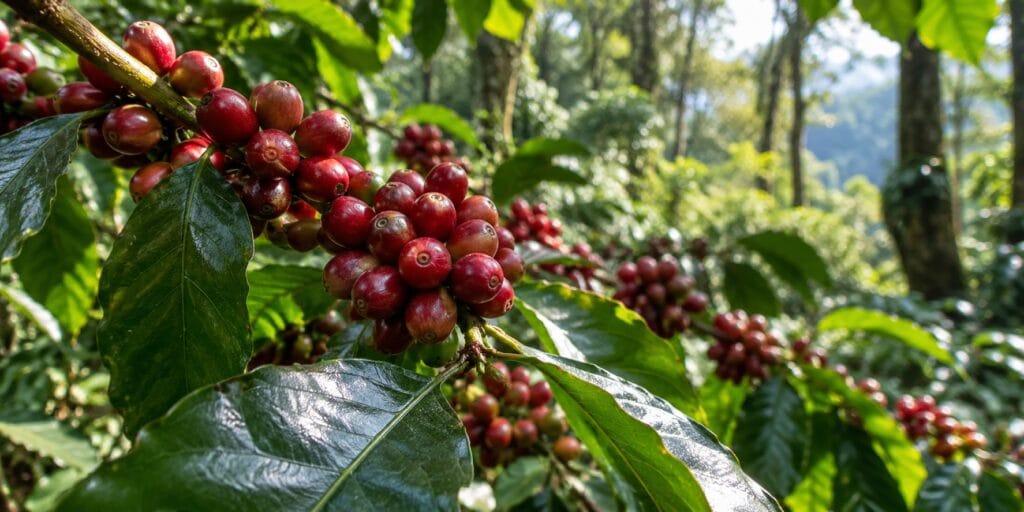
CxR is cultivated primarily in Kodagu (Coorg), Karnataka, in the Western Ghats of South India. This growing region sits at considerably higher elevations than most global Robusta-producing areas. Where commodity Robusta is typically grown between 200 and 600 MASL, CxR in Kodagu (Coorg) grows between 700 and 1,000 MASL, under agroforestry canopy systems that intercrop coffee with pepper, cardamom, areca nut, vanilla vines, and native forest trees.
That elevation difference matters in the cup. Cooler temperatures at altitude slow cherry development, extending the time available for sugars and aromatic compounds to build inside the bean. The result is a denser bean with more structural complexity than lower-altitude Robusta produces, even before processing begins.
The agroforestry system matters too. Coffee grown under a multi-tier canopy experiences moderated temperature swings, higher humidity, and a continuous supply of organic matter from leaf litter and intercropped species. These conditions support soil health and contribute to the complexity that distinguishes estate-grown CxR from commodity Robusta grown in cleared, open-sun monoculture.
How Processing Shapes CxR’s Cup Character
The congensis genetics give CxR a higher ceiling for cup quality than standard canephora, but processing is what determines whether that ceiling is reached. Two estates in Kodagu (Coorg) demonstrate how differently the same variety can express depending on the post-harvest approach applied.
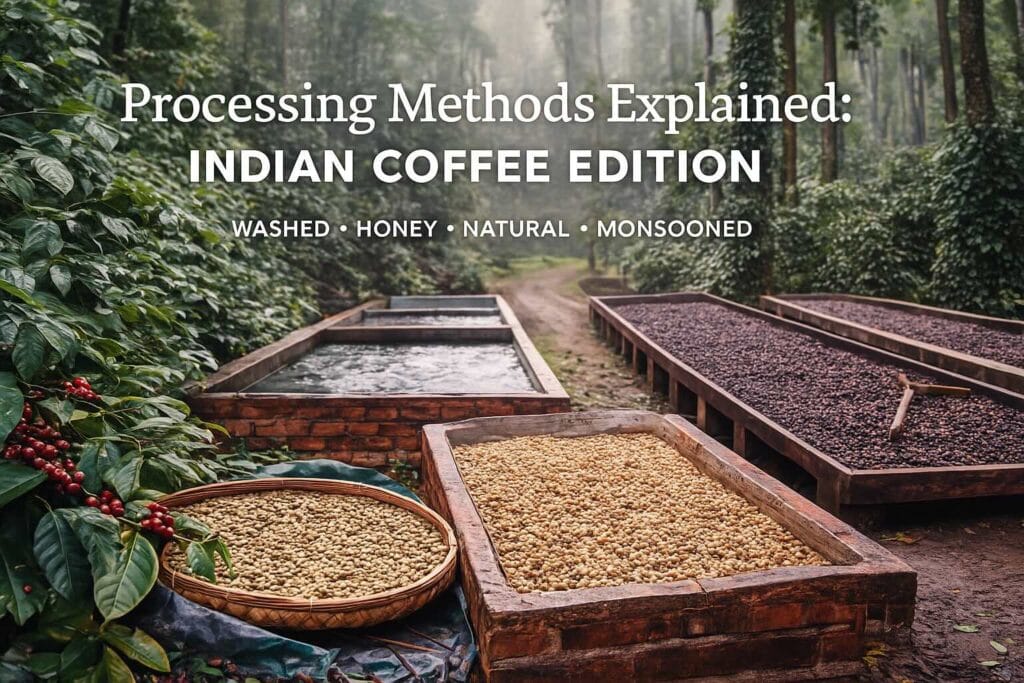
At Sandalkad Estate, CxR is processed through extended fermentation and slow drying on raised beds, a method the estate’s six-generation farming family has developed and refined specifically for this variety. Cherries are washed and fermented longer than standard commercial Robusta processing calls for, breaking down the tougher mucilage that Robusta carries and giving the beans time to develop sweetness and aromatic complexity rather than the harshness that fast processing preserves. After fermentation, the beans dry slowly on raised beds under shade rather than in direct sun, a deliberate choice that preserves aromatic compounds that fast drying would drive off.
The cup that results from this approach carries dark chocolate, warm spice, vanilla, black pepper, and cedar notes, with a full body and a long, clean finish. It is a Fine Cup India Top 5 award winner, a recognition that reflects the quality achievable when CxR genetics, altitude-grown density, and careful post-harvest processing come together at an estate with the capacity to execute the method consistently.
At Pambukal Estate, the same variety is processed as a washed AA lot, producing a distinctly different cup. Washed processing removes the mucilage before drying, producing a cleaner, more structured cup with cola, black pepper, walnut, and cedar notes. The AA grading confirms this lot comes from the estate’s largest, most uniform beans, supporting consistent roast development across a batch. Where the Sandalkad fermented lot rewards medium to medium-dark roasting with chocolate depth and spice, the Pambukal washed lot performs across medium to medium-dark with a savory, structured profile suited to both espresso and filter brewing.
These two lots illustrate a core principle in working with CxR: the variety is responsive. Unlike commodity Robusta, where processing is rarely designed to elevate cup character, CxR grown at altitude and processed deliberately produces results that vary meaningfully depending on the post-harvest choices made.
CxR and Espresso Blending
For roasters building espresso programs, CxR offers something genuinely useful. Standard commodity Robusta contributes body and crema but often brings bitterness, woodiness, and a generic harshness that requires careful management in a blend. CxR, particularly the fermented and washed lots from Kodagu (Coorg), contributes the same structural benefits, full body, dense crema, high caffeine, while bringing a cup character that adds to a blend rather than simply propping it up.
At a 15 to 25 percent inclusion alongside a light to medium roast Arabica, the Sandalkad fermented CxR lot delivers body, crema, and a spice-forward depth that integrates into the blend rather than dominating it. The Pambukal washed AA lot performs similarly, with a cleaner, more cola-driven contribution that works particularly well with fruit-forward Arabica components.
For roasters wanting to move beyond commodity Robusta in their espresso programs, CxR from Kodagu (Coorg) is the most direct path available in Indian green coffee.
Why CxR Matters for the Specialty Coffee Market
Specialty Robusta is a small but growing category. Roasters and cafes are increasingly looking beyond commodity Robusta for varieties that contribute meaningfully to a blend or stand alone as single-origin lots. CxR, processed carefully and grown at altitude in Kodagu (Coorg), delivers on both counts.
For roasters exploring Indian green coffee specifically, CxR is one of the most compelling entry points. It reflects India’s distinctive coffee genetics, grown in conditions that commodity Robusta farming does not replicate, processed by multi-generational estates with a clear focus on quality, and available in two distinct expressions that demonstrate just how wide the variety’s range can be.
India Coffee Company sources CxR Robusta directly from Sandalkad Estate and Pambukal Estate in Kodagu (Coorg), Karnataka.