Western Ghats Coffee Origins: What Connects Every Indian Specialty Lot
Every significant Indian specialty coffee origin sits within or immediately adjacent to the Western Ghats. Coorg, Chikmagalur, BR Hills, Wayanad, the Nilgiris, the Palani Hills – these names appear separately in sourcing catalogues and on roaster bags, but they share a common ecological foundation. Understanding that foundation is the most useful frame a roaster can have for evaluating Indian green coffee.
This post is not a region-by-region origin guide – those exist for each individual origin on this blog. This is about the mountain range itself: what it is, what it produces, and why the Western Ghats matters as a concept for specialty coffee sourcing in a way that goes beyond any single estate or district.
What the Western Ghats Actually Is
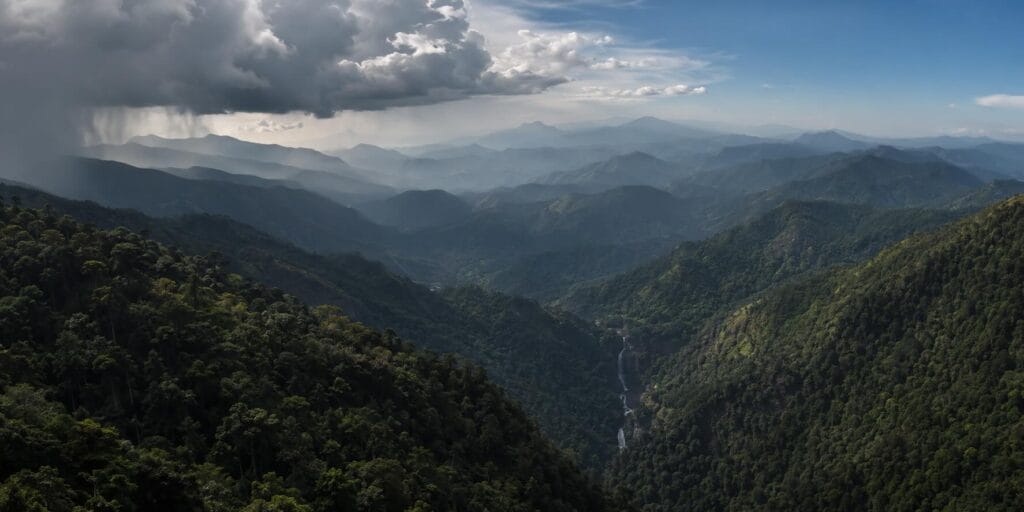
The Western Ghats, known locally as the Sahyadri or Benevolent Mountains, is a mountain range running approximately 1,600 kilometres parallel to India’s western coastline. It begins in Gujarat in the north, passes through Maharashtra and Goa, becomes progressively greener and more biodiverse through Karnataka, and reaches its most dramatic ecological form in Kerala and Tamil Nadu before terminating near the southern tip of the peninsula.
The elevation gradient across the range spans from 40 metres at the base to 2,625 metres at the highest peaks. The widest section of the range is in Karnataka – the state that produces 71% of India’s coffee. The highest peaks in Tamil Nadu, including Doddabetta in the Nilgiris at 2,637 metres and Vandaravu in the Palani Hills at 2,533 metres, create the altitude conditions that produce India’s most acidity-forward Arabica.
In 2012, the Western Ghats was inscribed as a UNESCO World Heritage Site. The designation covers 39 separate protected properties across Kerala, Karnataka, Tamil Nadu, and Goa – national parks, wildlife sanctuaries, and reserve forests that together protect the most ecologically significant portions of the range. The broader Western Ghats is classified as one of eight global biodiversity hotspots, a designation that applies to regions with exceptionally high concentrations of endemic species under significant threat.
The significance of this for coffee: every shade-grown, agroforestry-based coffee estate in India’s main producing regions exists within or adjacent to this UNESCO and globally-recognised biodiversity landscape. This is not marketing language retrofitted to a commodity crop. It is the geographic and ecological reality of where Indian coffee grows.
The Monsoon and What It Does to Coffee
The Western Ghats is the ecological engine of South India’s water cycle. The southwest monsoon, arriving from the Arabian Sea between June and September, hits the western face of the range and rises rapidly, cooling and condensing into the heaviest rainfall in the Indian subcontinent. The windward western slopes of the Ghats receive 2,500 to 5,000 millimetres of annual rainfall in the most exposed zones. The leeward eastern side sits in a rain shadow, receiving significantly less.
Coffee in the Western Ghats grows on the western slopes and the inter-mountain plateaux – the zones that receive the monsoon rainfall directly. Kodagu receives 1,800 to 2,500 millimetres annually, concentrated between June and September. Wayanad receives 2,500 millimetres. The Nilgiris receives rainfall from both the southwest and northeast monsoons, giving it a more balanced annual distribution than purely southwest-monsoon-dependent regions.
The monsoon cycle directly determines the rhythm of coffee cultivation in the Western Ghats:
June to September: Southwest monsoon drives vegetative growth. Coffee plants put on new leaves and lateral shoots. This is the period of highest rainfall and lowest farm activity in terms of harvesting.
October to November: Post-monsoon drying. The northeast monsoon may bring additional rainfall to Tamil Nadu origins. Cherry development accelerates as rainfall eases and temperatures moderate.
November to March: The cool, dry harvest season. Temperatures drop, rainfall is minimal, and cherries ripen for picking. This is the critical quality window – the cool dry months slow cherry maturation and allow sugar and flavour compounds to concentrate before picking.
March to May: The hot, dry pre-monsoon period. Estates complete harvesting and processing. The land prepares for the monsoon’s return.
This three-season cycle – monsoon, cool dry winter, hot dry summer – is fundamentally different from the year-round tropical climates of equatorial Robusta-growing regions. The pronounced seasonality of the Western Ghats is one of the primary reasons Indian coffee develops differently in the cup from Vietnamese or Central African Robusta at equivalent altitudes.
The Agroforestry System: What Research Actually Shows
India is frequently described as the only major coffee origin where almost all coffee is grown under shade. This claim is substantially accurate – and it is grounded in the Western Ghats farming system that has been in place for over 150 years.
Coffee in the Western Ghats grows under a multi-layered canopy that typically includes:
- Upper canopy: Rosewood (Dalbergia latifolia), silver oak (Grevillea robusta), jackfruit (Artocarpus heterophyllus), and native forest trees at 15 to 25 metres
- Mid canopy: Pepper vines (Piper nigrum) climbing the upper canopy trees, banana plants, and cardamom
- Under canopy: Coffee trees at 2 to 4 metres, growing in dappled light
Research published in peer-reviewed literature has documented the ecological performance of this system. A study by ScienceDirect on native coffee agroforestry systems in the Western Ghats found that native agroforestry farms and adjacent natural forests displayed comparable carbon stocks – 228 MgC per hectare in agroforests versus 234 MgC per hectare in native forest – and comparable tree diversity, with 44 species per plot in agroforestry versus 45 in native forest. In practical terms: a well-managed traditional Western Ghats coffee estate supports nearly the same level of above-ground carbon storage and tree diversity as native forest.
A separate study on Kodagu found that 81% of the district is under tree cover, and coffee agroforestry covers approximately 30% of the total district area. The implication is that Kodagu’s coffee farms are not a replacement for the forest – they are part of the forest ecosystem, providing habitat continuity across the landscape.
Research on bird species in Western Ghats coffee agroforests has documented that shade-grown Arabica farms support habitat specialist bird species at levels comparable to native forest. This includes species that require closed-canopy forest environments and cannot survive in open or monoculture agricultural land.
For roasters communicating sustainability and provenance to their customers, this research provides specific, verifiable claims that go beyond generic “shade-grown” language. The carbon performance, tree diversity, and bird habitat value of Western Ghats coffee agroforestry is documented in peer-reviewed scientific literature, not in producer marketing materials.
The Biodiversity Context
The Western Ghats hosts approximately 5,000 flowering plant species, with hundreds endemic to the range. The mammalian fauna includes tigers, leopards, Indian elephants, gaur, sloth bears, dholes, lion-tailed macaques, Nilgiri tahrs, and grizzled giant squirrels. Over 508 bird species have been recorded in the range, including 19 species endemic to the Western Ghats and Sri Lanka biodiversity hotspot.
Every coffee origin in the Western Ghats sits within this ecological context. The specific wildlife that appears in each origin’s story reflects the local biodiversity of that sub-region:
- Coorg: elephants, leopards, and gaur move through coffee estates in the Brahmagiri Hills and Pushpagiri corridor
- BR Hills: tigers, elephants, lion-tailed macaques at the junction of Western and Eastern Ghats
- Wayanad: Adivasi farming communities within the Nilgiri Biosphere Reserve, one of the largest protected elephant corridors in Asia
- Nilgiris: Nilgiri Tahr, tigers, lion-tailed macaques in the montane grassland and Shola forest ecosystem
- Palani Hills: Indian Gaur, Nilgiri Tahr, leopards in active wildlife corridors where coffee farms operate without fencing
This biodiversity is not incidental to the coffee. It is a consequence of the farming system. Where shade canopy is maintained, chemical inputs are minimised, and farm boundaries remain unfenced, wildlife movement continues through the agricultural landscape. The coffee farms that produce the most traceable and interesting specialty lots in the Western Ghats are, almost without exception, the farms that have preserved the ecological conditions that support this biodiversity.
The Geological Foundation
The Western Ghats is one of the oldest geological formations on Earth. The rocks that form the range are primarily ancient crystalline basement material – gneisses, charnockites, and granites – estimated at 600 million to 3 billion years old. These are not the volcanic soils of East Africa or the nutrient-rich red volcanic soils of Central America. They are old, heavily weathered rocks that have been producing the laterite soils characteristic of the Western Ghats for millions of years.
Laterite soil – the deep red-orange iron-rich soil visible on every roadscut and trail through a Western Ghats coffee district – is the weathering product of these ancient rocks under tropical conditions. It is relatively low in nutrients compared to volcanic soils but drains well, retains moisture in the deeper layers, and produces the mineral base that contributes to Western Ghats coffee’s characteristic earthiness and body.
The age and composition of the geological substrate is one reason why Western Ghats coffee has a recognisable regional character across different origins. The same laterite soil profile, derived from the same ancient crystalline geology, underlies farms in Coorg, Chikmagalur, Wayanad, and the Nilgiris. The soil is not the only determinant of cup character, but it is a consistent element that connects origins which differ in altitude, rainfall, and variety.
How the Western Ghats Connects the Origins
For a roaster building an India programme, the Western Ghats frame provides a way to connect the individual origin stories into a coherent regional identity. Each origin has its own distinct character:
- Coorg is India’s most productive coffee district, Robusta-dominant by volume, Arabica-dominant in the specialty catalog, with the most processing experimentation of any Karnataka region
- BR Hills is the junction of the Western and Eastern Ghats, growing Selection 9 Arabica at 1,400 metres under the most wildlife-rich forest canopy in the sourcing network
- Wayanad is the GI-tagged Robusta heartland of Kerala, home to Adivasi farming communities and the most significant natural-process Robusta lots in the specialty tier
- Nilgiris is India’s highest-altitude Arabica origin, growing Chandragiri at 1,800 metres in a UNESCO biosphere, almost entirely unknown in global specialty trade
- Palani Hills is Tamil Nadu’s emerging Arabica origin, with unfenced farming in active wildlife corridors and a cup profile distinct from Karnataka Arabica
These five origins are separated by hundreds of kilometres and differ in elevation, rainfall, variety, community, and cup character. What they share is the mountain range, the monsoon, the laterite soil, the shade-grown agroforestry system, and the biodiversity that that system supports.
When a roaster tells a customer that their Indian coffee comes from the Western Ghats, they are telling a true and meaningful story. The mountain range is not a vague geographic claim – it is a specific, documented, UNESCO-recognised landscape with a distinct ecology, a distinct farming tradition, and a distinct coffee character that no other origin on Earth replicates.
What This Means for Sourcing
The Western Ghats frame has practical implications for how roasters approach Indian green coffee:
Altitude varies significantly within the range. A Western Ghats Arabica at 800 metres reads differently from one at 1,500 metres. The range is not a single altitude zone – it spans 2,500 metres of elevation gradient. Always confirm the specific elevation of the lot you are sourcing.
The monsoon is the quality clock. Fresh crop Indian coffee from the Western Ghats arrives in consuming markets between March and June. This is when the coffee from the most recent harvest is at peak flavour. Planning sourcing around this window ensures you are working with green coffee that has not been held at origin through the next monsoon season.
Shade-grown is structural, not certified. Most Western Ghats coffee is shade-grown as a function of the farming system, not because of a certification programme. The canopy exists because it has always existed and because it supports the pepper, cardamom, and fruit crops that make the farming system economically viable. A roaster does not need a Bird-Friendly or Rainforest Alliance certification to confirm that a Western Ghats estate is shade-grown – the farming system is shade-grown by default.
Traceability within the range is uneven. At one end, you have estates like Sandalkad and Riverside with named lots, documented processing, and direct sourcing relationships. At the other end, commodity grades sourced at the aggregator level blend cherry from dozens of farms without documentation. The Western Ghats produces both categories from the same geography. Origin within the range does not determine quality tier – sourcing relationship and processing documentation do.
India Coffee Company sources green coffee from multiple Western Ghats origins including Coorg, BR Hills, Wayanad, the Nilgiris, and the Palani Hills. To enquire about current lots and availability, use the wholesale enquiry form.