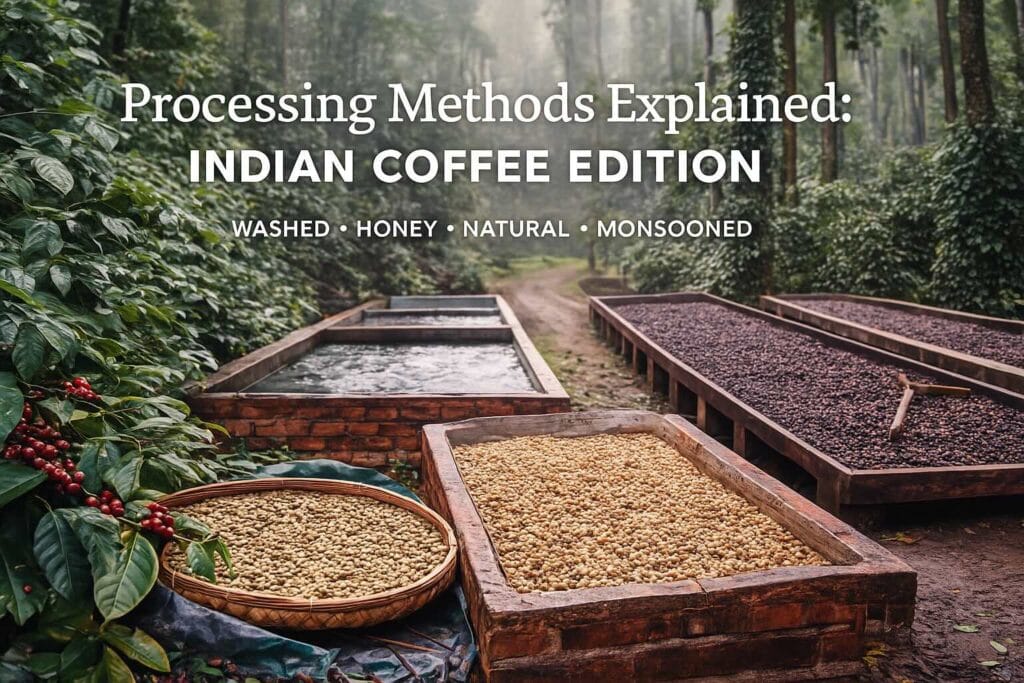
Post-harvest processing in coffee has expanded significantly over the past two decades. Where washed and natural processing once covered the vast majority of what specialty roasters encountered, the category now includes extended fermentation, anaerobic processing, carbonic maceration, and a growing range of producer-developed experimental methods that sit outside standard industry classifications.
Herb fermented natural processing is one of those methods. It was developed at Sandalkad Estate in Kodagu (Coorg), Karnataka, by the Bota family and the Siddiqua family of the Navayath community, whose six-generation farming history on this land gave them both the knowledge base and the long-term perspective to experiment with something no other Coorg estate of comparable scale had attempted.
Understanding what herb fermented processing is, how it works, and what it produces in the cup requires starting with what makes it distinct from both standard natural processing and the fermentation methods the specialty industry has become more familiar with in recent years.
What Standard Natural Processing Does
In a standard natural process, whole coffee cherries are dried in the sun with the fruit intact. The cherry’s skin, pulp, and mucilage remain on the parchment throughout the drying period, which typically runs from several days to several weeks depending on climate and drying infrastructure.
During this drying period, the sugars and aromatic compounds in the fruit transfer into the bean through the parchment layer. The result is a cup that carries fruit-forward sweetness, heavier body, and a fermented complexity that washed processing does not produce. The tradeoff is consistency: natural processing is more difficult to control than washed, and the risk of over-fermentation, mould, or uneven drying is higher.
Standard natural processing at its best produces cups with intense fruit character, dense sweetness, and a complexity that can be extraordinary. At its worst, it produces cups with harsh fermented notes, off-flavours from uneven drying, and a fermented character that reads as defective rather than complex.
The herb fermented natural method at Sandalkad Estate builds on the natural process foundation while introducing a specific additional variable: herbs sourced directly from the estate’s own land.
What Herb Fermented Natural Processing Adds
At Sandalkad Estate, the Arabica coffee grown on the higher, cooler blocks between 1,100 and 1,300 MASL is intercropped with pepper and cardamom alongside native forest species. The estate also grows a range of herbs on the same land, cultivated not as a commercial crop but as part of the estate’s integrated farming system.
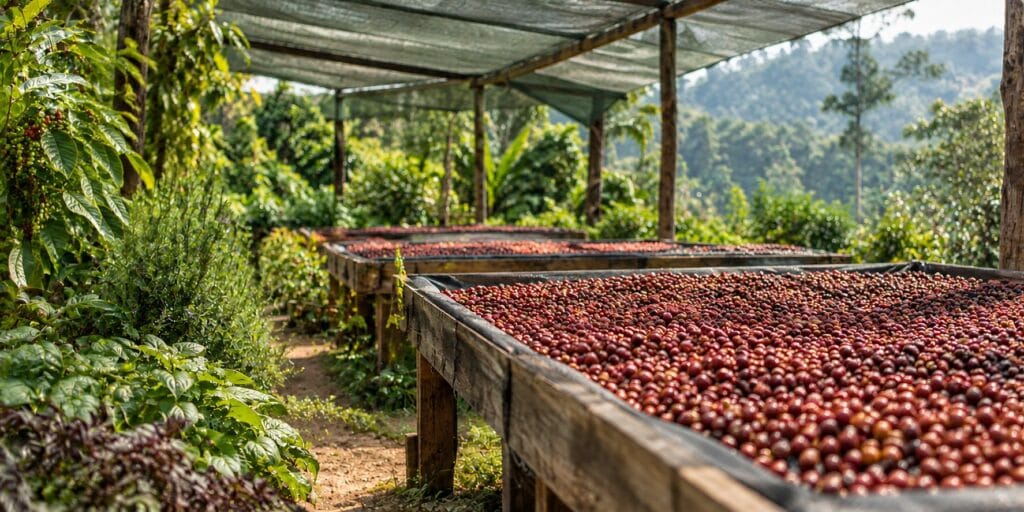
The herb fermented natural process involves introducing these estate-grown herbs into the fermentation environment alongside the coffee cherry. The cherries are handpicked at peak ripeness, then placed into a controlled fermentation environment where the herbs are added directly. The fermentation window is carefully managed, allowing the herb compounds to transfer into the cherry and through to the bean during the fermentation period, before the cherries move to drying on raised beds under shade rather than direct sun.
Several things make this method distinct from standard fermentation approaches:
- The herbs are sourced from the same land as the coffee, creating a direct relationship between the farm’s botanical environment and the cup character the fermentation produces
- The fermentation environment is controlled rather than open-air, giving the estate management over temperature, duration, and the microbial activity the fermentation supports
- Shade drying after fermentation preserves the aromatic compounds built during fermentation, rather than driving them off through the heat of direct sun drying
- The entire process is proprietary to Sandalkad Estate, developed through years of experimentation by the farming families who work this land
The result is a cup profile that sits in a category of its own within Indian Arabica. The tasting notes that come through from this lot, Cardamom, Coconut, Passion Fruit, Lavender, Orange, and Cinnamon, reflect both the variety’s natural character at altitude and the specific aromatic contribution of the herb fermentation method. These are not generic natural process fruit notes. They are flavors that trace directly back to the estate’s land, its farming practices, and the specific herbs introduced during fermentation.
Why Sandalkad Estate Developed This Method
The question of why an estate develops a proprietary processing method is worth examining carefully, because the answer shapes how roasters should think about this lot and what it represents in the broader context of Indian specialty coffee.
Sandalkad Estate is a six-generation farming operation. The Bota family and the Siddiqua family of the Navayath community have farmed this land for more than 170 years, developing a deep familiarity with its microclimates, its soil, its seasonal rhythms, and the species that grow across it. That accumulated knowledge is the foundation on which the herb fermented method was built.
The decision to experiment with herb fermentation came from a specific observation: the estate’s higher blocks, where Arabica grows between 1,100 and 1,300 MASL intercropped with pepper and cardamom, produce cherry with a density and aromatic potential that standard processing methods were not fully capturing. Washed processing produces a clean cup from this material, but clean is not the same as expressive. The farming families wanted a method that would allow the full aromatic complexity of what this land grows to come through in the cup.
Herb fermentation was the answer they developed. By introducing the estate’s own herbs into the fermentation environment, they created a processing method that does not exist elsewhere in Indian coffee, tied specifically to what this farm grows and how it farms. The experimental lot status of this coffee reflects that: it is produced in limited volume, season by season, as the farming families continue to refine the method and evaluate the results.
What This Means for Roasters
For roasters evaluating this lot, the herb fermented natural method raises a practical question: how does a processing method this specific translate into roasting and brewing decisions?
The answer starts with roast level. This lot performs across a range from light to medium, with each roast level expressing a different facet of the fermentation’s complexity.
At light roast, the fermentation’s aromatic contribution is most fully expressed. Coconut, orange, and lavender lead the cup, with the herb character prominent and the acidity intact. This is the profile best suited to pour-over and filter brewing, where the full aromatic range can develop without the concentration of espresso or the blunting effect of immersion methods.
At medium roast, the profile shifts toward cinnamon and cardamom spice, with the coconut and citrus notes fading into a rounder, warmer background. This is a different but equally valid expression of the same lot, suited to roasters wanting a more familiar cup structure while still carrying the fermentation’s spice-forward character.
The lot cups at 86.5, placing it firmly in specialty grade territory and giving buyers a quality benchmark alongside the flavor story. It is classified as an experimental lot, produced in limited volume, which means availability is seasonal and allocations are finite.
Sourcing Herb Fermented Natural Coffee from Sandalkad Estate
India Coffee Company sources this coffee directly from Sandalkad Estate in Kodagu (Coorg), Karnataka, making this proprietary lot available to North American specialty roasters through the current Season One green coffee sourcing program.
This is a direct trade relationship with full farm-to-cup traceability back to the Bota family and the Siddiqua family of the Navayath community at Sandalkad Estate. Request a cupping sample to evaluate this lot and discuss allocation availability for your roasting program.