When specialty roasters think about heritage coffee varieties, the conversation usually centers on Arabica. Gesha, Typica, Bourbon, and their descendants carry the weight of the specialty world’s origin storytelling. Robusta, by contrast, is typically treated as a commodity input, a species defined by yield, caffeine, and crema contribution rather than varietal character or lineage.
Old Peridinia Robusta sits outside that framing entirely. It is one of the oldest documented Robusta lineages still cultivated in India, with roots that predate the modern commercial Robusta selections most of the world’s coffee industry has moved toward. For roasters building an understanding of Indian green coffee, it is a variety worth knowing in detail.
Where Old Peridinia Robusta Comes From
The Peridinia lineage traces its introduction to India to the period of the Coffee Leaf Rust outbreak of the late 19th century. Coffee Leaf Rust, caused by the fungal pathogen Hemileia vastatrix, devastated Arabica plantations across South Asia during this period, forcing growers and colonial administrators to look for alternatives that could survive where Arabica could not.
Peridinia was among the varieties introduced from Sri Lanka’s Royal Botanical Gardens at Peradeniya during this period. The Peradeniya gardens had been accumulating plant material from across the botanical world for decades, and Peridinia was brought to India as part of a broader effort to establish Robusta varieties that could survive the conditions Arabica could not.
What distinguished Peridinia from the other Robusta introductions of this period was its cup character. Where most Robusta varieties selected during and after the Coffee Leaf Rust era were chosen primarily for hardiness and yield, Peridinia carried genetic material that produced a cleaner, more nuanced cup than standard canephora selections. That quality potential, combined with its adaptability to Indian growing conditions, is why it has survived in cultivation in Kodagu (Coorg) while many of the other introductions of that era have been replaced by higher-yielding modern selections.
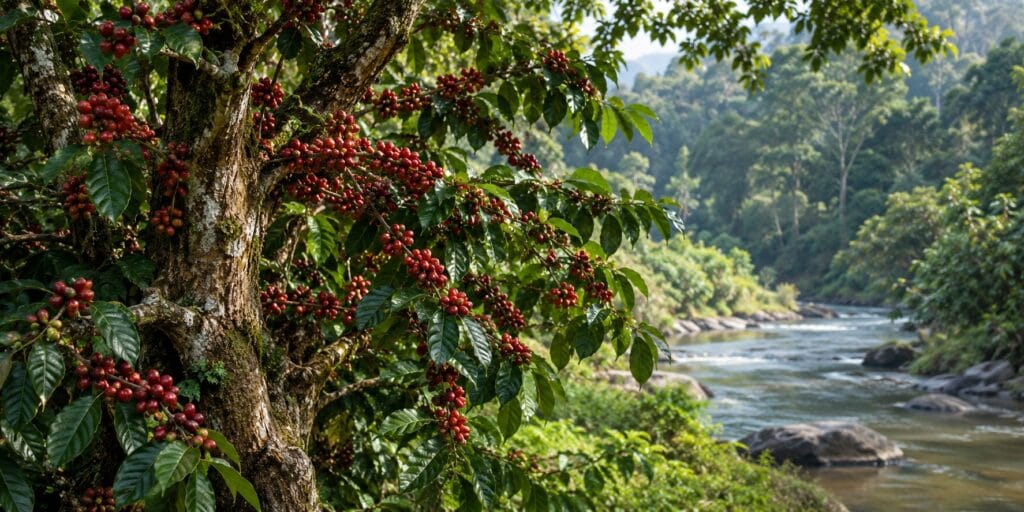
The “Old” in Old Peridinia refers to the age of the trees themselves. These are not recently planted stock. In estates like Riverside Estate in Kodagu (Coorg), Old Peridinia trees planted generations ago are still producing fruit, their root systems established deep in the soil over decades, their canopy integrated into the estate’s agroforestry structure in ways that newly planted trees cannot replicate.
How Old Peridinia Differs from Modern Robusta
To understand what Old Peridinia offers, it helps to compare it directly with the Robusta most roasters are familiar with.
Standard commodity Robusta, primarily Coffea canephora grown in Vietnam, Uganda, Indonesia, and Cote d’Ivoire, is selected and cultivated for:
- High yield per hectare
- Disease resistance across a range of pathogens
- Consistency at scale across large plantation systems
- Suitability for fast, mechanical processing and commodity-grade handling
Cup character in this selection context is a secondary consideration. The result is a species profile that delivers high body, high caffeine, and high crema contribution, alongside high bitterness, pronounced woodiness, and a robustness that can overwhelm a blend if not carefully managed.
Old Peridinia Robusta was not selected under these pressures. Its lineage predates the industrial scaling of Robusta cultivation, and the trees cultivated in Kodagu (Coorg) today have been shaped by decades of low-intervention, agroforestry farming rather than plantation management optimized for volume.
The differences in the cup reflect this:
- Lower bitterness than standard canephora selections at equivalent roast levels
- More nuanced aromatic development, particularly at medium roast
- A body and structure that holds up in both espresso and filter contexts
- Responsiveness to post-harvest processing in ways commodity Robusta rarely demonstrates
That last point is particularly important. Commodity Robusta is rarely processed with the same care applied to specialty Arabica because the variety’s cup ceiling, under standard growing and processing conditions, does not reward that investment. Old Peridinia, grown at altitude under agroforestry canopy and processed carefully, does.
Old Peridinia at Riverside Estate
Riverside Estate in Kodagu (Coorg) is one of the clearest demonstrations of what Old Peridinia Robusta can produce when grown and processed with genuine attention to quality.
The estate sits on the banks of the River Cauvery, farmed by the same family for five generations since 1898. Old Peridinia trees planted generations ago remain part of the estate’s Robusta plantings today, their age and root depth contributing to a bean density and structural complexity that younger, higher-yielding trees planted more recently do not match.
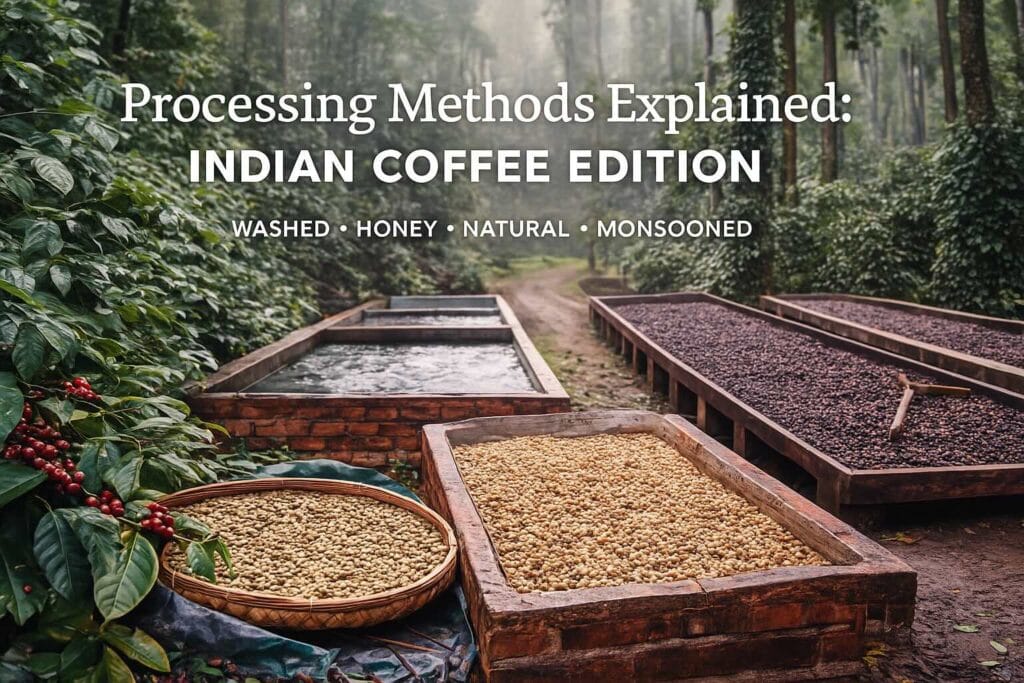
The processing method applied to this lot is Anaerobic Red Honey, a choice that reflects a deliberate effort to build on the raw material Old Peridinia provides rather than simply handling it as a commodity input. Red Honey processing retains a significant portion of the cherry’s mucilage on the parchment during drying, allowing natural sugars to soak into the bean as it dries. Conducting this process anaerobically, in a sealed, oxygen-limited environment, gives the estate tighter control over fermentation, encouraging fruit-forward sweetness to develop without the harsh or over-fermented notes that open-air honey processing can produce.
The result is a cup that carries:
- Juicy stone fruit and a hint of peach as the lead aromatic notes
- A base of dark chocolate that grounds the cup and provides structure
- High sweetness built through the mucilage retention of the honey process
- A clean finish, without the harshness or woodiness typical of commodity Robusta at similar roast levels
At medium roast, which is the recommended roast level for this lot, the stone fruit and peach notes stay vivid while the dark chocolate base keeps the cup grounded and structured. Pushed darker, the honey process fruit-forward character flattens into generic roast char, losing what makes this lot distinct. Kept at medium, the balance between the Old Peridinia’s natural cup character and the processing method’s contribution holds clearly.
Why Old Trees Matter in Coffee
The age of the trees at estates like Riverside is not a marketing detail. It has measurable implications for the cup.
Older trees develop deeper, more extensive root systems than younger plantings. Those root systems access water and nutrients from deeper in the soil profile, moderating the tree’s response to surface-level drought or waterlogging and contributing to a more consistent cherry development across the harvest season. Older trees also tend to yield less than younger, more vigorous plantings, a tradeoff that concentrates the available resources into fewer cherries, building density and complexity into each one.
This is the same principle behind old-vine wines in viticulture. The relationship between tree age and cup quality in coffee is not as thoroughly documented as it is in wine, but the pattern holds in estates where old-tree lots are cupped alongside younger-tree lots from the same variety and terroir. The density difference is real and translates into the cup.
At Riverside Estate, the Old Peridinia trees that have been producing fruit for multiple generations are an irreplaceable asset. Once removed, that genetic material and those root systems are gone. The estate’s decision to maintain them rather than replanting with higher-yielding modern selections reflects a farming philosophy that prioritizes quality and heritage over volume.
Old Peridinia and the Broader Case for Indian Robusta
Old Peridinia Robusta is one part of a broader argument that Indian Robusta deserves more attention from specialty roasters than it currently receives.
India’s Robusta-growing regions sit at higher altitudes than most of the world’s Robusta production, under agroforestry systems that have been cultivated across multiple generations, and with varieties like Old Peridinia and CxR that carry genetic backgrounds distinct from standard commodity canephora. When these factors come together with deliberate post-harvest processing, the resulting cup sits in a different category from the commodity Robusta most roasters are using as a reference point.
For roasters building espresso programs, Old Peridinia processed through Anaerobic Red Honey offers body, sweetness, and fruit-forward complexity that integrates into a blend or stands alone as a single-origin lot in ways standard commodity Robusta does not. For roasters expanding their single-origin Robusta offerings, it provides a heritage variety story with genuine depth, backed by a five-generation farming history and a processing method developed specifically to honor what the variety produces.
Sourcing Old Peridinia Robusta
India Coffee Company sources Old Peridinia Robusta directly from Riverside Estate in Kodagu (Coorg), Karnataka. The lot is available as part of the current Season One green coffee sourcing program, processed as an Anaerobic Red Honey micro lot with full farm-to-cup traceability back to Rishwin Devaya and Chendanda Chummi Poovaiah at Riverside Estate.
Request a cupping sample to evaluate this lot alongside other Coorg Robusta offerings in the current catalog.