Chikmagalur Green Coffee: A Sourcing Guide for Specialty Roasters
Chikmagalur is the origin that defines Indian coffee. Every other growing region in the country exists in relation to it. Coffee arrived in India through these hills in the 17th century, the first commercial plantations were established here, the Central Coffee Research Institute sits here, and today Chikmagalur accounts for 300 of the 921 coffees in India’s specialty catalog, more than all other Indian regions combined.
For specialty roasters, this density is both an opportunity and a challenge. The sheer volume of Chikmagalur coffee in the market means quality varies enormously between estate-level traceable lots and district-grade aggregated material. The same geography that produces some of India’s highest-cupping Arabica also produces commodity-grade volumes that move through conventional channels without lot documentation. Knowing how to read the difference is what this guide is for.
The Geography
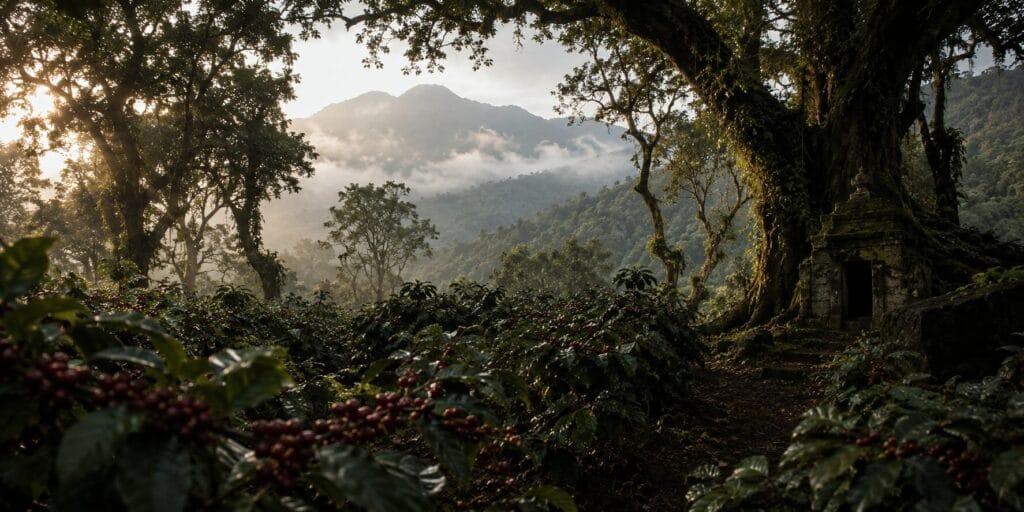
Chikmagalur district sits in the Western Ghats of Karnataka, bounded by the Shimoga district to the north and Chitradurga to the east. The district occupies the Malnad region, a term from the local Kannada that translates loosely as hill country or land of rain. It covers seven taluks: Chikmagalur, Kadur, Koppa, Mudigere, N.R. Pura, Sringeri, and Tarikere.
The elevation range across the district is the widest of any Indian coffee-growing region. Coffee is cultivated from approximately 900 metres at the lower estate blocks to 1,800 metres on the highest Bababudangiri peaks. Mudigere Taluk, on the western slopes of the Ghats, receives the heaviest rainfall in the district, over 3,000 millimetres annually in the most exposed areas, and produces some of the most intensely shade-grown coffee in Karnataka. The eastern taluks sit in a partial rain shadow and receive less rainfall, producing a drier growing season that influences the structure of the cherry and the cup.
The River Bhadra originates in the hills of Chikmagalur and flows through the district, creating the riverine microclimate that characterises the most prized sub-regions. Estates along the Bhadra’s upper tributaries combine the river’s moisture influence with altitude, producing a combination of growing conditions that roasters increasingly seek out at the sub-regional label level.
Annual rainfall across the district ranges from 1,500 to over 3,000 millimetres depending on elevation and aspect. Average temperatures range from 15 to 28 degrees Celsius across the year, with the coolest conditions at the highest Bababudangiri elevations where night temperatures can drop significantly during the harvest months.
Where Coffee Began in India
The story of coffee in India begins in Chikmagalur in 1670 AD. Baba Budan, a Sufi saint returning from pilgrimage to Mecca through the port of Mocha in Yemen, carried seven coffee seeds back to India and planted them on the hills near his home in Chikmagalur. The hills now bear his name: Bababudangiri, the Hills of Baba Budan, sitting at elevations up to 1,829 metres above sea level.
The story of those seven seeds is more than legend. It is the documented beginning of an industry that today produces over 400,000 metric tonnes annually and employs over 250,000 growers. The botanical garden at the Bababudangiri shrine where those first plants were established is considered sacred by both Hindu and Muslim communities in the region, a rare syncretic reverence that reflects the depth of coffee’s cultural integration into the Chikmagalur landscape.
From those original plantings, the first commercial estates were established in the 18th and 19th centuries. The Maharaja of Mysore donated land for large-scale plantation development. The Dutch East India Company identified Chikmagalur coffee’s export potential early. And the British colonial administration, from the 1820s onwards, developed the plantation infrastructure of roads, processing facilities, and labour systems that shaped the physical landscape of Chikmagalur’s coffee country as it exists today.
The variety first planted in the Bababudangiri hills was a Typica-derived Arabica that came to be known as Mysore coffee and later as Kent, after A.F. Kent who selected a rust-resistant strain from Doddengooda Estate in Mysore in the early 20th century. S795, India’s most widely planted Arabica, was developed directly from the Kent selection and the hybrid S288 at the Balehonnur research station in Chikmagalur district. The genetic lineage of what roasters in Chikmagalur now call S795 traces directly to those first seeds planted by Baba Budan over 350 years ago.
The Central Coffee Research Institute
The Central Coffee Research Institute, established at Balehonnur in Chikmagalur district in 1925, is the foundation of India’s entire coffee science programme and the institution responsible for every named Indian coffee variety currently in commercial cultivation.
CCRI developed S795 at Balehonnur and released it in 1945 to 1946. Selection 9, Chandragiri, Cauvery, and every other SLN-designated variety in the Indian specialty catalogue was developed here. The institute’s breeding programme has been running for 100 years from the heart of Chikmagalur’s coffee country, making this the longest continuously active coffee research programme in Asia.
For roasters who evaluate variety as a quality signal, the significance of Chikmagalur as the origin of Indian coffee science is practical, not just historical. Every Indian Arabica variety a roaster encounters was bred and tested in this district. The varieties that perform best in Chikmagalur’s specific altitude, rainfall, and soil conditions were selected here precisely because they suited those conditions. The terroir and the variety are co-developed in a way that few other origins can claim.
Sub-Regions: Where the Quality Signal Gets Specific
Chikmagalur’s 300-lot specialty catalog is not evenly distributed across the district. Quality concentrates in specific sub-regions, and specialty roasters are increasingly using sub-regional labels as a quality signal. A bag labelled with a sub-region rather than just “Chikmagalur” typically indicates direct estate sourcing rather than district-level procurement.
Bababudangiri (1,000 to 1,500 metres) The highest and most historically significant sub-region. The Bababudangiri range sits at the western edge of the district, receiving direct monsoon rainfall and producing some of the densest shade-grown Arabica in Karnataka. Estates at these elevations produce cleaner, more structured washed lots than lower-altitude Chikmagalur material, with altitude-driven brightness and chocolate-forward cup character. This is where the specialty catalog is most concentrated and where estate-level traceability is most developed.
Mudigere Taluk The wettest taluk in the district, on the western slope of the Ghats facing the Arabian Sea. Estates here receive the heaviest monsoon rainfall and grow under particularly dense canopy. Mudigere lots tend toward heavier body and more pronounced earthiness than the cleaner Bababudangiri profile.
Joldal Palya and Kaimara Belt Two sub-regions appearing with increasing frequency on specialty roaster pages in the UK and Europe. Their presence as origin labels signals direct estate relationships and smaller production volumes. Both sit within the broader Bababudangiri elevation range.
Koppa and Sringeri Taluks The western river valley taluks, lower in elevation than Bababudangiri but producing interesting Arabica and Robusta under dense forest canopy. Less represented in the international specialty catalog but home to some of Chikmagalur’s most ecologically intact coffee landscapes.
Processing: The Most Diverse in India
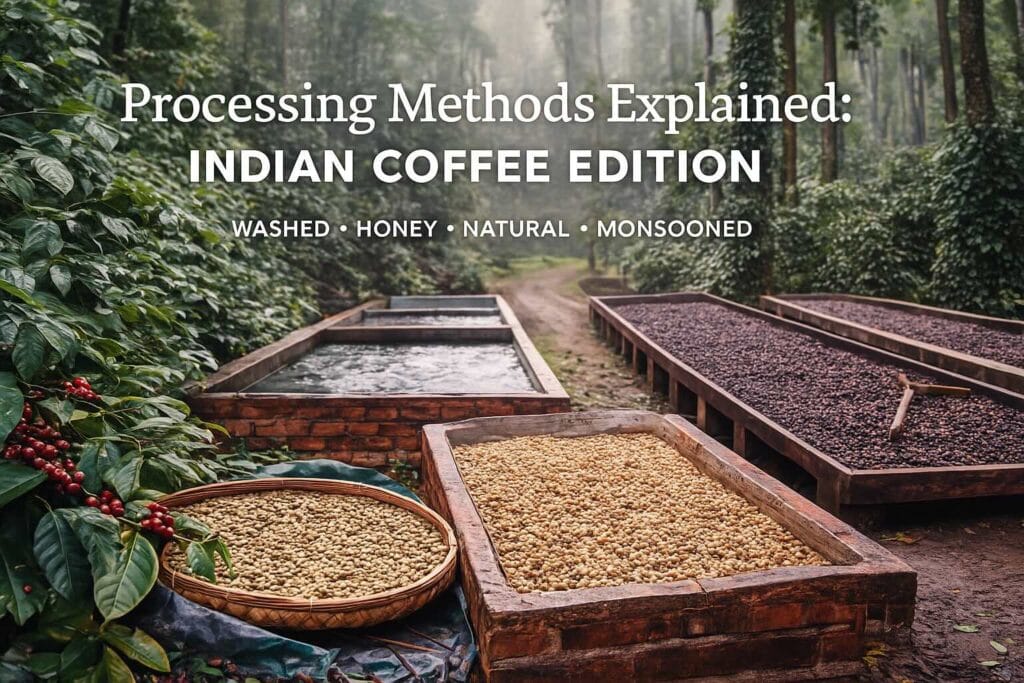
Chikmagalur’s specialty processing landscape is the most diverse of any Indian origin. The Indian Coffee Beans catalog documents washed, natural, honey, anaerobic, carbonic maceration, and monsooned lots from the district, with no single processing method dominating. The same 300-lot dataset shows an even distribution of roast levels from light through dark, confirming that specialty roasters interpret Chikmagalur material across the full roast spectrum rather than defaulting to a single approach.
This processing diversity is a function of three things: the density of estate-scale producers with their own processing infrastructure, the proximity to the CCRI which has historically been a source of post-harvest knowledge, and the competitive pressure of a district where 300 specialty lots means producers are actively experimenting to differentiate.
Washed remains the baseline and the most common processing method for specialty Arabica. Well-managed washed Chikmagalur lots from Bababudangiri elevations produce the district’s cleanest, most structured cups, with the dark chocolate and caramel character that leads the catalog by a wide margin.
Natural and honey lots are well-represented and show the same chocolate-forward base with additional sweetness and fruit complexity. The consistency of dark chocolate as the primary cup note across both washed and natural lots from Chikmagalur suggests a terroir-driven character that holds through different processing approaches.
Anaerobic and carbonic maceration lots are present and growing in number. These are the experimental tier and require the most careful evaluation, as quality varies more than in conventional processing. The best anaerobic lots from Bababudangiri estates show complex fruit and wine-adjacent notes built on the same chocolate base.
Monsooned Malabar has its origins in Chikmagalur and Hassan district coffee. The deliberate exposure of washed Arabica to monsoon humidity during storage in Mangalore produces the distinctive low-acid, heavy-bodied profile associated with this style. Monsooned Malabar is a process-defined product, not a terroir one, but its raw material is Chikmagalur Arabica.
Varieties
S795 is the dominant Arabica variety across Chikmagalur. Developed at Balehonnur from a cross involving S288 (an interspecific hybrid of Coffea arabica and Coffea liberica) and Kent, S795 is planted on approximately 25 to 30% of Indian Arabica acreage and represents the default Chikmagalur cup profile: dark chocolate, nuts, dried fruit, and a balanced, structured finish. It is the most documented Indian Arabica variety in the global specialty trade and the safest baseline for roasters evaluating the origin for the first time.
Selection 9 (SLN-9) brings Ethiopian genetic heritage into Chikmagalur lots through its Tafarikela parent. At Bababudangiri elevations above 1,200 metres, Selection 9 shows more brightness and aromatic complexity than S795, with brown sugar sweetness and a lighter, more agile cup structure. Lots specifically labelled Selection 9 from Chikmagalur are worth evaluating at light roast before committing to a profile.
Chandragiri (SLN-13) is the high-altitude Arabica, bred at CCRI with Villa Sarchi and Hybrido de Timor parents for maximum rust resistance and large AA-grade bean production. At Bababudangiri’s highest blocks, Chandragiri produces a clean, structured cup with mild brightness and nutty character.
Cauvery (SLN-12) is the commercial volume Arabica, widely planted in Chikmagalur’s lower-elevation blocks for yield efficiency. Its cup is full-bodied and chocolate-forward, suitable for espresso and milk-based drinks.
Robusta in Chikmagalur is predominantly CxR and Peridinia (Old Robusta), grown at lower elevations within the district alongside the estate Arabica. Chikmagalur Robusta from higher elevation blocks within the district has the same structural advantages as Coorg CxR: altitude, shade canopy, and careful processing producing a denser, cleaner bean than commodity-grade material.
The Ecological Context
Chikmagalur’s coffee landscape is one of the most extensively studied agroforestry systems in the world. Research published in peer-reviewed literature has documented that well-managed Chikmagalur coffee estates maintain tree diversity comparable to adjacent native forest. The two-tier shade canopy of silver oak, rosewood, jackfruit, and native forest trees that covers most estates in the district produces the forest-floor conditions that shade-grown coffee requires, while also supporting the wildlife that moves through the landscape.
Indian Gaur, leopards, and elephants move through the larger estates and forest corridors in the Bababudangiri range. Over 300 bird species have been recorded across Chikmagalur’s coffee districts. The district sits within the broader Western Ghats UNESCO World Heritage landscape and represents the northern extent of the most biodiverse section of the range.
Indravathi Estate in Chikmagalur grows coffee alongside over 50 species of jungle trees and documents ongoing wildlife and forest research projects, confirming that conservation engagement in Chikmagalur’s specialty tier is active rather than theoretical.
The Cup
Dark chocolate and caramel lead Chikmagalur’s cup character across all processing methods and roast levels. This is the most consistent flavor finding in the Indian Coffee Beans catalog of 300 Chikmagalur lots, and it holds whether the coffee is washed, natural, honey, or anaerobic.
At the specialty tier, the chocolate character is clean, precise, and layered. Well-processed washed S795 from Bababudangiri at 1,200 metres shows dark chocolate at the base, caramel sweetness in the mid-palate, and a clean, balanced finish with mild acidity. Natural lots from the same elevation add dried fruit and sweetness without losing the chocolate foundation.
Altitude sharpens the cup. Bababudangiri lots at 1,200 to 1,500 metres read noticeably different from lower-elevation district-grade lots at 900 metres: more structured, cleaner finish, better-defined acidity. Roasters evaluating Chikmagalur green coffee should confirm the elevation of the specific lot before drawing conclusions about the origin.
For roasters new to Chikmagalur, the entry point is a washed S795 from an estate with documented altitude above 1,000 metres and a harvest date within the current season. From that baseline, the processing diversity the district offers allows systematic exploration of what the terroir produces across different post-harvest approaches.
The Global Trade Position
Chikmagalur is better represented in the global specialty trade than any other Indian origin, but the representation is still thin relative to the quality and volume available. SICC sources from Chikmagalur estates for the UK and US market. Burman Coffee in the US lists the Arabidecool Estate near Bababudangiri. A small number of European specialty roasters have published sourcing documentation for specific Chikmagalur estates. ICT Coffee, a San Diego-based importer, lists Chikmagalur as part of their India offering.
The gap is at the sub-regional and estate level. District-grade “Chikmagalur Arabica” is available through commodity channels and some specialty importers without traceable lot documentation. The estate-level, sub-region-labelled, variety-designated lots that represent the top tier of the district’s output remain significantly underrepresented in North American specialty sourcing catalogues.
For roasters building an India programme, Chikmagalur as a named origin is the most recognisable and credible starting point in the country’s specialty narrative. The history is documented. The research institute is there. The cup is consistent. The processing is diverse. The sub-regional labels are beginning to carry meaning for buyers who know what to look for.
India Coffee Company sources green coffee from Chikmagalur through direct farm relationships built over years of engagement with the region’s farming community. To enquire about current availability, use the wholesale enquiry form.