Indian Robusta in Espresso Blends: What It Does and Why It Works
Most specialty roasters have a complicated relationship with Robusta. The species has been dismissed for decades in the third-wave conversation as a commodity filler – the cheap component in supermarket blends and instant coffee. The assumption that Robusta means low quality is so embedded in specialty culture that many roasters have never seriously evaluated it for their espresso programme.
That assumption is based on the wrong reference point. The Robusta that earned its reputation as harsh, rubbery, and bitter is commodity-grade material – low-altitude, sun-grown, strip-picked, and wet-hulled in mass-production systems. It is not the same product as shade-grown, hand-picked, washed or honey-processed Robusta from high-altitude farms in the Western Ghats.
Indian Robusta has been a known quantity in one part of the global espresso market for decades. Italian roasters have sourced it specifically and deliberately – not as a cost-cutting measure but because it performs better in espresso blends than commodity Robusta from any other origin. The Fresh Cup documented this directly: Indian Robusta has flowed to Italy for decades “because it brings a lot of body to the coffee without making it taste bitter. Some of the Robusta from other origins don’t have the same smoothness.”
This post is for roasters who have not yet evaluated Indian Robusta seriously, or who are evaluating it for the first time and want a framework for doing so.
Why Robusta in Espresso at All
The science of why Robusta contributes specifically to espresso – and not in the same way to filter or pour-over – comes down to two chemical facts.
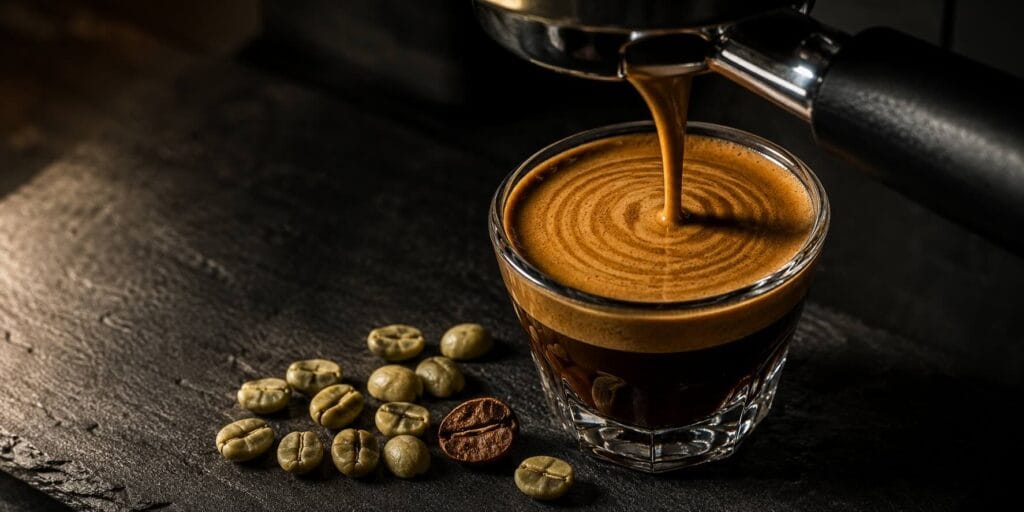
Crema production: Robusta beans contain lower lipid content than Arabica but produce significantly more CO2 during roasting. When extracted under pressure in an espresso machine, this CO2 drives the formation of crema – the foam layer on top of the shot. A blend with 10 to 20% Robusta produces noticeably thicker, more persistent crema than a 100% Arabica blend at the same extraction parameters. The crema is not just aesthetic. It carries aromatic compounds that affect how the espresso smells and how it tastes in the first few sips. Thicker crema also creates a physical barrier that slows oxidation of the shot.
Body and extraction stability: Robusta’s higher chlorogenic acid content and denser bean structure produce a heavier, more viscous extraction than Arabica under pressure. In milk-based drinks – cappuccinos, flat whites, lattes – this body cuts through the milk in a way that lighter-bodied Arabica does not. A blend with Robusta performs more consistently across a range of milk temperatures and ratios than a pure Arabica blend. This is why Italian espresso culture, which built itself around milk-based drinks, developed the Arabica-Robusta blend as the standard rather than an exception.
The practical result: roasters who use Robusta in espresso blends are not compromising on quality. They are optimising for the specific demands of pressure extraction and milk-based serving.
Why Indian Robusta Specifically
The global Robusta market is dominated by Vietnam, which produces approximately 40% of world Robusta volume. Vietnamese Robusta is grown primarily at 400 to 600 metres above sea level, largely in full sun, and processed using the wet-hull method that produces the characteristic rubbery, earthy profile associated with commodity Robusta. It is reliable, available in massive volume, and cheap. It is also the Robusta that gave the species its poor reputation in specialty circles.
Indian Robusta is structurally different from Vietnamese commodity Robusta in every growing and processing parameter that determines cup quality:
Altitude: Indian Robusta in the Western Ghats is grown at 800 to 1,200 metres, with some blocks reaching 1,300 metres. Vietnamese commodity Robusta averages 400 to 600 metres. The altitude difference of 400 to 800 metres produces a measurably different bean. At higher elevations, temperatures are lower, bean development is slower, sugar concentrations are higher, and the chlorogenic acids that produce Robusta’s characteristic bitterness at low altitudes are moderated. The result is a Robusta that is inherently less aggressive before any processing decision is made.
Shade canopy: Indian Robusta in the Western Ghats grows under a multi-layered shade canopy of jackfruit, rosewood, silver oak, pepper vines, and native forest trees. Direct sunlight exposure is minimal. Vietnamese commercial Robusta is grown predominantly in full sun. The shade canopy moderates temperature extremes, maintains soil moisture, and slows cherry development in the same way altitude does – producing a denser, more complex bean than sun-grown material at equivalent elevations.
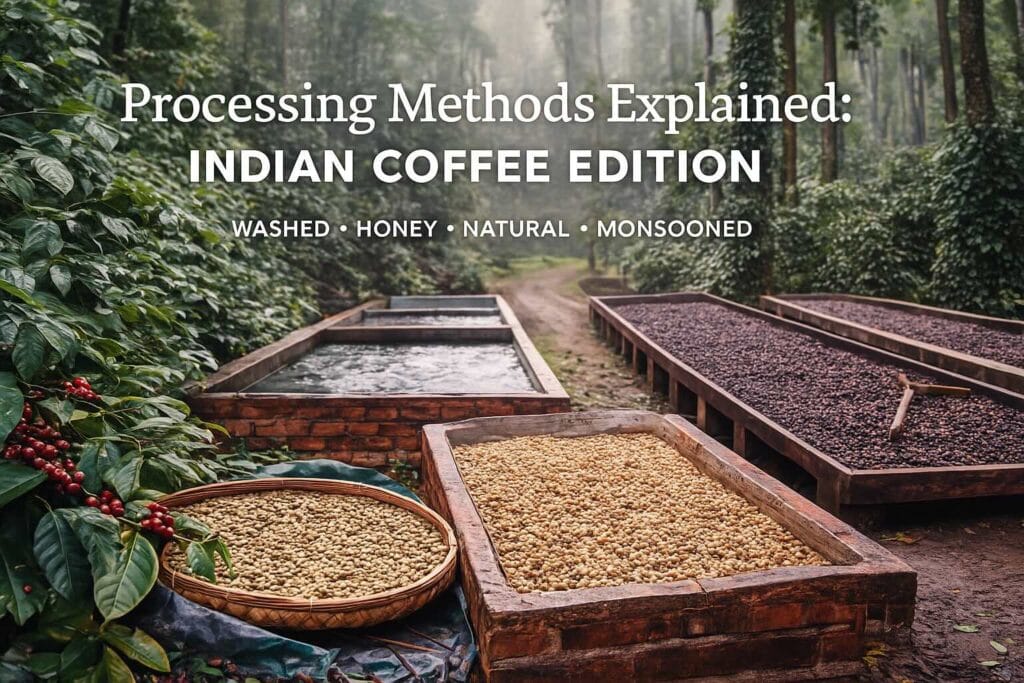
Processing: Indian specialty Robusta is processed as washed parchment or honey, using the same care applied to Arabica on the same estates. Selective hand-picking, tank fermentation for washed lots, controlled drying, and moisture management are standard on Indian specialty Robusta estates. Vietnamese commodity Robusta is typically strip-picked – entire branches stripped rather than selective hand-picking – and processed at scale without individual lot management.
Variety: CxR, the dominant Indian Robusta, is an interspecific hybrid of Coffea canephora and Coffea congensis – not standard Coffea canephora. The congensis parentage contributes genetic material outside the standard Robusta pool and is part of why Indian CxR cups differently from commodity Robusta at equivalent altitudes. Peridinia, the old-growth Indian Robusta variety, is an even older and more distinctive genetic lineage with a documented cup profile – chocolate, malt, citrus – that is atypical of any commodity Robusta.
In 1996, Coffee Enterprises in Burlington, Vermont, evaluated Indian Kaapi Royale washed Robusta for espresso blending and found: “At 25 percent, one could hardly tell the inclusion of Robusta in the blend.” That assessment – from a professional cupping context nearly 30 years ago – reflects what Italian roasters had already established through practical experience: Indian Robusta at altitude, washed and processed with care, contributes body, crema, and intensity to an espresso blend without the bitterness and harshness that make commodity Robusta difficult to work with.
What Indian Robusta Actually Contributes to a Blend
Understanding the specific contributions of Indian Robusta to an espresso blend allows roasters to make informed decisions about ratio and positioning.
Body and mouthfeel: The primary functional contribution. Indian Robusta from high-altitude Western Ghats estates has a full, viscous body that adds weight and texture to the espresso extraction. In milk-based drinks, this creates the mouthfeel that allows the espresso character to persist through the milk rather than being diluted by it. Roasters using 100% light-roast Arabica in espresso often find the shot disappears in a flat white. A 15 to 25% inclusion of Indian Robusta restores the body without adding bitterness.
Crema persistence: The CO2-driven crema from Robusta is thicker and more persistent than Arabica crema. In a high-volume cafe environment where shots sit for a few seconds before serving, Robusta crema holds its structure longer than pure Arabica. This is directly visible in the shot glass and is one of the most immediate and consistent arguments for Robusta inclusion in high-volume espresso programmes.
Caffeine: Robusta contains approximately twice the caffeine of Arabica by dry weight. A blend with 20% Indian Robusta delivers meaningfully more caffeine per shot than a 100% Arabica blend. For customers who want their espresso to perform functionally as well as taste good, this is a real advantage.
Flavour contribution: At the specialty tier, Indian Robusta’s flavour contribution to a blend is chocolate, nuts, and a subtle earthiness that deepens rather than masks the Arabica’s character. The bitterness that dominates low-grade commodity Robusta blends is largely absent in well-processed Indian material at altitude. At 15 to 20% inclusion in a blend, Indian washed CxR or Peridinia honey reads as body and depth rather than as a distinct Robusta flavour.
Stability across seasons: Indian Robusta production is highly consistent season to season in both volume and cup profile. The Western Ghats growing conditions – monsoon-driven rainfall, consistent altitude, shade canopy – produce a stable agricultural product that varies less between harvests than high-altitude Arabica from the same region. For roasters building a blend that needs to taste consistent across the year and across multiple harvests, Indian Robusta as a blend component provides the most stable anchor in the cup.
Blend Ratios and When to Use Them
There is no universal correct ratio for Arabica-Robusta espresso blends. The right ratio depends on the intended cup outcome, the brewing parameters, and the milk-to-espresso ratio in the target drink. However, documented practice across commercial and specialty contexts provides useful benchmarks:
10 to 15% Robusta: The minimum inclusion level at which crema enhancement is clearly visible and body contribution is perceptible. At this ratio, the Robusta is functional rather than flavour-forward. Suitable for roasters who want the technical benefits of Robusta inclusion while keeping the espresso character predominantly Arabica.
15 to 25% Robusta: The Italian espresso tradition range. Body is clearly enhanced, crema is thick and persistent, and the Robusta contributes a background depth that supports the Arabica rather than competing with it. At 25% Indian Robusta, Coffee Enterprises confirmed “one could hardly tell the inclusion of Robusta in the blend.” This is the sweet spot for most Arabica-Robusta espresso blends targeting milk-based drinks.
25 to 40% Robusta: More pronounced Robusta character. Body is dominant, caffeine is significantly elevated, and the blend reads as intentionally bold. Appropriate for South Indian filter style, Vietnamese filter, strong espresso blends targeting East Asian markets, or roasters specifically positioning the Robusta character as a feature rather than a background element.
40 to 100% Robusta: Single-origin or high-Robusta blends where the species character is the point. This is a niche but growing category. India’s South Indian filter coffee tradition uses this range as its default – South Indian filter coffee is typically 80 to 100% Robusta, sometimes blended with chicory. For roasters building a South Indian filter programme or a high-caffeine single-species offering, 100% Indian Robusta has a legitimate and well-documented use case.
Roasting Indian Robusta for Espresso
Robusta and Arabica respond differently to heat during roasting. Understanding these differences allows roasters to profile Indian Robusta effectively rather than applying Arabica protocols to a denser, chemically different bean.
Bean density: Indian Robusta from high-altitude shade-grown estates is denser than commodity Robusta and denser than most Arabica at comparable screen sizes. Denser beans require more energy input to reach first crack and respond more slowly to heat changes during the roast. Profiles developed for lighter Arabica lots will under-develop Indian Robusta.
First crack timing: Robusta first crack occurs earlier than Arabica at the same charge weight and environmental conditions – approximately 7 minutes 30 seconds versus 8 minutes 45 seconds on a standard 10kg drum roaster at common batch sizes. The tighter post-crack development window for Robusta – 1 minute 45 seconds to 2 minutes versus 2 minutes 30 to 3 minutes for Arabica – means roasters need to be responsive rather than running a predetermined time-based profile.
Roast level for espresso blending: Indian Robusta performs best in espresso blends at medium to medium-dark roast. At light roast, the chlorogenic acids that contribute to Robusta’s natural bitterness are not fully developed into their roasted form and can produce harsh, green notes in the cup. At very dark roast, the varietal character of the Robusta is consumed by carbon and the contribution to the blend becomes generic. The 215 to 220 degrees Celsius bean temperature range at drop, with development time ratio of 20 to 22%, is a documented starting point for Indian Robusta for espresso blending – adjust based on your specific roaster and batch size.
Separate or combined roasting: Roasters blending Indian Robusta with Arabica have two options: roast them separately to their respective optimal roast levels and blend post-roast, or roast together and accept a compromise profile. Separate roasting and post-roast blending produces a better result because it allows each species to be developed correctly. The additional operational complexity is justified by the cup outcome.
Sourcing Considerations
When sourcing Indian Robusta for espresso blending, the following parameters are most relevant:
Altitude – confirm the elevation of the specific lot. 800 metres is the minimum for specialty-grade Indian Robusta. Above 1,000 metres the cup quality difference from commodity material is clearly detectable. Lots without altitude documentation should be treated as commodity grade regardless of other claims.
Processing method – washed parchment is the most controlled and consistent processing for espresso blending. Honey processed lots produce more sweetness and complexity at the cost of some lot-to-lot consistency. Natural lots are the most variable and require the most careful evaluation before committing to blend volumes.
Variety designation – CxR and Peridinia are the two Indian Robusta varieties worth specifying. S274 is a reliable commercial option. Lots without variety designation are likely mixed-variety commercial grades – acceptable for blending but not differentiated at the specialty level.
Moisture content and water activity – Indian Robusta for espresso blending should arrive at 10.5 to 12% moisture with water activity below 0.65. Higher moisture increases fermentation risk in storage. Lower moisture produces woody, flat extraction in the cup.
Screen size – larger screen sizes extract more evenly in espresso than mixed-size lots. Screen 17 and above is the target for espresso-grade Indian Robusta. Mixed screen lots grind inconsistently, producing uneven extraction across the puck.
The Italian Precedent and What It Means for Specialty Roasters
Italian espresso culture built its global reputation on blends that included Indian Robusta as a deliberate and valued component. The Italian tradition is not 100% Arabica – it never was. The body, crema, and caffeine performance of Italian espresso depends on Robusta inclusion, and Italian roasters have sourced Indian Robusta specifically for decades because it performs better in that role than commodity alternatives.
The specialty coffee movement’s rejection of Robusta was a reaction to commodity-grade material in supermarket blends, not a rejection of the species on its merits. As specialty roasters build espresso programmes that need to perform consistently across high-volume service, the practical case for Indian Robusta as a blend component is the same case Italian roasters understood 50 years ago.
The difference now is that Indian Robusta is available at a level of traceability and processing quality that was not accessible to most international roasters historically. Variety-designated, altitude-documented, washed or honey-processed lots from named estates in Coorg and Wayanad are a different product from the unlabelled Karnataka Robusta that moved through commodity channels.
For specialty roasters building an espresso programme that performs consistently, differentiates from 100% Arabica competitors, and carries a provenance story that is specific and verifiable – Indian Robusta from the Western Ghats is the most underutilised ingredient in the category.
India Coffee Company sources washed and honey-processed Robusta from Coorg and Wayanad. Current lots include CxR Washed from Sandalkad Estate and Red Honey Peridinia from Riverside Coffee. To enquire about espresso blending samples and availability, use the wholesale enquiry form.