Palani Hills Arabica Green Coffee: Tamil Nadu’s Wildlife Corridor Origin
Most roasters who know Indian coffee know Karnataka. Coorg, Chikmagalur, BR Hills – the Karnataka origins have built the foundational vocabulary for Indian specialty coffee in the global trade. Tamil Nadu is less frequently cited, and within Tamil Nadu, the Palani Hills is one of the least documented coffee origins in the country.
That is beginning to change. A small number of specialty producers have started sourcing from the Palani Hills in the past two years, and what they have found is a combination of altitude, ecology, farming practice, and cup character that is genuinely distinct from anything Karnataka offers. Hard Lines Coffee in Cardiff has already featured Palani Hills as part of their India programme, describing it as a fast-growing origin. Wood Street Coffee, also in the UK, sourced a Palani Hills lot through Indochina importer – washed Arabica at 1,100 to 1,300 metres with notes of dark chocolate, prune, and hazelnut – calling it their inaugural Indian coffee.
For roasters looking for an Indian Arabica origin that is still in the early stages of global awareness, the Palani Hills is worth understanding now rather than after the market catches up.
The Geography
The Palani Hills are a mountain range in southwestern Tamil Nadu, an eastward extension of the Western Ghats that adjoins the Anaimalai Hills of Kerala to the west. The range covers approximately 2,068 square kilometres in Dindigul District and extends about 70 kilometres in length and 20 to 30 kilometres in width.
Elevation across the range varies significantly between its two distinct zones. The upper Palanis in the west consist of rolling grassland hills reaching 1,800 to 2,533 metres above sea level, with Vandaravu Peak, the highest point, at 2,533 metres. These upper elevations are dominated by Shola forests – the dense, stunted montane forest systems characteristic of the Western Ghats above 1,500 metres – and open grasslands that are home to the endemic Nilgiri Tahr. The town of Kodaikanal sits in a high basin at approximately 2,150 metres, one of the most elevated hill stations in South India.
The lower Palanis in the east form a more complex, jumbled terrain of peaks ranging from 900 to 1,500 metres, separated by steep wooded valleys. This is where coffee is grown. The Thandikudi area, near the Coffee Research Station established by the Coffee Board of India, is the epicentre of Palani Hills coffee cultivation. Estates in this zone start from around 850 metres at the Pullaveli river and extend up to 1,280 metres at the highest blocks.
The geologically ancient landscape – the Palani Hills are composed of hard crystalline rocks including gneisses and charnockites estimated at 3,000 to 500 million years old – produces soils with a mineral composition that is distinct from the laterite-heavy profiles of Karnataka’s coffee districts. The rivers that originate in the Palani Hills, including the Bhavani, are significant water sources for Tamil Nadu’s agricultural regions. The forest cover in the valleys supports a year-round water table that benefits coffee cultivation at the lower elevations.
Rainfall in the Palani Hills comes from both the southwest and northeast monsoons, giving the region a more balanced annual distribution than origins that depend on a single monsoon. The harvest period runs from November to February.
Wildlife and the No-Fence Farming Model
The Palani Hills are ecologically significant within the Western Ghats biodiversity hotspot. The Palani Hills Wildlife Sanctuary covers 736 square kilometres and is a proposed expansion to a national park. The sanctuary and its buffer zones are home to Bengal tigers, Indian leopards, Indian elephants, gaur, sambar deer, barking deer, lion-tailed macaques, bonnet macaques, Nilgiri tahr, and the grizzled giant squirrel. Tiger sightings were documented in Kodaikanal forests during a 2010 carnivore survey. The 2025 census recorded 1,303 Nilgiri Tahr individuals in Tamil Nadu, with populations present in the Palani Hills grasslands.
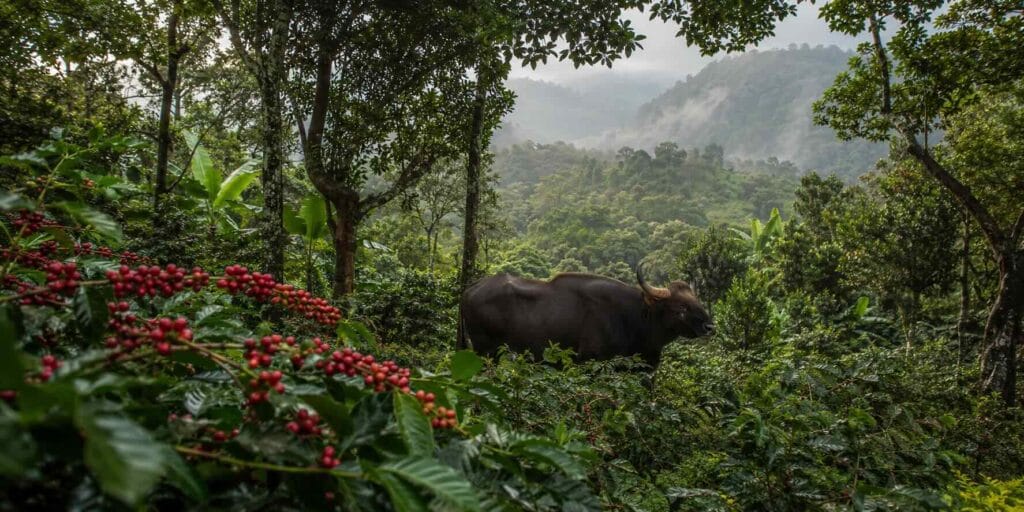
The coffee farms that Black Baza Coffee sources from in the Palani Hills operate within this wildlife landscape without fencing. This is not a policy position or a marketing claim. It is the farming reality of smallholder producers who cultivate coffee on plots that are part of active wildlife corridors. The Indian Gaur – the world’s largest bovine species – and the Nilgiri Tahr move through these farms. Conflict is managed through traditional coexistence practices rather than physical barriers.
The no-fence model has direct implications for biodiversity. Fencing fragments wildlife corridors and concentrates human-animal conflict at fence lines. Unfenced farms that are integrated into the broader forest and grassland landscape allow animals to move as they would naturally, reducing pressure on any single crossing point and maintaining the ecological connectivity that large mammals require to sustain viable populations.
For roasters who communicate provenance and conservation impact to their customers, Palani Hills coffee from unfenced farms in a wildlife sanctuary buffer zone is one of the most specific and verifiable conservation stories in Indian specialty coffee. It is not a general sustainability claim. It is a documented farming practice in a documented ecological context.
The Farming Community
Black Baza began its engagement with the Palani Hills in 2023, making it one of the more recently established sourcing relationships in their network. The landscape they describe is a mosaic of shola forests, grasslands, and human communities – forest-dwellers, honey-harvesters, and small farmers whose livelihoods are intertwined with the health of the surrounding forest.
The Kaati lot, which India Coffee Company sources through Black Baza, comes from the Kariyamal collective – a group of smallholder producers growing Arabica on plots of 2 to 8 acres under native forest canopy. Farm sizes in this range mean each producer manages a small, personally tended plot rather than a commercial estate. Selective harvesting by hand is the only practical approach at this scale. Cherry that is not ripe is not economical to pick, which means natural selection for quality at the point of harvest without requiring a formal protocol.
The intercropping on these farms includes jackfruit, orange, lime, banana, and pepper vines – a multi-layered canopy structure that provides shade, additional income streams, and habitat for the birds and insects that maintain the farm ecosystem. The Indian Gaur, which the Kaati lot is named after – the largest bovine in the world, called Kaati in the local Kannada language – moves through this landscape. The name is not decorative. It reflects the daily reality of farming in a place where large wild animals are neighbours.
Organic farming is the practice on these plots by a combination of necessity and tradition. Chemical inputs at small-farm scale in a forest context are economically impractical. The resulting green coffee carries no chemical residue risk and qualifies for organic certification if the producer chooses to pursue it.
The Varieties: Selection 9 and Sarchimor
Two Arabica varieties are grown in the Palani Hills farming community: Selection 9 and Sarchimor.
Selection 9 is one of India’s most successful Arabica varieties, developed at the Coffee Research Station in Balehonnur, Karnataka. It was bred from a cross involving Tafarikela, an Ethiopian heirloom variety, giving it some of the genetic heritage of African highland coffees alongside Indian climate adaptation. Selection 9 is known for its balanced cup – brown sugar sweetness, moderate acidity, good body – and its consistency across growing conditions. At the 1,100 to 1,300 metre elevation of the Palani Hills, with the region’s dual monsoon rainfall pattern, Selection 9 develops slowly enough to build complexity without the intensity that higher altitudes sometimes produce.
Sarchimor is a hybrid between Villa Sarchi, a natural Bourbon mutation from Costa Rica, and the Timor Hybrid, which carries Robusta genetics and confers disease resistance. Sarchimor has become widely planted across coffee-producing regions globally because of its resistance to coffee leaf rust and coffee berry disease – both significant challenges in humid, forested growing environments. The Timor Hybrid genetics that give Sarchimor its disease resistance also give it a cup character that differs from pure Arabica varieties: more body, a broader flavour foundation, and in the right conditions, a complexity that rewards careful processing. At Palani Hills altitudes with washed processing, Sarchimor produces a clean, structured cup that complements the lighter, brighter profile of Selection 9 in blended lot processing.
The combination of Selection 9 and Sarchimor in a single lot, washed and processed together, produces a cup that has the accessibility of Selection 9’s sweetness and the structure of Sarchimor’s body. Wood Street Coffee’s tasting note – dark chocolate, prune, hazelnut – reflects this combination processed at 1,100 to 1,300 metres. Hard Lines described their extended fermentation Palani Hills lot as rich in dark chocolate and hazelnut with the intense sweetness of jaggery. Both profiles are consistent with what well-processed Selection 9 and Sarchimor at this altitude produce when given careful fermentation management.
The Global Trade Picture
Palani Hills as a named specialty coffee origin in global trade is very new. Black Baza began working here in 2023. The Wood Street and Hard Lines sourcing relationships are among the first documented cases of international roasters specifically naming the Palani Hills as an origin on a product label.
No green coffee importer in North America currently lists Palani Hills as a named region. The origin does not appear in any of the major importer catalogues for the North American or Australian market. The European presence – Hard Lines in Cardiff, Wood Street in the UK – represents the most advanced development of the origin’s international market identity, and even there, it is a recent development.
For roasters in North America, Australia, Japan, or the Middle East, Palani Hills is an origin they can be genuinely first to market with. The cup credentials are documented. The ecological story is verifiable and specific. The farming community is real and traceable. The altitude is comparable to the most respected South Indian origins. The gap is simply access – which requires an importer who has the sourcing relationship.
What to Expect in the Cup
Palani Hills washed Arabica at 1,100 to 1,300 metres cups with:
Dark chocolate as the dominant base note – consistent across multiple roaster references for this origin. The chocolate character is clean and not bitter, suggesting well-managed fermentation and careful drying.
Dried fruit – prune, raisin, or dried berry depending on the specific lot and roast level. This is the contribution of the higher-altitude development and, in lots with extended fermentation, the post-harvest processing.
Nut notes – hazelnut and almond references appear frequently in documented tastings. These are characteristic of well-processed South Indian washed Arabica at mid to high altitude.
Sweetness – jaggery and brown sugar are the most commonly cited sweetness references. These reflect the slow cherry development at altitude combined with washed processing that preserves the natural sugar profile without the fermentation-driven sweetness of natural or honey lots.
Acidity – moderate. Not the high brightness of Nilgiris lots at 1,800 metres, but noticeably more lively than lower-altitude South Indian Arabica. The dual monsoon climate and altitude combination produces enough acidity to give the cup structure without making it difficult for roasters who serve acidity-sensitive markets.
Roasters evaluating Palani Hills lots should cup at light to medium roast. The dried fruit and chocolate character that define this origin are most accessible at 85 to 88 degrees Celsius brewing temperature at those roast levels. Darker roasts absorb the origin character into generic caramel and roast notes.
For Roasters Evaluating Palani Hills Green Coffee
When sourcing Palani Hills lots, the most relevant information to request:
Variety documentation – confirm whether the lot is Selection 9, Sarchimor, or a blend of both. The cup character differs between the two and the blend ratio affects what you get.
Fermentation duration – extended fermentation Palani Hills lots read differently from standard washed. Hard Lines sourced an extended fermentation lot. Standard washed lots have a cleaner, more restrained profile. Know which you are evaluating.
Altitude of specific block – within the 850 to 1,280 metre range documented in the region, elevation affects acidity and flavour complexity. Confirm the elevation of the specific lot.
Processing facility – whether the lot was processed at farm level with small village pulping machines or at a centralised facility affects consistency. Centralised processing typically produces more consistent lot quality across multiple small producers.
Harvest date – Palani Hills harvest runs November to February. Lots from early in the season (November to December) and late in the season (January to February) can differ in ripeness profile and processing conditions.